
The great respect that I have for your leadership, Mr. President, in this little understood, unfamiliar war, the first war of the 21st century -- it is not well-known, it was not well-understood, it is complex for people to comprehend. Donald Rumsfeld's parting words
As the first sacrificial lamb headed for slaughter it opened its mouth and out came irony.
Yes, Donald, (I use the familiar as he is no longer an official) this war is both unfamiliar and little understood. Of course, obscurantist speech has that effect, does it not? As with many lessons in life, the virtues of plain speech are only recognized when the opposite choice has born fruit.
It's the deception, stupid.
The War in Iraq and the broader War on Terror, that is, the War on those who don't take US imperialism lying down is not well understood. The causes of the War, to name a few, can be found in the US' choice, in the early 80s to not continue to reduce dependence on foreign oil imports, in the rapid success of Gulf War I, which inflated views of the efficacy of force, and in the fall of the Soviet Union, which led many, like Francis Fukuyama, to see Neo-liberalism as the final stage of political-economic development.
The glamour of utopia is always and everywhere seductive.
I also agree with Mr. Rumsfeld's earlier assertions that the War in Iraq is not at all like that in Vietnam. Fighting to maintain and/or gain colonies was still in (albeit waning) vogue in the 60s. Western dominance was a given. Notions of national sovereignty have strengthened in the intervening decades. The world, as Thomas Friedman put it, has flattened.
Vietnam was also not a significant trader on the world stage, as it did not possess or produce hard to find commodities.
Iraq, by contrast, sits on a sea of black gold, which can, as President Bush recently warned, be held from the market to mold opinion in importing countries, or be sold at substantial profit to build up military might. From this perspective, walking away from Vietnam was easy (although in the event it looked anything but) while walking away from Iraq will have major consequences- not insurmountable consequence, but painful nonetheless.
Before I create too much confusion, I'm not arguing that the decision to go to War was wise, or that the US should continue this adventure in colonialism. My argument is that the focus on finding a bureaucratic reason, to quote Wolfowitz, to sell the war to the people was detrimental to a real inquiry into the pros and cons of such a risky endeavor. The very fat (and getting fatter by the minute) tail in the study of possible future scenarios of what if we lose was, as virtually every book on the topic argues, never discussed.
Cheney's one percent doctrine comes to mind, if there was but a one percent chance the US might lose the War in Iraq, given the cataclysmic effects of such an event, it should not have been pursued.
But it was pursued. And an ugly, non-spinnable reality unfolded, and unfolds still.
The US is caught in Iraq. To stay is to pour more lives and treasure into an unwinnable, or so I believe, exercise of a colonial world view which had already been disproven. It wasn't the end of history, but the lack of study thereof.
To leave Iraq lock, stock and permanent military base, is to admit that the American Empire is dead, and to begin to rationalize the US economy on apples to apples terms. For when the American Empire dies, the US$ will need to find its own level and the terms of trade will change, most likely not in our favor.
I, for one, will be happy to see the Empire go, for then I might find the country I read about, remember and still see about me in small pockets again. To use a sports analogy, it was the awareness of a probable loss that made the 1980 US Olympic Hockey Gold Medal so sweet. Being the underdog suits us, or so I believe.
I still have faith in the tenets of this nation and the people who believe in them.
But it will be a tough sell. Just as the end of wars leads to distress among the makers of munitions, the end of empire will lead to distress among its proponents, and they are many, on both sides of the political aisle.
I've been party to a few growing companies and that was always a fun experience-hiring new people, finding new office space and handing out bigger checks. What's not to like?
I was also working at Chase during the late 80s down sizing and that was not fun. Management at the time was a revolving door because few can survive for long as the bearer of bad tidings.
If Jimmy Carter found it a tough sell to get the US to conserve oil back when we only imported a third of what we used, back when the trade and fiscal deficits were orders or magnitude less, who will be able to sell conservation and sacrifice now? The meme of dominance will be hard to shake. So the final cuts will likely be ostensibly inflected from outside, perhaps China's recent comment about diversifying away from US$ reserves is the first of these.
Yes, Donald, the War in Iraq was little understood, by yourself. It did not need to be our Waterloo, Stalingrad or Suez, but barring some miracle looks likely to be so.
And we, or at least some of us, might find that it's OK. People are still happy in France, Germany and the UK.
Life goes on.
Thursday, November 09, 2006


Wednesday, November 08, 2006
Swapping caviar for butter..but keeping the war
Way back in the dark ages, when your author was a mere child and the Vietnam War was a Democratic initiative, President Johnson's team dusted off a well worn phrase, "guns and butter" to describe his economic policy of coincidentally funding both the wars on Communism and Poverty. In 1968, Richard Nixon won the Presidency from Democrats by promising a victorious end to the Vietnam War with honor. However, neither a victorious end nor honor (nor Nixon for that matter) were seen when the US finally left Vietnam in 1975.
Even sweeping electoral changes which would seem to argue for a change in foreign policy often take years to manifest. While dissatisfaction with the War in Iraq likely (according to exit polls) fueled the termination of Republican control of the House of Representatives, the Democrats are only talking of "phased redeployment" not complete withdrawal with the redeployment conditioned on the Iraqis' ability to stabilize the country. I assume "stability" will be assumed to occur with the permanent US bases in Iraq intact.
In other words, the War in Iraq is a long way from over. As in 1968, the new boss will prove to be quite similar to the old boss in certain respects.
However, in other respects, the focus will shift. George Bush's economic choices of guns and caviar, or so I consider the choice to fund both the war and tax breaks for the rich will shift back to guns and butter, at least until the hard choices of funding entitlement programs is faced. I won't hold my breath for that one.
The Democrats New Direction for America consists of six items, or as they call it, six for '06.
As you can see there are no calls for a rollback of empire, but rather a call to find a way to win. Without the financial benefits of empire, or so policy makers see them, funding the other needs will be that much more difficult. The empire experiment will continue for at least a few more years.
The Democratic plan, it seems to me, is merely to better appease the "unwashed masses", swapping caviar for butter. I expect this shift in focus will finally unleash the inflationary forces partially held in check by the rich man's penchant for investing in paper markets. As labor's share of national income rises under the Democrats wage push inflation will come back into play. Wall Street's share of the flow of funds will decrease.
Given the raised hopes of the populace following a successful, in the sense that the vote totals matched the polls, election, faith in the painless solution will initially grow. Democratic plans to maintain the empire and, for instance, end our dependence on imported oil will require massive investment and writedowns of obsolete infrastructure. Ending the empire dreams, which I believe inevitable, will also require massive writedowns. Faith in the free lunch is alive and well.
While the election of '06 was a referendum on the Bush doctrine, now seen as a failure, it wasn't a call for a shift to a more humble foreign policy. The US has yet to experience its Eden moment (in reference to Britain's Prime Minister from 1955-1957). On his death, the Times of London wrote that Eden was the last prime minister to believe Britain was a great power and the first to confront a crisis [Suez] which proved she was not.
The real financial reckoning will not arrive until America refuses to see itself as the driving nation of the world but rather one of many. In the meantime, the slow death of the US$ will continue, albeit, I believe, at a quicker pace.
All of which is not to argue that, as an opponent to the notion that the US should be an empire, I didn't find the election results heartening. I was surprised to see the benefits of incumbency (non-euphemistically: the ability to cheat, which has always been a feature of American representative government) so easily vanquished.
I'm merely arguing that, to borrow a phrase from the film, The Matrix, residual self image as an Empire tends to linger long after it is gone in fact. I can imagine skating from end to end during one of my hockey games, scoring when needed, but I can't do it anymore.
Even sweeping electoral changes which would seem to argue for a change in foreign policy often take years to manifest. While dissatisfaction with the War in Iraq likely (according to exit polls) fueled the termination of Republican control of the House of Representatives, the Democrats are only talking of "phased redeployment" not complete withdrawal with the redeployment conditioned on the Iraqis' ability to stabilize the country. I assume "stability" will be assumed to occur with the permanent US bases in Iraq intact.
In other words, the War in Iraq is a long way from over. As in 1968, the new boss will prove to be quite similar to the old boss in certain respects.
However, in other respects, the focus will shift. George Bush's economic choices of guns and caviar, or so I consider the choice to fund both the war and tax breaks for the rich will shift back to guns and butter, at least until the hard choices of funding entitlement programs is faced. I won't hold my breath for that one.
The Democrats New Direction for America consists of six items, or as they call it, six for '06.
- Real Security - at home and overseas: reclaim American leadership with a tough, smart plan to transform failed Bush administration policies in Iraq, the Middle East and around the world.
- Prosperity - better American jobs and better pay: raise the minimum wage and end tax credits for corporate job outsourcing
- Opportunity - College access for all: make college tuition tax deduction permanent, cut student loan interest rates, expand Pell grants
- Energy Independence - lower gas prices: free America from dependence on foreign oil
- Affordable health care - life saving science:
- Retirement security and dignity: Keep social security public, enact real pension reform to protect pensions from corporate looting
As you can see there are no calls for a rollback of empire, but rather a call to find a way to win. Without the financial benefits of empire, or so policy makers see them, funding the other needs will be that much more difficult. The empire experiment will continue for at least a few more years.
The Democratic plan, it seems to me, is merely to better appease the "unwashed masses", swapping caviar for butter. I expect this shift in focus will finally unleash the inflationary forces partially held in check by the rich man's penchant for investing in paper markets. As labor's share of national income rises under the Democrats wage push inflation will come back into play. Wall Street's share of the flow of funds will decrease.
Given the raised hopes of the populace following a successful, in the sense that the vote totals matched the polls, election, faith in the painless solution will initially grow. Democratic plans to maintain the empire and, for instance, end our dependence on imported oil will require massive investment and writedowns of obsolete infrastructure. Ending the empire dreams, which I believe inevitable, will also require massive writedowns. Faith in the free lunch is alive and well.
While the election of '06 was a referendum on the Bush doctrine, now seen as a failure, it wasn't a call for a shift to a more humble foreign policy. The US has yet to experience its Eden moment (in reference to Britain's Prime Minister from 1955-1957). On his death, the Times of London wrote that Eden was the last prime minister to believe Britain was a great power and the first to confront a crisis [Suez] which proved she was not.
The real financial reckoning will not arrive until America refuses to see itself as the driving nation of the world but rather one of many. In the meantime, the slow death of the US$ will continue, albeit, I believe, at a quicker pace.
All of which is not to argue that, as an opponent to the notion that the US should be an empire, I didn't find the election results heartening. I was surprised to see the benefits of incumbency (non-euphemistically: the ability to cheat, which has always been a feature of American representative government) so easily vanquished.
I'm merely arguing that, to borrow a phrase from the film, The Matrix, residual self image as an Empire tends to linger long after it is gone in fact. I can imagine skating from end to end during one of my hockey games, scoring when needed, but I can't do it anymore.
Monday, November 06, 2006
The spoiled brat trade
Many people can recall at least one spoiled brat event in their childhood. Having been on both sides of the issue, I can recall being both a doer and receiver of spoiled brat-ness, if you will.
As the specter of losing, for instance, a game of Monopoly or perhaps Risk might be a more appropriate choice, becomes too imposing to ignore, the spoiled brat flips the board over, thus destroying the game for everyone. The lesson is driven home-the spoiled brat is only willing to play if he is going to win. Losing, as many in the current administration have averred, is not an option.
For many of us, being a spoiled brat was a phase. We eventually learned (in my case, the hard way, by having my cousins throw me into a creek behind their house) that being a spoiled brat meant that nobody would play with us.
Fortunately, in my case, I was not born with a silver spoon in my mouth, and never had the goods such that people would overlook my bratty behavior. Others are not so lucky.
The administration of George Bush the younger seems filled with spoiled brats. This shouldn't be surprising as political dominance tends to bring out the spoiled brat in all of us. Thus Lord Acton's dictum about power corrupting.
So I wonder what the current bunch of brats might do in the event the Democrats win control of one or more Houses of Congress. A die hard brat might choose the real world version of flipping over the Risk board, by launching an all out nuclear war. I hope that won't happen. But there are other options.
Might the Republicans, in an attempt to show those uppity voters their error, demonstrate how the financial world might look without their support? What a wonderful lesson to teach the naive voters- here's what a vote for a Democrat really means: a cheaper US$, a swooning stock market and rocketing oil prices.
A big win for the Democrats might provide excellent cover for a much needed, in my view, repricing of American assets, which is to argue that I don't agree with the catalyst, but I do agree with the result. To the extent the current matrix of prices (a.k.a. the termf of trade) is more a function of intervention than equilibrium seeking, one would need such cover to effect any change. This too would not be new. A change in commercial corporate governance is often used by major shareholders as cover for a "cleansing" of known bad positions that can be blamed on the old regime.
Such cover might also be looked on as something of a gift from our external financiers. While China, for instance, rightly fears the wrath of its population in the event they need to take a hit on their reserves, if they can blame the problems on the silly American notion of changing governmental control, they might just go along.
We will see what happens tomorrow at the polls. More importantly, for my financially minded readers, we will see how the markets react to the news. I can almost see the Risk pieces flying through the air.
As the specter of losing, for instance, a game of Monopoly or perhaps Risk might be a more appropriate choice, becomes too imposing to ignore, the spoiled brat flips the board over, thus destroying the game for everyone. The lesson is driven home-the spoiled brat is only willing to play if he is going to win. Losing, as many in the current administration have averred, is not an option.
For many of us, being a spoiled brat was a phase. We eventually learned (in my case, the hard way, by having my cousins throw me into a creek behind their house) that being a spoiled brat meant that nobody would play with us.
Fortunately, in my case, I was not born with a silver spoon in my mouth, and never had the goods such that people would overlook my bratty behavior. Others are not so lucky.
The administration of George Bush the younger seems filled with spoiled brats. This shouldn't be surprising as political dominance tends to bring out the spoiled brat in all of us. Thus Lord Acton's dictum about power corrupting.
So I wonder what the current bunch of brats might do in the event the Democrats win control of one or more Houses of Congress. A die hard brat might choose the real world version of flipping over the Risk board, by launching an all out nuclear war. I hope that won't happen. But there are other options.
Might the Republicans, in an attempt to show those uppity voters their error, demonstrate how the financial world might look without their support? What a wonderful lesson to teach the naive voters- here's what a vote for a Democrat really means: a cheaper US$, a swooning stock market and rocketing oil prices.
A big win for the Democrats might provide excellent cover for a much needed, in my view, repricing of American assets, which is to argue that I don't agree with the catalyst, but I do agree with the result. To the extent the current matrix of prices (a.k.a. the termf of trade) is more a function of intervention than equilibrium seeking, one would need such cover to effect any change. This too would not be new. A change in commercial corporate governance is often used by major shareholders as cover for a "cleansing" of known bad positions that can be blamed on the old regime.
Such cover might also be looked on as something of a gift from our external financiers. While China, for instance, rightly fears the wrath of its population in the event they need to take a hit on their reserves, if they can blame the problems on the silly American notion of changing governmental control, they might just go along.
We will see what happens tomorrow at the polls. More importantly, for my financially minded readers, we will see how the markets react to the news. I can almost see the Risk pieces flying through the air.
Friday, November 03, 2006
Right view, wrong vehicle for the $ bears
As my friend Stephen Plant and I learned while working for a NY hedge fund, there are two aspects to a good trade, divining the macro trend correctly AND implementing that view using the right vehicle. There are few things more vexing, as Warren Buffett and Robert Rubin have recently discovered, than divining the macro trend correctly, but implementing the trade using the wrong vehicle.
For instance, if you want to go long petroleum, buy the strongest component. Going into winter, other things equal, heating oil tends to be a better bet than crude or unleaded gas, while going into spring, again other things equal, unleaded gas will likely outperform crude or heating out.
In the arena of currency trading, the prevailing wisdom seems to be that only currencies issued by Central Banks count as currency. Specie, or what used to be known as hard money, apparently does not make the grade.
Thus Rubin, Buffett and many others have implemented their US$ bearish trades by selling the US$ index, or by selling $s against other currencies, like the Euro or Yen. Thus we have what Brad Setser calls the Club of Puzzled Dollar Bears.
One reason behind this restricted choice is the lack of liquidity in the Gold or Silver market compared to the currency markets. Speculators can sell a few billion $s without moving the relevant exchange rate much, while a purchase of $1Bil of Gold (50 short tons) would certainly move the $ Gold exchange rate. Ironically, the significant difference in liquidity between the paper money and specie markets seems to me a very good reason to buy specie.
Who knew the authors of the Gospels had insight into currency trading: Enter through the narrow gate. For wide is the gate and broad is the road that leads to destruction, and many enter through it.
Another factor arguing against the paper currency denomination of the short $ trade is the unwillingness to let the US adopt a "begger thy neighbor" policy a la the Plaza Accord when the rest of the world allowed the US$ to fall. The Chinese, to single out one nation, seem unwilling to take the same hit the Japanese took during the late 80s.
As a practical matter, this theoretical view has supporting empirical evidence. While the US$ has retained surprising strength vs. other currencies since Rubin and Buffett went short, it has fallen significantly vs. specie. According to Warren Buffett's wonderful annual letter to shareholders, Berkshire Hathaway began shorting the US$ in 2002.
Gold was trading at less than $350/oz during the whole of 2002, while Silver was changing hands at less than $5/oz. Meanwhile the USDX was falling from 120 to 103, the Yen (IMM) was rising from .75 to .875 and the Euro was rising from .86 to 1.04. Even if one assumes that Mr. Buffett picked the best entry points over the course of 2002 in the FX markets (120 in the USDX, .75 in the Yen and .86 in the Euro) the returns for the specie denominated short $ trade at current prices (Gold up 79%, Silver up 151%) far exceed even the best executed paper money denominated $ short trade (USDX down 28%, Yen up 13% and Euro up 48%). If the same trades were put on in 2004, the differences in returns are even larger (Gold up 49%, Silver up 78%) relative to the paper money markets (USDX down 4%, Yen down 7.6%, and Euro up 5% assuming an early year entry).
All of which is to argue, if you want to short the US$, buy specie or you risk joining the club of puzzled $ bears.
For instance, if you want to go long petroleum, buy the strongest component. Going into winter, other things equal, heating oil tends to be a better bet than crude or unleaded gas, while going into spring, again other things equal, unleaded gas will likely outperform crude or heating out.
In the arena of currency trading, the prevailing wisdom seems to be that only currencies issued by Central Banks count as currency. Specie, or what used to be known as hard money, apparently does not make the grade.
Thus Rubin, Buffett and many others have implemented their US$ bearish trades by selling the US$ index, or by selling $s against other currencies, like the Euro or Yen. Thus we have what Brad Setser calls the Club of Puzzled Dollar Bears.
One reason behind this restricted choice is the lack of liquidity in the Gold or Silver market compared to the currency markets. Speculators can sell a few billion $s without moving the relevant exchange rate much, while a purchase of $1Bil of Gold (50 short tons) would certainly move the $ Gold exchange rate. Ironically, the significant difference in liquidity between the paper money and specie markets seems to me a very good reason to buy specie.
Who knew the authors of the Gospels had insight into currency trading: Enter through the narrow gate. For wide is the gate and broad is the road that leads to destruction, and many enter through it.
Another factor arguing against the paper currency denomination of the short $ trade is the unwillingness to let the US adopt a "begger thy neighbor" policy a la the Plaza Accord when the rest of the world allowed the US$ to fall. The Chinese, to single out one nation, seem unwilling to take the same hit the Japanese took during the late 80s.
As a practical matter, this theoretical view has supporting empirical evidence. While the US$ has retained surprising strength vs. other currencies since Rubin and Buffett went short, it has fallen significantly vs. specie. According to Warren Buffett's wonderful annual letter to shareholders, Berkshire Hathaway began shorting the US$ in 2002.
Gold was trading at less than $350/oz during the whole of 2002, while Silver was changing hands at less than $5/oz. Meanwhile the USDX was falling from 120 to 103, the Yen (IMM) was rising from .75 to .875 and the Euro was rising from .86 to 1.04. Even if one assumes that Mr. Buffett picked the best entry points over the course of 2002 in the FX markets (120 in the USDX, .75 in the Yen and .86 in the Euro) the returns for the specie denominated short $ trade at current prices (Gold up 79%, Silver up 151%) far exceed even the best executed paper money denominated $ short trade (USDX down 28%, Yen up 13% and Euro up 48%). If the same trades were put on in 2004, the differences in returns are even larger (Gold up 49%, Silver up 78%) relative to the paper money markets (USDX down 4%, Yen down 7.6%, and Euro up 5% assuming an early year entry).
All of which is to argue, if you want to short the US$, buy specie or you risk joining the club of puzzled $ bears.
Thursday, November 02, 2006
Missing the (oil) beam for the (oil) mote
Give me a second here, Rush, because I want to share something with you. I am deeply concerned about a country, the United States, leaving the Middle East. I am worried that rival forms of extremists will battle for power, obviously creating incredible damage if they do so; that they will topple modern governments, that they will be in a position to use oil as a tool to blackmail the West. People say, "What do you mean by that?" I say, "If they control oil resources, then they pull oil off the market in order to run the price up, and they will do so unless we abandon Israel, for example, or unless we abandon allies. President Bush
And why beholdest thou the mote that is in thy brother's eye, but considerest not the beam that is in thine own eye? Matthew 7:3
In psychology, according to Wikipedia, psychological projection (or projection bias) is a defense mechanism in which one attributes ("projects") to others, one’s own unacceptable or unwanted thoughts or/and emotions. Projection reduces anxiety by allowing the expression of the unwanted subconscious impulses/desires without letting the ego recognize them.
I agree with the President, although I'd change some of the verb tenses and rearrange pro and an-tagonists. To wit: I am worried that rival forms of extremists are battling for power, obviously creating incredible damage as they do so; that they have toppled modern governments, that they wish to be in a position to use oil as a tool to blackmail the World.
Oh well, at least a few guys will learn that one does not create and mold history to one's liking, the flow of the story of man envelops all men- it is a medium in which we all live, whether we are aware of it or not. I believe at best one can ride the waves of history, if you will, by getting ahead of the story. Attempts to create one's own waves often obscures the onrushing, "big one."
And why beholdest thou the mote that is in thy brother's eye, but considerest not the beam that is in thine own eye? Matthew 7:3
In psychology, according to Wikipedia, psychological projection (or projection bias) is a defense mechanism in which one attributes ("projects") to others, one’s own unacceptable or unwanted thoughts or/and emotions. Projection reduces anxiety by allowing the expression of the unwanted subconscious impulses/desires without letting the ego recognize them.
I agree with the President, although I'd change some of the verb tenses and rearrange pro and an-tagonists. To wit: I am worried that rival forms of extremists are battling for power, obviously creating incredible damage as they do so; that they have toppled modern governments, that they wish to be in a position to use oil as a tool to blackmail the World.
Oh well, at least a few guys will learn that one does not create and mold history to one's liking, the flow of the story of man envelops all men- it is a medium in which we all live, whether we are aware of it or not. I believe at best one can ride the waves of history, if you will, by getting ahead of the story. Attempts to create one's own waves often obscures the onrushing, "big one."
Friday, October 13, 2006
ex-Nixonites get a do-over
There are no do-overs in life, goes the old adage.
But even old adages have their caveats. For some, apparently, there are do-overs in life.
Consider the group of Nixon era hold-overs who currently hold many of the reins of US power, such as: Donald Rumsfeld, Richard Cheney and Henry Kissinger, to name a few. For these people the current wars in Iraq and Afghanistan provide a do-over of the Vietnam War.
To their credit, these men admit mistakes were made in the late 60s and early 70s. To their detriment, in my view, the mistake they admit is a lack of executive resolve. For these men, the mistake was not the decision to go to war in the first place, always a hazardous endeavor, but the decision to listen to the will of the populace and leave.
Alas for these men, but fortunately for us, the remains of representative government are still in place, even if only in slightly better shape than was the case in Rome when Augustus became Emperor. For those unfamiliar with that period in Roman history, Augustus learned from the experience of his grand-uncle and adopted father, Julius that he needed to maintain the outward form of government the people wished, i.e. the Republic, even if the true power resided in his person. The nasty eventual effects of this policy of government by gross deception can be seen in a review of the reigns of the later Tiberius, Caligula, Claudius and Nero.
Returning our attention to the present moment, what can a group of men do who believe the problem lies with a reluctant population? One possible solution: lie.
Enter Henry Kissinger, stage left, repeating a favorites maxim: It is not a matter of what is true that counts, but a matter of what is perceived to be true.
Thus, if you wish people to agree with your policies, you must make them believe things which beg those policies, and those in positions of power have the ability to, in the words of Noam Chomsky, manufacture consent. The temptations of power, and credibility recall the wise words of Voltaire, those who can make you believe absurdities can make you commit atrocities.
Thus the torturing of statistics becomes as legal and desirable as waterboarding, at least to those not on the receiving end.
If too many domestic wartime casualties leads people to demand an end to war then such statistics needs to be downplayed or outright fudged.
If too many civilian casualties in the theater of operations leads people to demand an end to the war then statistics portraying such a reality need to be deemed, not credible.
If the projected cost of the wars leads people to think twice about the venture, then one avers that the wars will be self financing.
If the effects of the war on the domestic economy lead people to demand an end to the war then the domestic economy, and most importantly the financial expressions thereof must be supported even if it results in a bigger problem down the road.
Of course, the key question of whether this view that the problem during the Vietnam War was a lack of resolve remains unanswered, for now.
Kissinger's view that perception trumps reality is, in my view, only valid in a local sense. While I agree that people act on their beliefs and not on reality, whether they are aware of this or not, men can change their beliefs while reality remains what it is. You can lead people to believe that hugging rattlesnakes prolongs life but this faith will quickly change once put to the test in the real world. Reality can, and does, bite.
"Life," quoth the bard, Forest Gump, "is like a box of chocolates. You never know what you're gonna' get." Paraphrased, life is an experiment for testing ideas, or so the Pragmatists put it. The truth, argued William James, has a cash value in the walk of life. Faith in the truth improves one's life while faith in the false has the opposite effect.
So I sit and watch the experiment in greater executive branch resolve run its course. Unlike the Nixon version, there will be no "cutting and running". There will be no open discussions of increasing casualties or costs. Economic and financial controls will not be lifted and nobody will ever resign. As Donald Rumsfeld put it the other day, you can bank it.
Yet the theorist in me yearns to speculate on the end result of this experiment, in the, to some, unlikely event that the guiding view of the executive branch proves false.
Let us, dear readers (dare I use the plural after so long an absence from the screen) try to imagine a world in which reality trumps perception- in which obscuring, embellishing and even outright lying about the effects of one's actions makes problems worse.
In a world where hugging rattlesnakes is a bad idea regardless of what people believe, wars which kill lots of people and impoverish populations lead to a lack of state credibility. In that world continued denial and obfuscation by the executive branch only makes the eventual reckoning that much worse. That is, the people's skepticism of the state and institutions in general during the 70s might pale in comparison to the coming skepticism.
For my financial minded readers, in that world where reality trumps perception the current efforts to revive the myth of the goldilocks economy and deny the view of an economy caught between the Scylla of an imploding housing bubble that could make the 30s seem tame and the Charybdis of an inflationary spiral might, if the view is believed, as seems to be the case, catch the markets off sides.
For it is in the world of finance that perceptions with the most tenuous relation with reality quickly manifest as large scale bets- bets which, as an rather large aside, beg the emergence of the reality forecast by the perceptions in order to not have deleterious effect. And the bigger the bet, and the further from reality the perception, the more deleterious the effects of those bets will prove to be.
In the event that the Goldilocks economy proves as accurate an assessment as the view that the wars in Iraq and Afghanistan are going well, the backlash could get violent. The months long trend favoring bonds and equities over commodities might reverse, and quickly.
In a recent phone conversation with some players in the financial markets I expressed my fear that quite a few funds were, given my sense of current conditions, in a very risky position- long things which can be easily produced, bonds and equities and short things much harder to produce, commodities. Bonds and equities can lose all their value, in some cases quite quickly, like those of Enron while commodities are never valueless, and sometimes cannot be got for any amount of currency, such as in the Weimar Republic.
As I cut my teeth, so to write, in the commodity markets, I very early on learned that there were two things to avoid as a commodity speculator, taking delivery and getting caught short in a squeeze and the latter was far worse than the former. While I don't know too many people who would wish to have 5,000 bushels of soybeans sitting in their driveway it would be far worse to owe those same 5,000 bushels while the price keeps rising. In the first case, the downside is limited to the cost of the beans, and mitigated by the possession thereof, while in the latter case the downside can be many multiple of the original price and in certain rare cases, virtually unlimited.
In a world where reality eventually trumps perception, revelation follows denial. Thus as an adherent to that faith, I wait for the moment of revelation when the veil of denial is pierced and the sun shines brightly. These wars have not been self financing and as of this writing have not produced anything but negative returns for the many. Commerce, argued Bastiat, is not assisted by breaking windows. When the veil of denial is pierced I expect to see a rather violent correction in fund positioning.
In the meantime, I'm enjoying the scenery of upstate NY in the fall.

But even old adages have their caveats. For some, apparently, there are do-overs in life.
Consider the group of Nixon era hold-overs who currently hold many of the reins of US power, such as: Donald Rumsfeld, Richard Cheney and Henry Kissinger, to name a few. For these people the current wars in Iraq and Afghanistan provide a do-over of the Vietnam War.
To their credit, these men admit mistakes were made in the late 60s and early 70s. To their detriment, in my view, the mistake they admit is a lack of executive resolve. For these men, the mistake was not the decision to go to war in the first place, always a hazardous endeavor, but the decision to listen to the will of the populace and leave.
Alas for these men, but fortunately for us, the remains of representative government are still in place, even if only in slightly better shape than was the case in Rome when Augustus became Emperor. For those unfamiliar with that period in Roman history, Augustus learned from the experience of his grand-uncle and adopted father, Julius that he needed to maintain the outward form of government the people wished, i.e. the Republic, even if the true power resided in his person. The nasty eventual effects of this policy of government by gross deception can be seen in a review of the reigns of the later Tiberius, Caligula, Claudius and Nero.
Returning our attention to the present moment, what can a group of men do who believe the problem lies with a reluctant population? One possible solution: lie.
Enter Henry Kissinger, stage left, repeating a favorites maxim: It is not a matter of what is true that counts, but a matter of what is perceived to be true.
Thus, if you wish people to agree with your policies, you must make them believe things which beg those policies, and those in positions of power have the ability to, in the words of Noam Chomsky, manufacture consent. The temptations of power, and credibility recall the wise words of Voltaire, those who can make you believe absurdities can make you commit atrocities.
Thus the torturing of statistics becomes as legal and desirable as waterboarding, at least to those not on the receiving end.
If too many domestic wartime casualties leads people to demand an end to war then such statistics needs to be downplayed or outright fudged.
If too many civilian casualties in the theater of operations leads people to demand an end to the war then statistics portraying such a reality need to be deemed, not credible.
If the projected cost of the wars leads people to think twice about the venture, then one avers that the wars will be self financing.
If the effects of the war on the domestic economy lead people to demand an end to the war then the domestic economy, and most importantly the financial expressions thereof must be supported even if it results in a bigger problem down the road.
Of course, the key question of whether this view that the problem during the Vietnam War was a lack of resolve remains unanswered, for now.
Kissinger's view that perception trumps reality is, in my view, only valid in a local sense. While I agree that people act on their beliefs and not on reality, whether they are aware of this or not, men can change their beliefs while reality remains what it is. You can lead people to believe that hugging rattlesnakes prolongs life but this faith will quickly change once put to the test in the real world. Reality can, and does, bite.
"Life," quoth the bard, Forest Gump, "is like a box of chocolates. You never know what you're gonna' get." Paraphrased, life is an experiment for testing ideas, or so the Pragmatists put it. The truth, argued William James, has a cash value in the walk of life. Faith in the truth improves one's life while faith in the false has the opposite effect.
So I sit and watch the experiment in greater executive branch resolve run its course. Unlike the Nixon version, there will be no "cutting and running". There will be no open discussions of increasing casualties or costs. Economic and financial controls will not be lifted and nobody will ever resign. As Donald Rumsfeld put it the other day, you can bank it.
Yet the theorist in me yearns to speculate on the end result of this experiment, in the, to some, unlikely event that the guiding view of the executive branch proves false.
Let us, dear readers (dare I use the plural after so long an absence from the screen) try to imagine a world in which reality trumps perception- in which obscuring, embellishing and even outright lying about the effects of one's actions makes problems worse.
In a world where hugging rattlesnakes is a bad idea regardless of what people believe, wars which kill lots of people and impoverish populations lead to a lack of state credibility. In that world continued denial and obfuscation by the executive branch only makes the eventual reckoning that much worse. That is, the people's skepticism of the state and institutions in general during the 70s might pale in comparison to the coming skepticism.
For my financial minded readers, in that world where reality trumps perception the current efforts to revive the myth of the goldilocks economy and deny the view of an economy caught between the Scylla of an imploding housing bubble that could make the 30s seem tame and the Charybdis of an inflationary spiral might, if the view is believed, as seems to be the case, catch the markets off sides.
For it is in the world of finance that perceptions with the most tenuous relation with reality quickly manifest as large scale bets- bets which, as an rather large aside, beg the emergence of the reality forecast by the perceptions in order to not have deleterious effect. And the bigger the bet, and the further from reality the perception, the more deleterious the effects of those bets will prove to be.
In the event that the Goldilocks economy proves as accurate an assessment as the view that the wars in Iraq and Afghanistan are going well, the backlash could get violent. The months long trend favoring bonds and equities over commodities might reverse, and quickly.
In a recent phone conversation with some players in the financial markets I expressed my fear that quite a few funds were, given my sense of current conditions, in a very risky position- long things which can be easily produced, bonds and equities and short things much harder to produce, commodities. Bonds and equities can lose all their value, in some cases quite quickly, like those of Enron while commodities are never valueless, and sometimes cannot be got for any amount of currency, such as in the Weimar Republic.
As I cut my teeth, so to write, in the commodity markets, I very early on learned that there were two things to avoid as a commodity speculator, taking delivery and getting caught short in a squeeze and the latter was far worse than the former. While I don't know too many people who would wish to have 5,000 bushels of soybeans sitting in their driveway it would be far worse to owe those same 5,000 bushels while the price keeps rising. In the first case, the downside is limited to the cost of the beans, and mitigated by the possession thereof, while in the latter case the downside can be many multiple of the original price and in certain rare cases, virtually unlimited.
In a world where reality eventually trumps perception, revelation follows denial. Thus as an adherent to that faith, I wait for the moment of revelation when the veil of denial is pierced and the sun shines brightly. These wars have not been self financing and as of this writing have not produced anything but negative returns for the many. Commerce, argued Bastiat, is not assisted by breaking windows. When the veil of denial is pierced I expect to see a rather violent correction in fund positioning.
In the meantime, I'm enjoying the scenery of upstate NY in the fall.

Friday, September 22, 2006
Crazy like foxes
- All warfare is based on deception.
- Hence, when able to attack, we must seem unable; when using our forces, we must seem inactive; when we are near, we must make the enemy believe we are far away; when far away, we must make him believe we are near.
- Hold out baits to entice the enemy. Feign disorder, and crush him. If he is secure at all points, be prepared for him. If he is in superior strength, evade him.
- If your opponent is of choleric temper, seek to irritate him. Pretend to be weak, that he may grow arrogant. If he is taking his ease, give him no rest.
If his forces are united, separate them.
- Attack him where he is unprepared, appear where you are not expected.
While self-righteous indignation seems to permeate much of the nation in the aftermath of recent UN speeches by Iranian President Ahmadenijad and Venezuelan President Chavez, I can't help but think of Sun Tzu's Art of War.
Another commentator I enjoy reading is also thinking along the same lines so I will express the view briefly and direct you to his site for further explanation. While I don't think Iran wants to be attacked at all, if an attack must come maybe now while domestic support for such an affair in the US is so low is best.
Perhaps Ahmedinejad and Chavez, seeing that Bush is of choleric temper, are seeking to irritate him. If Iran can withstand the first strike, then like Nasrallah in Lebanon, they win the war in world opinion.
On the topic of Nasrallah, one of his tactics (which is not to imply that it wasn't also his belief) was to keep arguing that Israel was going to attack and try to take territory. When they did, he looked quite smart, and was prepared. Chavez spoke of Imperialism...if the US attacks Iran he too will look smart.
Back to Nasrallah, I notice that suddenly the two state solution to Palestine is back on the agenda. So who won that war again?
Ah the dangers of giving in to the temptation to assume your enemies aren't as clever as you.
Somebody needs to tell these cowboys in Washington that there are other ways to win wars. As Sun Tzu wrote:
In the practical art of war, the best thing of all is to take the enemy's country whole and intact; to shatter and destroy it is not so good. So, too, it is better to recapture an army entire than to destroy it, to capture a regiment, a detachment or a company entire than to destroy them.
Hence to fight and conquer in all your battles is not supreme excellence; supreme excellence consists in breaking the enemy's resistance without fighting.
Thursday, September 14, 2006
No fuel, no fire....share the wealth
The fire is in the minds of men, not in the roofs of houses. Fyodor Dostoyevsky
The phrase, fire in the minds of men, recently repopularized by President Bush, originated in Dostoyevsky's The Possessed and also served as the title of a book by James Billington which chronicled the rise of the revolutionary ideology in Western civilization from the French through the Russian revolutions. It seems to me no mere coincidence that the science of economics with an increasing socialist bent was formalized and adopted by the new governments during this period.
While I take Billington's point that the fomenters of revolution were less than savory characters who often had only their own gain in mind, e.g. Napoleon who was lauded as a savior when he deposed the nobility but ran into difficulty when he wished to then become Emperor, I imagine that there are always nefarious characters wishing to overthrow the powers that be and jump into their place. Despite the perpetual presence of those wishing to overturn the power structure, revolutions remain reasonably rare events in human history. I contend that one needs fuel, in the case of an extremely dissatisfied population to make the fire.
Additionally, while Napoleon himself wasn't such a fun guy the reforms he imposed, in many cases, have endured. Sometimes even bad guys have positive effects or in Biblical terminology, the Lord moves in mysterious ways.
Going back a few centuries, I wonder why the anti-Vatican rhetoric of Jan Hus was easily quashed while that of Martin Luther a century later was heeded? One key difference between the two periods was the increased flow of funds from northern Europe to the south in Luther's time.
That is, while both Luther and Hus spoke of the evil of indulgences, it wasn't until the sales of indulgences were dramatically increased, in part to finance the rebuilding of Rome in general and Vatican City, e.g. the Sistine Chapel and St. Peters, specifically, that such critiques found open ears. One could argue that the Protestant Revolution was a case similar to today when the developing world (at that time northern Europe) was financing the developed world, (at that time Southern Europe). Just as Osama bin Laden complains about the Middle East financing the US, the citizens of the northern Europe complained about their financing of southern Europe.
The egalitarian drive which was in part an impetus behind the international schism in Christendom in the 16th and 17th centuries, continued intra-nationally as documented by Billington. If it was OK to complain about the Netherlands, for instance, financing Rome, it eventually became OK for the peasantry to complain about their financing of the nobility, particularly as Europe industrialized, the peasantry become literate and the new nobility, the industrialists' concentration of wealth on the sweat of a peasantry relocated to cities and thus removed from their little plots of food providing land, became evident
I find the period of Europe's industrialization and subsequent labor turmoil in the 19th Century particularly instructive at the present in the sense that globalization can be seen as the same process but on an international rather than intra-national scale. That is, the disputes between Manchester, one of the industrial centers of England, and London, for instance, can be expected between China, the current swing industrial producer, and the West, or as noted, between the Middle East and the West.
Returning to my point about the more than merely coincidental adoption of the newly formalized science of economics with an increasing socialist attitude as time passed by the new governments during the egalitarian revolutions, I contend that such actions were taken, at least in part, because it became important to ensure that the newly literate citizenry were at least well off enough to not add fuel to the revolutionary fire. Fat, drunk and happy citizens are far less likely to complain than thin starving ones. To cite a current example, if gas was still $1.00/gallon and the housing boom was continuing far fewer people would be complaining about the War in Iraq.
The term laissez faire was coined by French Physiocrats who wished the Monarchy would stop interfering with the economy and just let it be. That is, in its origins, the term aimed at greater egalitarianism. The liberal movement among the newly powerful merchants in Europe, and notably the American revolutionaries which adopted the phrase can then be seen as the first steps in what later continued as the rise of more socialist governments.
The drive for freedom President Bush speaks of had its roots in the desire to get the nobility off their backs, only in the current instance President Bush would have us believe that the current nobility or corporatocracy which isn't sharing the wealth of globalization adheres to its credos. This seems to me to be a misapprehension of the historical trend.
In a recent essay George Soros called for a new rhetorical frame to combat the problems of the world as the War on Terror frame was not useful. I agree and not simply because one cannot make war on a tactic.
The War on Terror frame focuses on the fire in the roofs of the houses, the acts of the complainants, rather than their motivations, that which drove them to set the fires. It seems to me worth noting that Dostoyevsky lived in one of, if not the most oppressive state in Europe, Tsarist Russia. The Romanov family's refusal to give an inch, after Alexander II, in the wake of Napoleon's triumphs, began a reformation but was dissuaded from going further by inter alios, Metternich, played a large part in setting the stage for the most sweeping revolution of Europe. One can only hold the lid on a pot of boiling water for so long.
While I don't think any single frame can capture all the elements of dissatisfaction, an economic frame at least casts the problem in a practical form. If, as seems to be the case, one wishes to forestall the rise of a Middle Eastern Napoleon deposing the many Sheikdoms and Western financing governments in the region, a dose of economic egalitarianism might be the best ticket. A widely shared prosperity in the Middle East and Asia would remove fuel from the revolutionary fires burning in the Middle East and in my view soon to come in Asia.
Had the US, after ousting the Taliban, built up Afghanistan as a model for the Islamic World, as was promised in Iraq, the tensions of the world would be lower. It seems to me that the best way to immunize the Islamic street from jihadi rhetoric is not to blow up towns and villages but to build them.
The success of Hezbollah is a case in point. It isn't only by virtue of their military arm that Hezbollah has gained popularity but also by virtue of its economic support. Given their recent success I suspect there will be more movements in the Middle East modeled on their platform of being a more agreeable government from an economic perspective than those currently in power.
Saddam's rise to power in Iraq was on the back of just such a wealth sharing vision. Admittedly, while he began well, he too fell into Napoleon's trap. I also suspect that one of the key problems currently fomenting civil war in Iraq is the allocation of oil export wealth, as noted, one of Osama bin Laden's concerns.
But, just as the European Monarchies resisted egalitarianism even after Napoleon's stunning successes, so too are Western governments, led primarily by the US, resisting egalitarianism today. Just as the likes of Metternich persuaded some of Europe's monarchs to roll back the clock on Napoleonic reforms, so too are the neo-liberals, such as the Neo-Cons trying to roll back the clock on the welfare state and suppress emerging economies. I suspect that the current attempt to roll back the clock will fail just as spectacularly.
Before anyone decides to send me nasty-grams let me state that I am not in favor of wealth transfer systems except in the event that the elite are failing to maintain civil societies. It was, I contend the failure to heed Herbert Hoover's calls for volunteerism, to my mind the ideal option, which allowed FDR to impose the New Deal.
A return to the Gilded Age of Industrialists lording over their workers will, I argue, only serve to reignite the labor movement and given the international scope of the issue, possibly inflame what Henry Kissinger, an admirer of Metternich, would have you see as a war of civilizations.
The problem as I see it, is not between competing civilizations but within them. Who knows, Marx' vision of a global revolution might have needed industrialization on a global scale in order to be fomented. Not that I pine for such an event. Reform seems to me always a better option as revolutions tend to throw the baby out with the bathwater. Unfortunately, concentrated power tends to resist reform.
On the bright side, there are some, such as Robert Rubin, and even Ben Bernanke who have warned about the need to ensure that the benefits of globalization flow to a larger portion of the population in order for the process to continue. This need will be one of the key topics discussed at the upcoming World Bank/IMF meetings in Singapore. Unfortunately I suspect that it will take more conflict before the War on Terror answer to the problems of the world is dropped and a more useful war on concentrations of power and wealth is adopted.
At some point people will begin to wonder why the jihadis haven't attacked Christian Latin and South America or Asia for that matter. Perhpas the flow of funds has something to do with jihadi attitudes.
Lest we forget, the American Revolution was sparked in part due to a flow of funds issue. "Why?," the American Revolutionaries asked, "should we pay taxes to England and have the English set the terms of trade." This same question is being pondered by others.
The phrase, fire in the minds of men, recently repopularized by President Bush, originated in Dostoyevsky's The Possessed and also served as the title of a book by James Billington which chronicled the rise of the revolutionary ideology in Western civilization from the French through the Russian revolutions. It seems to me no mere coincidence that the science of economics with an increasing socialist bent was formalized and adopted by the new governments during this period.
While I take Billington's point that the fomenters of revolution were less than savory characters who often had only their own gain in mind, e.g. Napoleon who was lauded as a savior when he deposed the nobility but ran into difficulty when he wished to then become Emperor, I imagine that there are always nefarious characters wishing to overthrow the powers that be and jump into their place. Despite the perpetual presence of those wishing to overturn the power structure, revolutions remain reasonably rare events in human history. I contend that one needs fuel, in the case of an extremely dissatisfied population to make the fire.
Additionally, while Napoleon himself wasn't such a fun guy the reforms he imposed, in many cases, have endured. Sometimes even bad guys have positive effects or in Biblical terminology, the Lord moves in mysterious ways.
Going back a few centuries, I wonder why the anti-Vatican rhetoric of Jan Hus was easily quashed while that of Martin Luther a century later was heeded? One key difference between the two periods was the increased flow of funds from northern Europe to the south in Luther's time.
That is, while both Luther and Hus spoke of the evil of indulgences, it wasn't until the sales of indulgences were dramatically increased, in part to finance the rebuilding of Rome in general and Vatican City, e.g. the Sistine Chapel and St. Peters, specifically, that such critiques found open ears. One could argue that the Protestant Revolution was a case similar to today when the developing world (at that time northern Europe) was financing the developed world, (at that time Southern Europe). Just as Osama bin Laden complains about the Middle East financing the US, the citizens of the northern Europe complained about their financing of southern Europe.
The egalitarian drive which was in part an impetus behind the international schism in Christendom in the 16th and 17th centuries, continued intra-nationally as documented by Billington. If it was OK to complain about the Netherlands, for instance, financing Rome, it eventually became OK for the peasantry to complain about their financing of the nobility, particularly as Europe industrialized, the peasantry become literate and the new nobility, the industrialists' concentration of wealth on the sweat of a peasantry relocated to cities and thus removed from their little plots of food providing land, became evident
I find the period of Europe's industrialization and subsequent labor turmoil in the 19th Century particularly instructive at the present in the sense that globalization can be seen as the same process but on an international rather than intra-national scale. That is, the disputes between Manchester, one of the industrial centers of England, and London, for instance, can be expected between China, the current swing industrial producer, and the West, or as noted, between the Middle East and the West.
Returning to my point about the more than merely coincidental adoption of the newly formalized science of economics with an increasing socialist attitude as time passed by the new governments during the egalitarian revolutions, I contend that such actions were taken, at least in part, because it became important to ensure that the newly literate citizenry were at least well off enough to not add fuel to the revolutionary fire. Fat, drunk and happy citizens are far less likely to complain than thin starving ones. To cite a current example, if gas was still $1.00/gallon and the housing boom was continuing far fewer people would be complaining about the War in Iraq.
The term laissez faire was coined by French Physiocrats who wished the Monarchy would stop interfering with the economy and just let it be. That is, in its origins, the term aimed at greater egalitarianism. The liberal movement among the newly powerful merchants in Europe, and notably the American revolutionaries which adopted the phrase can then be seen as the first steps in what later continued as the rise of more socialist governments.
The drive for freedom President Bush speaks of had its roots in the desire to get the nobility off their backs, only in the current instance President Bush would have us believe that the current nobility or corporatocracy which isn't sharing the wealth of globalization adheres to its credos. This seems to me to be a misapprehension of the historical trend.
In a recent essay George Soros called for a new rhetorical frame to combat the problems of the world as the War on Terror frame was not useful. I agree and not simply because one cannot make war on a tactic.
The War on Terror frame focuses on the fire in the roofs of the houses, the acts of the complainants, rather than their motivations, that which drove them to set the fires. It seems to me worth noting that Dostoyevsky lived in one of, if not the most oppressive state in Europe, Tsarist Russia. The Romanov family's refusal to give an inch, after Alexander II, in the wake of Napoleon's triumphs, began a reformation but was dissuaded from going further by inter alios, Metternich, played a large part in setting the stage for the most sweeping revolution of Europe. One can only hold the lid on a pot of boiling water for so long.
While I don't think any single frame can capture all the elements of dissatisfaction, an economic frame at least casts the problem in a practical form. If, as seems to be the case, one wishes to forestall the rise of a Middle Eastern Napoleon deposing the many Sheikdoms and Western financing governments in the region, a dose of economic egalitarianism might be the best ticket. A widely shared prosperity in the Middle East and Asia would remove fuel from the revolutionary fires burning in the Middle East and in my view soon to come in Asia.
Had the US, after ousting the Taliban, built up Afghanistan as a model for the Islamic World, as was promised in Iraq, the tensions of the world would be lower. It seems to me that the best way to immunize the Islamic street from jihadi rhetoric is not to blow up towns and villages but to build them.
The success of Hezbollah is a case in point. It isn't only by virtue of their military arm that Hezbollah has gained popularity but also by virtue of its economic support. Given their recent success I suspect there will be more movements in the Middle East modeled on their platform of being a more agreeable government from an economic perspective than those currently in power.
Saddam's rise to power in Iraq was on the back of just such a wealth sharing vision. Admittedly, while he began well, he too fell into Napoleon's trap. I also suspect that one of the key problems currently fomenting civil war in Iraq is the allocation of oil export wealth, as noted, one of Osama bin Laden's concerns.
But, just as the European Monarchies resisted egalitarianism even after Napoleon's stunning successes, so too are Western governments, led primarily by the US, resisting egalitarianism today. Just as the likes of Metternich persuaded some of Europe's monarchs to roll back the clock on Napoleonic reforms, so too are the neo-liberals, such as the Neo-Cons trying to roll back the clock on the welfare state and suppress emerging economies. I suspect that the current attempt to roll back the clock will fail just as spectacularly.
Before anyone decides to send me nasty-grams let me state that I am not in favor of wealth transfer systems except in the event that the elite are failing to maintain civil societies. It was, I contend the failure to heed Herbert Hoover's calls for volunteerism, to my mind the ideal option, which allowed FDR to impose the New Deal.
A return to the Gilded Age of Industrialists lording over their workers will, I argue, only serve to reignite the labor movement and given the international scope of the issue, possibly inflame what Henry Kissinger, an admirer of Metternich, would have you see as a war of civilizations.
The problem as I see it, is not between competing civilizations but within them. Who knows, Marx' vision of a global revolution might have needed industrialization on a global scale in order to be fomented. Not that I pine for such an event. Reform seems to me always a better option as revolutions tend to throw the baby out with the bathwater. Unfortunately, concentrated power tends to resist reform.
On the bright side, there are some, such as Robert Rubin, and even Ben Bernanke who have warned about the need to ensure that the benefits of globalization flow to a larger portion of the population in order for the process to continue. This need will be one of the key topics discussed at the upcoming World Bank/IMF meetings in Singapore. Unfortunately I suspect that it will take more conflict before the War on Terror answer to the problems of the world is dropped and a more useful war on concentrations of power and wealth is adopted.
At some point people will begin to wonder why the jihadis haven't attacked Christian Latin and South America or Asia for that matter. Perhpas the flow of funds has something to do with jihadi attitudes.
Lest we forget, the American Revolution was sparked in part due to a flow of funds issue. "Why?," the American Revolutionaries asked, "should we pay taxes to England and have the English set the terms of trade." This same question is being pondered by others.
Friday, September 08, 2006
Iconography Wars: The meaning of 9/11
From the movie Wall St.
Bud Fox: So what do you see in this?
Darien Taylor: Purity. Innocence.
Bud Fox: A few thousand dollars down the tubes, if you ask me.
Beauty, they say, is in the eye of the beholder. I'd go further and suggest that meaning is as well. It isn't the world itself, which is as it has always (at least relative to human experience) been, but the perception thereof that, inter alia, distinguishes a Sumatran tribesman from a Wall St. stockbroker.... or not as the case may be. The meaning of life or any symbol thereof is, at least as I view the world, in the individual mind.
Meaning, of course, can be taught. While teaching my son mathematics, I've had to teach him the meaning of the symbols "+", "-", "x" and "÷". By "teaching him the meaning" I mean that I've taught him what he should think when he sees these symbols.
But, having taught him this meaning, I should not assume that for the rest of his life these symbols will always evoke the thoughts I have taught him. Fortunately, positive and negative reinforcement, given the existing consensus on the meaning of these symbols, should work to ensure that he thinks "divide" when he sees "÷".
Pause for a moment, and think about that notion- the ability to instruct a mind to think this or that when they recognize a symbol, be it a Coat of Arms, the Presidential Seal or a Stop sign. To control others' thoughts is about the highest form of power I know of. Fortunately, or so I believe, while it is not too difficult to impose a meaning on an image or symbol, the mind of man, over the long run is free to think of things as it will. Symbols and Icons that held the mind in thrall eventually come to have different meanings.
More complex symbols, like paintings or photographic images, can evoke more diverse meanings. Moreover, while the surface meaning of say, a picture of a young woman crying over a person lying on the ground, might be similar in many people, fewer likely recognize that the photo is of the Kent State shootings and fewer still likely recall how such a tragedy came to pass. I know I could sing (in a manner of speaking) the lyrics of "Ohio" long before the song evoked the image and the history of the event. It took a desire to understand the image and song to uncover its meaning and context.
Look at the image below and consider the words of Bud Fox: What do you see in this?
 click for larger view
The artist, Pablo Picasso, painted the mural "Guernica" in reaction to the Nazi bombing of the Spanish town of Guernica.
A tapestry copy of the mural hangs outside the entrance to the United Nations Security Council. Oddly enough, when Colin Powell argued for military action against Iraq in the spring of 2003, a blue curtain was hung over the tapestry. Now there's some symbolism.
The image below is likely quite familiar.

As with a work of art, the meaning of the image varies from person to person and even within individual people, over time. Right after the event, many saw in it a call to do battle with those who would perpetrate such a deed. Over the next few days many will try to impose a meaning on the image. It will be interesting to see what meanings the image evokes as time passes.
A few millennia ago, the Roman Empire used an image, in real life, to evoke fear of the wrath of the Empire. In the aftermath of a slave revolt, Marcus Lucinius Crassus ordered that the main road into Rome, the Appian Way, should be decorated with the crucified corpses of the thousands of captured slaves.

Today, many people see something quite different in the image of a crucifixion.
Bud Fox: So what do you see in this?
Darien Taylor: Purity. Innocence.
Bud Fox: A few thousand dollars down the tubes, if you ask me.
Beauty, they say, is in the eye of the beholder. I'd go further and suggest that meaning is as well. It isn't the world itself, which is as it has always (at least relative to human experience) been, but the perception thereof that, inter alia, distinguishes a Sumatran tribesman from a Wall St. stockbroker.... or not as the case may be. The meaning of life or any symbol thereof is, at least as I view the world, in the individual mind.
Meaning, of course, can be taught. While teaching my son mathematics, I've had to teach him the meaning of the symbols "+", "-", "x" and "÷". By "teaching him the meaning" I mean that I've taught him what he should think when he sees these symbols.
But, having taught him this meaning, I should not assume that for the rest of his life these symbols will always evoke the thoughts I have taught him. Fortunately, positive and negative reinforcement, given the existing consensus on the meaning of these symbols, should work to ensure that he thinks "divide" when he sees "÷".
Pause for a moment, and think about that notion- the ability to instruct a mind to think this or that when they recognize a symbol, be it a Coat of Arms, the Presidential Seal or a Stop sign. To control others' thoughts is about the highest form of power I know of. Fortunately, or so I believe, while it is not too difficult to impose a meaning on an image or symbol, the mind of man, over the long run is free to think of things as it will. Symbols and Icons that held the mind in thrall eventually come to have different meanings.
More complex symbols, like paintings or photographic images, can evoke more diverse meanings. Moreover, while the surface meaning of say, a picture of a young woman crying over a person lying on the ground, might be similar in many people, fewer likely recognize that the photo is of the Kent State shootings and fewer still likely recall how such a tragedy came to pass. I know I could sing (in a manner of speaking) the lyrics of "Ohio" long before the song evoked the image and the history of the event. It took a desire to understand the image and song to uncover its meaning and context.
Look at the image below and consider the words of Bud Fox: What do you see in this?
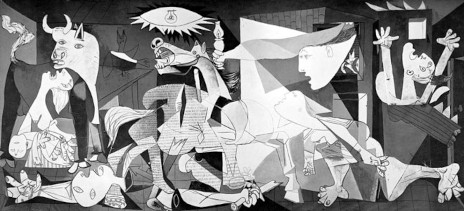 click for larger view
A tapestry copy of the mural hangs outside the entrance to the United Nations Security Council. Oddly enough, when Colin Powell argued for military action against Iraq in the spring of 2003, a blue curtain was hung over the tapestry. Now there's some symbolism.
The image below is likely quite familiar.
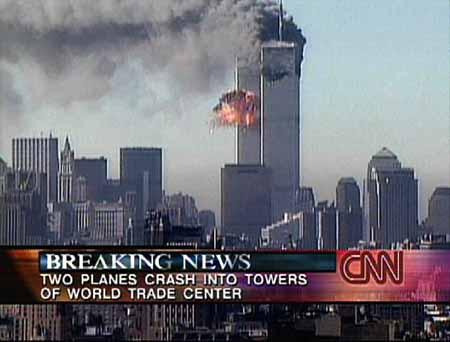
As with a work of art, the meaning of the image varies from person to person and even within individual people, over time. Right after the event, many saw in it a call to do battle with those who would perpetrate such a deed. Over the next few days many will try to impose a meaning on the image. It will be interesting to see what meanings the image evokes as time passes.
A few millennia ago, the Roman Empire used an image, in real life, to evoke fear of the wrath of the Empire. In the aftermath of a slave revolt, Marcus Lucinius Crassus ordered that the main road into Rome, the Appian Way, should be decorated with the crucified corpses of the thousands of captured slaves.
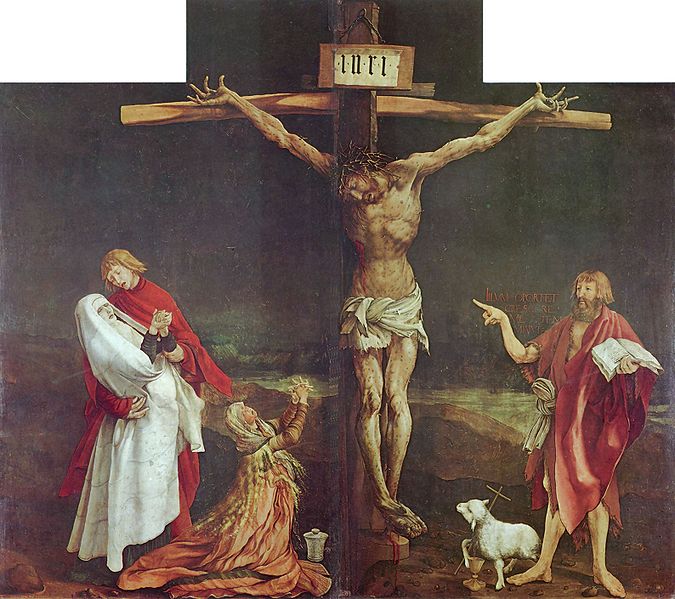
Today, many people see something quite different in the image of a crucifixion.
Tuesday, September 05, 2006
Does the Shoe fit?
I'm sure there are people who thought it was a mistake to fight the Civil War to its end and to insist that the emancipation of slaves would hold. I know there were people who said, 'Why don't we get out of this now, take a peace with the South, but leave the South with slaves?' Condoleezza Rice US Secretary of State
The old adage, if the shoe fits, wear it, comes to mind when contemplating recent Bush administration attempts to find the fitting historic metaphor to describe the War in Iraq and those who argue against its continuation. The opening quote from Ms. Rice which equates the War in Iraq with the US Civil War is one attempt and Secretary Rumsfeld's recent attempt to paint war critics as Neville Chamberlain-esque "appeasers" is another. Let's contemplate for a moment, if such metaphoric shoes might fit.
In one sense I agree with Ms. Rice. The War in Iraq and the US Civil War are both examples of wars where the cause célèbre wasn't really causal. Lincoln, according to this view, was far less interested in abolishing slavery (the Emancipation Proclamation was issued almost 3 years into the War) than in assuring the Northern Industrialists retained economic dominance. President Bush, as recent debates arguing in favor of another dictatorship in Iraq indicate to me, seems far less interested in leading the Iraqis to a "free democracy" than in assuring that the US retain dominance over global petroleum flows.
Mr. Rumsfeld's attempt to paint Saddam with the Hitler brush only serves to remind me of Godwin's Law: as an online discussion grows longer, the probability of a comparison involving Nazis or Hitler approaches 1. Oddly enough, as I discovered reading this article from Harper's the Neo-Cons should be aware of what their intellectual godfather, Leo Strauss, called, Reductio ad Hitlerum- the absurd smearing of any opposing line of thought as Hitleresque. ....nuff said.
In my view, one of the more fitting historical metaphors describing the War on Terror is the Spanish Hapburg's War on Protestantism, which began (in one frame of mind) with the Thirty Years War, and ended with the sinking of the "Invincible Armada" in the attempt to break Elizabeth's England and the eventual bankrupting of Spain.
Spain, like the US, in my view, overestimated both the efficacy of its clearly superior war machine in changing hearts and minds- despite winning many battles Protestantism kept winning the war, and the economic advantage of monetary inflation.
Religious dogmatism, another Carlinesque word combo- religion seems to me about enlightening minds, not closing them behind repeated dogmatic mantras, fueled both leaders, Philip II and George Bush.
The economic aspect seems to me quite apt. Just as Spain found that the huge inflow of Gold from the Americas allowed them to, for a while, buy without working, so to may America find that issuing the world's reserve currency allows them to, for a while, buy without working. Ultimately, however, such actions only serve to weaken the underlying economy, in a way which is hidden from view, until it is too late.
The ideological rigidity of the Spanish Hapsburgs led them to sideline and then purge the nation of dissenting groups, like the Moors and the Jews, who just happened to be the a large portion of the entrepreneurs of the nation. I hope similar purging of dissenting groups doesn't occur here, but the signs at the moment are not promising.
Of course, one key element that distinguishes life in the present moment from history is the lack of completion. We'll have to wait and see which metaphoric shoes history deems fitting to describe the current adventures.
The old adage, if the shoe fits, wear it, comes to mind when contemplating recent Bush administration attempts to find the fitting historic metaphor to describe the War in Iraq and those who argue against its continuation. The opening quote from Ms. Rice which equates the War in Iraq with the US Civil War is one attempt and Secretary Rumsfeld's recent attempt to paint war critics as Neville Chamberlain-esque "appeasers" is another. Let's contemplate for a moment, if such metaphoric shoes might fit.
In one sense I agree with Ms. Rice. The War in Iraq and the US Civil War are both examples of wars where the cause célèbre wasn't really causal. Lincoln, according to this view, was far less interested in abolishing slavery (the Emancipation Proclamation was issued almost 3 years into the War) than in assuring the Northern Industrialists retained economic dominance. President Bush, as recent debates arguing in favor of another dictatorship in Iraq indicate to me, seems far less interested in leading the Iraqis to a "free democracy" than in assuring that the US retain dominance over global petroleum flows.
Mr. Rumsfeld's attempt to paint Saddam with the Hitler brush only serves to remind me of Godwin's Law: as an online discussion grows longer, the probability of a comparison involving Nazis or Hitler approaches 1. Oddly enough, as I discovered reading this article from Harper's the Neo-Cons should be aware of what their intellectual godfather, Leo Strauss, called, Reductio ad Hitlerum- the absurd smearing of any opposing line of thought as Hitleresque. ....nuff said.
In my view, one of the more fitting historical metaphors describing the War on Terror is the Spanish Hapburg's War on Protestantism, which began (in one frame of mind) with the Thirty Years War, and ended with the sinking of the "Invincible Armada" in the attempt to break Elizabeth's England and the eventual bankrupting of Spain.
Spain, like the US, in my view, overestimated both the efficacy of its clearly superior war machine in changing hearts and minds- despite winning many battles Protestantism kept winning the war, and the economic advantage of monetary inflation.
Religious dogmatism, another Carlinesque word combo- religion seems to me about enlightening minds, not closing them behind repeated dogmatic mantras, fueled both leaders, Philip II and George Bush.
The economic aspect seems to me quite apt. Just as Spain found that the huge inflow of Gold from the Americas allowed them to, for a while, buy without working, so to may America find that issuing the world's reserve currency allows them to, for a while, buy without working. Ultimately, however, such actions only serve to weaken the underlying economy, in a way which is hidden from view, until it is too late.
The ideological rigidity of the Spanish Hapsburgs led them to sideline and then purge the nation of dissenting groups, like the Moors and the Jews, who just happened to be the a large portion of the entrepreneurs of the nation. I hope similar purging of dissenting groups doesn't occur here, but the signs at the moment are not promising.
Of course, one key element that distinguishes life in the present moment from history is the lack of completion. We'll have to wait and see which metaphoric shoes history deems fitting to describe the current adventures.
Thursday, August 31, 2006
Soros on the dis-utility of the "Terror" Frame
George Soros has popularized a well studied, but alas not well known feature of human awareness under the rubric of Reflexivity. That is, humans tend to view the world through common frames, which pre-sorts, in a sense, their perceptions of experience.
In the world of finance, if market participants become bullish, i.e. if they adopt a bullish frame of mind, they will tend to focus on the positive until it becomes too painful to continue.
In an editorial in today's Boston Globe, Blinded by a Concept, Mr. Soros applies his notion of reflexivity to the Terror frame of mine, and warns that the pain is going to get worse until we drop it.
For the financially minded, remember that reflexivity leads one to Soros' trading maxim- find the trend whose premise is false, and bet against it.
In the world of finance, if market participants become bullish, i.e. if they adopt a bullish frame of mind, they will tend to focus on the positive until it becomes too painful to continue.
In an editorial in today's Boston Globe, Blinded by a Concept, Mr. Soros applies his notion of reflexivity to the Terror frame of mine, and warns that the pain is going to get worse until we drop it.
For the financially minded, remember that reflexivity leads one to Soros' trading maxim- find the trend whose premise is false, and bet against it.
Worse than a conspiracy theory...
Thanks to the internet, one can find conspiracy theories under every virtual rock overturned. Like the printing press before it, which decentralized, dare we write, democratized, publication of the written word, the internet acts as an amplifier of non-mainstream ideas. It is the medium through which Dostoyevsky's fire currently jumps from mind to mind.
As one who believes that ultimately the truth (or whatever variant thereof which comfortably fits in the vessels of the times) wins out, I think we live in exciting, albeit dangerous times. Any idea can be amplified and the death throes of certain ideas have human costs.
But my focus today is not on the new medium but on the content therein. I've been thinking about causal factors behind government conspiracy theories. One, as noted above, is merely the ease, by virtue of the new medium, with which such ideas can be transmitted.
Another causal factor might be a desire for the world not to be the way it seems. That is, it may well be easier to imagine government involvement in, say, 9/11 than to imagine that a group of otherwise unspectacular humans pulled off such a tragic event. Contemplation of the latter leads one to accept the ease of repetition.
As Hitler seems to be a topic of conversation in the mass media these days let's use his example as foil. There were many "conspiracy theories" surrounding Hitler's Third Reich. I think some arose because it was easier to imagine a conspiracy with greed, revenge or other self-serving notion as driving factor than to take him seriously. Surely he couldn't believe what he wrote years before he came to power and what he was saying at rallies...it was all just a ploy to seize power....right?
Alas, in Hitler's case, it was worse than a conspiracy, it was the truth. He believed his own bullsh!t..(a.k.a. becoming one's own God)....and that is really scary.
As one who believes that ultimately the truth (or whatever variant thereof which comfortably fits in the vessels of the times) wins out, I think we live in exciting, albeit dangerous times. Any idea can be amplified and the death throes of certain ideas have human costs.
But my focus today is not on the new medium but on the content therein. I've been thinking about causal factors behind government conspiracy theories. One, as noted above, is merely the ease, by virtue of the new medium, with which such ideas can be transmitted.
Another causal factor might be a desire for the world not to be the way it seems. That is, it may well be easier to imagine government involvement in, say, 9/11 than to imagine that a group of otherwise unspectacular humans pulled off such a tragic event. Contemplation of the latter leads one to accept the ease of repetition.
As Hitler seems to be a topic of conversation in the mass media these days let's use his example as foil. There were many "conspiracy theories" surrounding Hitler's Third Reich. I think some arose because it was easier to imagine a conspiracy with greed, revenge or other self-serving notion as driving factor than to take him seriously. Surely he couldn't believe what he wrote years before he came to power and what he was saying at rallies...it was all just a ploy to seize power....right?
Alas, in Hitler's case, it was worse than a conspiracy, it was the truth. He believed his own bullsh!t..(a.k.a. becoming one's own God)....and that is really scary.
Wednesday, August 30, 2006
The Greenspan Era is over
Further progress in global economic integration should not be taken for granted, however. Geopolitical concerns, including international tensions and the risks of terrorism, already constrain the pace of worldwide economic integration and may do so even more in the future. And, as in the past, the social and political opposition to openness can be strong. Although this opposition has many sources, I have suggested that much of it arises because changes in the patterns of production are likely to threaten the livelihoods of some workers and the profits of some firms, even when these changes lead to greater productivity and output overall. The natural reaction of those so affected is to resist change, for example, by seeking the passage of protectionist measures. The challenge for policymakers is to ensure that the benefits of global economic integration are sufficiently widely shared--for example, by helping displaced workers get the necessary training to take advantage of new opportunities--that a consensus for welfare-enhancing change can be obtained. Building such a consensus may be far from easy, at both the national and the global levels. However, the effort is well worth making, as the potential benefits of increased global economic integration are large indeed.
Ben Bernanke Aug 25, 2006
It is certainly true, as Mallaby notes, that Walmart’s efficient distribution of imported goods has lowered the retail price of many manufactured goods. Auto workers in the Mid-west may not have a job anymore, but the dollars they get from borrowing against their accumulated home equity go further than ever before.
Ok, that remark is a bit over the top. But I think it goes to the issue – if nominal wages were constant and prices were falling, the Walmart economy would be consistent with higher real wages across the board. Workers released from manufacturing would find other jobs – in construction, perhaps, or in the services sector. The composition of the economy would change. I would still worry about taking on external debt to support a boom in investment in non-tradables. But living standards for the median worker would be rising as the changing composition of the economy increased its overall productivity.
That obviously hasn’t happened. At least not recently. Cheap Chinese assembly, global supply chains and efficient big box retailing haven’t been associated with much of a rise in the real purchasing power of the median worker. Indeed Leonhardt and Greenhouse note in New York Times that real compensation (counting benefits as well as wages) fell over the past year.
Brad Setser
The Greenspan era, in my view, is officially over. Ben Bernanke has emerged from the shadow of "welfare state confiscation" hatin' Greenspan to raise the once verboten topic of distribution, and at Jackson Hole, of all places. That is, it seems the new Fed Chair wants to alert the powers that be to the importance of the trickle in the trickle down economy.
Rising political tensions between the haves and have nots may have been obscured by the US media's slavish adherence to the "Terror" frame but like the proverbial tree falling in the forest, lack of awareness of a thing is not the same as the lack of a thing.
Political upheaval in Mexico, which may lead to the creation of a shadow, tax receiving, government has likely raised alarm bells among the powers that be in the US. To the extent the current housing slowdown becomes more of a crash, cheap labor might not be the only thing that crosses the border, political upheaval may follow.
For the financially minded, the rising concern over distribution issues, evident in both Bernanke's recent speech and a number pf papers cited in Mr. Setser's blog post (whose analysis I highly recommend) rather than a sole focus on Rubin's bigger pies, suggests to me that in the event further inflation is the monetary policy choice, as I suspect, then the next round of wage and price increases will be a bit more widespread.
One of the impediments to a virtuous (in the self-sustaining, not positive, sense) inflation cycle in the US of late has been the failure of wages to rise. If social stability is feared, wages may well begin to rise, and the cycle will be completed, just in time for the costs of the adventures in the Middle East to be apportioned.
Sometimes putting off until tomorrow is not wise because then all problems must be dealt with at once. This recalls the line from the spoof film "Airplane"..."look's like I picked the wrong week to stop sniffing glue."
Ben Bernanke Aug 25, 2006
It is certainly true, as Mallaby notes, that Walmart’s efficient distribution of imported goods has lowered the retail price of many manufactured goods. Auto workers in the Mid-west may not have a job anymore, but the dollars they get from borrowing against their accumulated home equity go further than ever before.
Ok, that remark is a bit over the top. But I think it goes to the issue – if nominal wages were constant and prices were falling, the Walmart economy would be consistent with higher real wages across the board. Workers released from manufacturing would find other jobs – in construction, perhaps, or in the services sector. The composition of the economy would change. I would still worry about taking on external debt to support a boom in investment in non-tradables. But living standards for the median worker would be rising as the changing composition of the economy increased its overall productivity.
That obviously hasn’t happened. At least not recently. Cheap Chinese assembly, global supply chains and efficient big box retailing haven’t been associated with much of a rise in the real purchasing power of the median worker. Indeed Leonhardt and Greenhouse note in New York Times that real compensation (counting benefits as well as wages) fell over the past year.
Brad Setser
The Greenspan era, in my view, is officially over. Ben Bernanke has emerged from the shadow of "welfare state confiscation" hatin' Greenspan to raise the once verboten topic of distribution, and at Jackson Hole, of all places. That is, it seems the new Fed Chair wants to alert the powers that be to the importance of the trickle in the trickle down economy.
Rising political tensions between the haves and have nots may have been obscured by the US media's slavish adherence to the "Terror" frame but like the proverbial tree falling in the forest, lack of awareness of a thing is not the same as the lack of a thing.
Political upheaval in Mexico, which may lead to the creation of a shadow, tax receiving, government has likely raised alarm bells among the powers that be in the US. To the extent the current housing slowdown becomes more of a crash, cheap labor might not be the only thing that crosses the border, political upheaval may follow.
For the financially minded, the rising concern over distribution issues, evident in both Bernanke's recent speech and a number pf papers cited in Mr. Setser's blog post (whose analysis I highly recommend) rather than a sole focus on Rubin's bigger pies, suggests to me that in the event further inflation is the monetary policy choice, as I suspect, then the next round of wage and price increases will be a bit more widespread.
One of the impediments to a virtuous (in the self-sustaining, not positive, sense) inflation cycle in the US of late has been the failure of wages to rise. If social stability is feared, wages may well begin to rise, and the cycle will be completed, just in time for the costs of the adventures in the Middle East to be apportioned.
Sometimes putting off until tomorrow is not wise because then all problems must be dealt with at once. This recalls the line from the spoof film "Airplane"..."look's like I picked the wrong week to stop sniffing glue."
Tuesday, August 29, 2006
This ain't no game, Jack
The timer on the scoreboard flashed under 2:00 and astonishingly, this motley crew of aging hockey players from upstate NY was still clinging to a 2-1 lead in the finals. Our opponents were a tough bunch of cops from Toronto who out shot us by more than 2 to 1 but just couldn't slide them by our goalie who was, as we say, "standing on his head."
Suddenly a fluke goal is scored by the Toronto cops on a deflected pass through the crease. The clock now shows just under 20 seconds and all I am thinking after playing 4 games inside of 48 hours is "please, no overtime." I get my wish- our opponents break the puck out of their zone, beat our defenseman and score with 2 seconds left. The buzzer sounds and the trophy is handed to the guys from Toronto while we skate off the ice dejected.
It is difficult to "spin" the results of a game, although this difficulty apparently dissuades few. There is only one question involved in assessing the results of a hockey game; who put more pucks in the opposing team's goal within the allotted time.
Victory and defeat are far less easy to determine in other avenues of human endeavor. Take Wars for example.
Who won the recent war between Israel and Lebanon (perhaps more accurately Hezbollah)?
Who's winning the War in Iraq?
Who's winning the War in Afghanistan?
Scoring Wars is difficult. What should we count? People killed? Territory taken?
Scoring Wars is very difficult. Even if we could arrive at a consensus of what to count to determine a victor, we would find it extremely difficult to verify the count. Hockey has referees and judges to determine penalties and goals while Wars are "self-scored."
Who killed whom and what territory is held by whom are not only fought over in real life but in the media as well- the war within the war. The Germans and Japanese who trusted official media accounts were a bit shocked to discover they weren't winning as the bombs started to fall on their cities. The scoreboard they trusted was showing the Home team up 5-2 when the real score was 2-8.
This makes planning difficult, which is unfortunate. Unlike our hockey game, which decided who would take home a trophy, wars often determine a significant portion of national flow of funds. Knowing who is winning and losing is key to choosing the form in which one denominates one's savings.
Reparations, the modern variant of tribute, and a silly one at that (take two functioning civilizations, blow up some of each others stuff and then fight over who should pay for the mess) are a case in point.
Iraq, by virtue of losing the first Gulf War still owes Kuwait billions of $. Germany, by virtue of losing WWI, owed the victors so much money that their currency eventually became worthless. The United States, by virtue of its failure to impose its will on the Vietnamese, had to pay for that war itself, thus contributing to the inflation of the 70s.
So I wonder.
Who's winning the War in Iraq?
Who's winning the War in Afghanistan?
Who's going to pay for these experiments in "democracy?"
I still chuckle at the notion of "imposing democracy" i.e. self rule, on a people. As George Carlin would say, it's like jumbo shrimp or military intelligence, two words which just don't go together.
In my view, those who come up with the right answers to the above questions, and position themselves accordingly, will be the big winners in the game of financial speculation. I won't argue the case here as this is another issue (like exercise) where division of labor is not helpful. I will, however, caution one more time, don't trust the home team scoreboard, which sometimes takes the form of financial market prices. Think for yourself on this one.
If the US gains greater control of Middle Eastern oil exports, many of the fears over the growing deficits will be quieted. Conversely, if control over ME oil exports is lost, the effects of those deficits will be felt much more strongly.
Somebody is going to pay for the war and for rebuilding the Middle East such that the residents will continue to export their oil. And these costs are rising by the minute.
This ain't no game, Jack. This is War.
Suddenly a fluke goal is scored by the Toronto cops on a deflected pass through the crease. The clock now shows just under 20 seconds and all I am thinking after playing 4 games inside of 48 hours is "please, no overtime." I get my wish- our opponents break the puck out of their zone, beat our defenseman and score with 2 seconds left. The buzzer sounds and the trophy is handed to the guys from Toronto while we skate off the ice dejected.
It is difficult to "spin" the results of a game, although this difficulty apparently dissuades few. There is only one question involved in assessing the results of a hockey game; who put more pucks in the opposing team's goal within the allotted time.
Victory and defeat are far less easy to determine in other avenues of human endeavor. Take Wars for example.
Who won the recent war between Israel and Lebanon (perhaps more accurately Hezbollah)?
Who's winning the War in Iraq?
Who's winning the War in Afghanistan?
Scoring Wars is difficult. What should we count? People killed? Territory taken?
Scoring Wars is very difficult. Even if we could arrive at a consensus of what to count to determine a victor, we would find it extremely difficult to verify the count. Hockey has referees and judges to determine penalties and goals while Wars are "self-scored."
Who killed whom and what territory is held by whom are not only fought over in real life but in the media as well- the war within the war. The Germans and Japanese who trusted official media accounts were a bit shocked to discover they weren't winning as the bombs started to fall on their cities. The scoreboard they trusted was showing the Home team up 5-2 when the real score was 2-8.
This makes planning difficult, which is unfortunate. Unlike our hockey game, which decided who would take home a trophy, wars often determine a significant portion of national flow of funds. Knowing who is winning and losing is key to choosing the form in which one denominates one's savings.
Reparations, the modern variant of tribute, and a silly one at that (take two functioning civilizations, blow up some of each others stuff and then fight over who should pay for the mess) are a case in point.
Iraq, by virtue of losing the first Gulf War still owes Kuwait billions of $. Germany, by virtue of losing WWI, owed the victors so much money that their currency eventually became worthless. The United States, by virtue of its failure to impose its will on the Vietnamese, had to pay for that war itself, thus contributing to the inflation of the 70s.
So I wonder.
Who's winning the War in Iraq?
Who's winning the War in Afghanistan?
Who's going to pay for these experiments in "democracy?"
I still chuckle at the notion of "imposing democracy" i.e. self rule, on a people. As George Carlin would say, it's like jumbo shrimp or military intelligence, two words which just don't go together.
In my view, those who come up with the right answers to the above questions, and position themselves accordingly, will be the big winners in the game of financial speculation. I won't argue the case here as this is another issue (like exercise) where division of labor is not helpful. I will, however, caution one more time, don't trust the home team scoreboard, which sometimes takes the form of financial market prices. Think for yourself on this one.
If the US gains greater control of Middle Eastern oil exports, many of the fears over the growing deficits will be quieted. Conversely, if control over ME oil exports is lost, the effects of those deficits will be felt much more strongly.
Somebody is going to pay for the war and for rebuilding the Middle East such that the residents will continue to export their oil. And these costs are rising by the minute.
This ain't no game, Jack. This is War.
Thursday, August 24, 2006
Back Monday
I'm off to a Hockey Tournament in Montreal this weekend so I won't be updating again until Monday.
Wednesday, August 23, 2006
CATO suggests a gentler, more grounded frame for Terrorism
A False sense of insecurity?
Even with the Spetember 11 attacks included in the count, the number of Americans killed by international terrorism since the late 1960s (which is when the State Department began counting) is about the same as the number of Americans killed over the same period by lightning, accident-causing deer or sever allegeric reaction to peanuts.
Even with the Spetember 11 attacks included in the count, the number of Americans killed by international terrorism since the late 1960s (which is when the State Department began counting) is about the same as the number of Americans killed over the same period by lightning, accident-causing deer or sever allegeric reaction to peanuts.
Tuesday, August 22, 2006
Propagandizing one's self out of work
From the Financial Times:
First it was the typewriter, then the teleprinter. Now a US news service has found a way to replace human beings in the newsroom and is instead using computers to write some of its stories.
Thomson Financial, the business information group, has been using computers to generate some stories since March and is so pleased with the results that it plans to expand the practice.
The computers work so fast that an earnings story can be released within 0.3 seconds of the company making results public.
Well, well, apparently there are limits to the virtue of being a corporate shill. If you are just going to be a mouth piece for the corporate view (and what else what you call a reporter who simply takes the corporation's view and data at face value) you are expendable.
Descartes wrote what has come to be known as the cogito, I think, therefore I am. He rejected the idea of simply repeating the lies others had told him. Reporters at Thomson might be finding new meaning in the cogito, or they would if it was ever found in a corporate news release.
Now, let's talk about a few of the guys who work for the major news organizations regurgitating press releases from the Department of Defense, Bureau of Labor Statistics and Bureau of Economic Analysis. I think replacing those who are willing to sell their souls with machines a step towards greater honesty in society.
First it was the typewriter, then the teleprinter. Now a US news service has found a way to replace human beings in the newsroom and is instead using computers to write some of its stories.
Thomson Financial, the business information group, has been using computers to generate some stories since March and is so pleased with the results that it plans to expand the practice.
The computers work so fast that an earnings story can be released within 0.3 seconds of the company making results public.
Well, well, apparently there are limits to the virtue of being a corporate shill. If you are just going to be a mouth piece for the corporate view (and what else what you call a reporter who simply takes the corporation's view and data at face value) you are expendable.
Descartes wrote what has come to be known as the cogito, I think, therefore I am. He rejected the idea of simply repeating the lies others had told him. Reporters at Thomson might be finding new meaning in the cogito, or they would if it was ever found in a corporate news release.
Now, let's talk about a few of the guys who work for the major news organizations regurgitating press releases from the Department of Defense, Bureau of Labor Statistics and Bureau of Economic Analysis. I think replacing those who are willing to sell their souls with machines a step towards greater honesty in society.
The end of Terrorism as we know it
From Today's Guardian:
The Tories have gained over the last month while support for Labour has fallen heavily in the wake of the recent alleged terror plot against airlines. An overwhelming majority of voters appear to pin part of the blame for the increased threat on Tony Blair's policy of intervention in Iraq and Afghanistan. Ministers - including Mr Blair - have repeatedly denied that there is a connection. But 72%, including 65% of Labour voters, think government policy has made Britain more of a target for terrorists. Only 1% of voters believe the government's foreign policy has made Britain safer, a devastating finding given that action in Iraq and Afghanistan has been justified in part to defeat Islamist terrorism. The findings will shock many at Westminster who had expected Labour to gain ground following John Reid's high-profile handling of the alleged plot against transatlantic airlines. Carried out over the past weekend, following the series of terror arrests, the poll shows voters do not believe the government is giving an honest account of the threat facing Britain. Only 20% of all voters, and 26% of Labour voters, say they think the government is telling the truth about the threat, while 21% of voters think the government has actively exaggerated the danger. A majority, 51%, say the government is not giving the full truth and may be telling less than it knows.
Yesterday from CNN:
Just 35 percent of 1,033 adults polled say they favor the war in Iraq; 61 percent say they oppose it -- the highest opposition noted in any CNN poll since the conflict began more than three years ago. ....... Most Americans (54 percent) don't consider him [President Bush] honest, most (54 percent) don't think he shares their values and most (58 percent) say he does not inspire confidence.
The full survey results details the public's growing sense that the President is not honest. 77% of the public (according to this survey) believed him to be honest in late April 2002. Currently, only 47% believe him to be honest.
As I have been noting a bit in my musings of late, the human spirit is a fickle thing. Sometimes, as occurred in the US after 9/11 and recently in Lebanon, external threats drive people together, while at other times, they can lead to dissatisfaction with those in charge.
It may well be that another 9/11 type of a attack could lead people here in the US or in the UK to see their current leaders not as saviors but as part of the problem. At least that is one view I entertain after reading these latest poll numbers.
In that regard, I think we may be witnessing the beginning of the end of terrorism as we know it. The more that terrorism becomes a liability for the majority party, the more likely will its framing change.
Of course, the majority party needs to discover the truth of this for themselves.
The Tories have gained over the last month while support for Labour has fallen heavily in the wake of the recent alleged terror plot against airlines. An overwhelming majority of voters appear to pin part of the blame for the increased threat on Tony Blair's policy of intervention in Iraq and Afghanistan. Ministers - including Mr Blair - have repeatedly denied that there is a connection. But 72%, including 65% of Labour voters, think government policy has made Britain more of a target for terrorists. Only 1% of voters believe the government's foreign policy has made Britain safer, a devastating finding given that action in Iraq and Afghanistan has been justified in part to defeat Islamist terrorism. The findings will shock many at Westminster who had expected Labour to gain ground following John Reid's high-profile handling of the alleged plot against transatlantic airlines. Carried out over the past weekend, following the series of terror arrests, the poll shows voters do not believe the government is giving an honest account of the threat facing Britain. Only 20% of all voters, and 26% of Labour voters, say they think the government is telling the truth about the threat, while 21% of voters think the government has actively exaggerated the danger. A majority, 51%, say the government is not giving the full truth and may be telling less than it knows.
Yesterday from CNN:
Just 35 percent of 1,033 adults polled say they favor the war in Iraq; 61 percent say they oppose it -- the highest opposition noted in any CNN poll since the conflict began more than three years ago. ....... Most Americans (54 percent) don't consider him [President Bush] honest, most (54 percent) don't think he shares their values and most (58 percent) say he does not inspire confidence.
The full survey results details the public's growing sense that the President is not honest. 77% of the public (according to this survey) believed him to be honest in late April 2002. Currently, only 47% believe him to be honest.
As I have been noting a bit in my musings of late, the human spirit is a fickle thing. Sometimes, as occurred in the US after 9/11 and recently in Lebanon, external threats drive people together, while at other times, they can lead to dissatisfaction with those in charge.
It may well be that another 9/11 type of a attack could lead people here in the US or in the UK to see their current leaders not as saviors but as part of the problem. At least that is one view I entertain after reading these latest poll numbers.
In that regard, I think we may be witnessing the beginning of the end of terrorism as we know it. The more that terrorism becomes a liability for the majority party, the more likely will its framing change.
Of course, the majority party needs to discover the truth of this for themselves.
Monday, August 21, 2006
Pricing power and inflation
Inflation cannot rise because firms don't have pricing power, goes one of the anti-inflation arguments I come across quite often.
It seems like a sound argument- If firms can't raise prices, inflation cannot occur. Yet, I lived through a period of time (the late 90s) in a region (SE Asia) where pricing power was very limited, but inflation rose dramatically anyway. The flaw in the argument recalls the over my dead body argument. The response being...if that's the way you want it.
If a firm cannot raise prices without severely reducing unit sales but the firm's input costs are rising it goes bankrupt depending on the amount of cash it can get its hands on. Other firms, whose financials are geared toward lower volumes or with deeper pockets will make up the slack, at higher prices.
With that thought in mind, I'm keenly watching the US auto industry. Bankruptcies could signal a round of inflation as competition declines, i.e. the pricing power of the industry as a whole gets divided amongst fewer hands.
Speaking (actually writing) of pricing power, it seems the Fed fears it no longer has any. They may be correct in that view. For the first time since 2000 (when the Fed removed $20 odd Billion from Dec. 1999 to Feb 2000), the monetary base is contracting, albeit slowly (less than $5B from the May peak).
Funny how rates could rise substantially (thus inflating interest profits at the banks) for many quarters without much complaint but when the monetary base contracts, people begin to worry.
The former action is, in my view, the Fed, i.e. the OPEC of money, acting as an agent for the banks, and giving it some room to cut later, the latter action is the Fed trying to keep a lid on inflation, or perhaps just trying to gin up a little equity/housing market sell off, which would get the world crying for some more money. (Gosh, I start writing about the Fed and I get verbal inflation, no simple sentences, just run on and on and ons).
Fortunately, Helicopter Ben will be there to bail us all out, likely to popular acclaim.
It seems like a sound argument- If firms can't raise prices, inflation cannot occur. Yet, I lived through a period of time (the late 90s) in a region (SE Asia) where pricing power was very limited, but inflation rose dramatically anyway. The flaw in the argument recalls the over my dead body argument. The response being...if that's the way you want it.
If a firm cannot raise prices without severely reducing unit sales but the firm's input costs are rising it goes bankrupt depending on the amount of cash it can get its hands on. Other firms, whose financials are geared toward lower volumes or with deeper pockets will make up the slack, at higher prices.
With that thought in mind, I'm keenly watching the US auto industry. Bankruptcies could signal a round of inflation as competition declines, i.e. the pricing power of the industry as a whole gets divided amongst fewer hands.
Speaking (actually writing) of pricing power, it seems the Fed fears it no longer has any. They may be correct in that view. For the first time since 2000 (when the Fed removed $20 odd Billion from Dec. 1999 to Feb 2000), the monetary base is contracting, albeit slowly (less than $5B from the May peak).
Funny how rates could rise substantially (thus inflating interest profits at the banks) for many quarters without much complaint but when the monetary base contracts, people begin to worry.
The former action is, in my view, the Fed, i.e. the OPEC of money, acting as an agent for the banks, and giving it some room to cut later, the latter action is the Fed trying to keep a lid on inflation, or perhaps just trying to gin up a little equity/housing market sell off, which would get the world crying for some more money. (Gosh, I start writing about the Fed and I get verbal inflation, no simple sentences, just run on and on and ons).
Fortunately, Helicopter Ben will be there to bail us all out, likely to popular acclaim.
The line in the sand has been drawn
We're not leaving [Iraq] so long as I'm President. That would be a huge mistake. President Bush Aug 21, 2006
The Dude wonders which proposition is the huge mistake.
The Dude wonders which proposition is the huge mistake.
Subscribe to:
Posts (Atom)

