Sunday, October 16, 2005

Behold Greenspan-Shiva

A little learning is a dangerous thing
Drink deep, or taste not the Pierian spring
There shallow draughts intoxicate the brain,
And drinking largely sobers us again.
Tired at first sight with what the muse imparts,
In fearless youth we tempt the heights of arts
While from the bounded level of our mind
Short views we take nor see the lengths behind
But more advanced behold with strange surprise,
New distant scenes of endless science rise!
So pleased at first the towering Alps we try,
Mount o'er the vales and seem to tread the sky,
The eternal snows appear already passed
And the first clouds and mountains seem the last.
But those attained we tremble to survey
The growing labors of the lengthened way
The increasing prospect tires our wandering eyes,
Hills peep o'er hills and Alps on Alps arise!
Alexander Pope - Essay on Criticism

There is a Zen saying, One moon shows in every pool; in every pool, the one moon, which I find to be a wonderful description of the relation between internal minds and the external world. The corollary saying A finger pointing at the moon is not the moon is an earlier manifestation of Korzybski's maxim the map is not the territory i.e. the words one uses to describe a phenomenon are not the phenomenon, the thoughts in your head of the external world are not the external world. Yes, I promised a bit of Greenspan today and I'll get there, but first I'd like to bring a few thoughts to the foreground of your mind to act as an anchor.

Man has been thinking about the experience of life for a very long time. Throughout that time, as each culture or collective sense of the world has waxed and waned, the same elemental questions keep popping up. In Philosophy circles one of these issues is expressed as the problem of universals; what is the relation, if any, between a general word or thought and the "real world" for want of a better phrase. Here's the kicker, your ability to understand the external world will be profoundly affected by your answer to this question...and everyone has to make a choice, whether you are aware of that or not.

Keeping those thoughts in mind, let's turn to the big cheese himself, Fed Chairman, Alan Greenspan. My professional life in finance has coincided almost exactly with Greenspan's tenure. Ever since the crash of '87 that served as his "wake up" call, I've been reading his speeches, parsing his comments and trying to get my head around his philosophy. I've found this no easy task; as he once noted in a speech, I guess I should warn you, if I turn out to be particularly clear, you've probably misunderstood what I've said. Like Rep. Ron Paul of Texas, I've raged at his seeming about face from Gold Standard advocate in 1966 to High Priest of Fiat Money. Like an impudent child in a classroom I've poked fun at seeming contradictions in his speeches. Like a tenured college professor who confuses his view of the world with metaphysical truth, I've noted that Greenspan alternatively "gets it" or "doesn't get it" when I perceive his comments to be in accord or discord respectively, with my own views. What I haven't done is to take a step back and remember that he is just a man, or in Zen terms, one of many pools reflecting on the light of the one moon.

The child who became the man was born in 1926 in the Washington Heights area of NYC. According to most accounts I've read he was a good student, class president and a jazz musician of some acclaim. After dropping out of Julliard he switched gears from music to money, enrolled in NYU and earned his BS and MA in Economics.

Although he was employed in the "suit and tie crowd" Greenspan in his mid twenties hadn't yet turned his back on artistic bohemia. He met an artist, [Thanks to a reader who alerted me to an error, the Joan Mitchell to whom Greenspan was married was not the abstract expressionist, but more of a formalist], with whom he was married briefly, Joan Mitchell, who introduced him to Ayn Rand, nee Alissa Zinovievna Rosenbaum, the author of a novel with a cult-like following, The Fountainhead. Although Greenspan initially was not enthused about Rand, Ms. Mitchell, before, during and after their marriage, kept urging him to open his mind to her philosophy given his own views. Eventually he did opt to associate with Rand, quite closely, and in the process decided his answer to the immortal question of universals.

Justin Martin, in Greenspan: The Man Behind Money, describes that decision process:

Mitchell continually urged Greenspan to be more open toward Rand and her circle. Given his personality, she was certain that he would respond to objectivism's emphasis on rationality and individualism. It was through her that Greenspan got to know Nathaniel Branden, objectivism's chief proselytizer. Over several months in 1954, they met a number of times, sometimes in restaurants, sometimes at Branden's apartment at 165 East 35th Street.

.....

Branden kept after Greenspan. At their meetings, Greenspan would say things such as: "I think that I exist. But I don't know for sure. Actually, I can't say with certainty that anything exists."

[note: According to Nathaniel Brandon Greenspan was philosophically a logical positivist and economically a Keynesian when he met Rand. Logical Positivists are skeptical of theological and metaphysical propositions [i.e. assumptions] and exclude them from logical reasoning. To those of this persuasion, the logical truth of a proposition must be ultimately grounded in its accordance with the (physical) material world. This rigidity might seem just the ticket but as Descartes' plunge into the skeptical abyss suggests, if you can't assume the universe is real or even that you exist, two of those aforenoted metaphysical propositions, then there can be no accord, for there is nothing with which to compare the thought. In a sense logical positivism's view of the world puts the cart before the horse, logic is great once you have some assumptions and associations with which to work, but useless without, call it a case of analysis-paralysis. Greenspan's doubts are entirely consistent with this philosophy.

.....

One day, Branden was riding in a cab with Rand. He had some surprising news and could hardly contain himself. Finally, he just blurted it out.

"Guess who exists?"

Rand was shocked.

"Don't tell me," she said, "you've won over Alan Greenspan."

"Yes, I have," he answered. "And I think you're going to change your mind about him. I think he's a really interesting man with a very unusual brain."

I wonder if he knew he was walking in Descartes' footsteps when he was soul searching, or if he questioned whether the road he took out of the skeptical pit, Rand's road of self affirmation [a is a, I exist, existence exists], was really a road at all, but we'll get back to that.

As noted in this article, once he made his choice in 1954, Greenspan's close association with Rand continued throughout the rest of her life:

...Greenspan was a member of Rand’s inner circle during this entire period and beyond. He lectured on economics for the Nathaniel Branden Institute. He wrote for the first issue of The Objectivist Newsletter, and when Rand broke with Branden, he signed a public statement condemning the traitor “irrevocably.” When Gerald Ford appointed him to the Council of Economic Advisors, he invited Rand to his swearing-in ceremony, and attended her funeral in 1982.

The article also notes that Greenspan's name first appeared in the NYTimes in the fall of 1957 not, as one might expect, in connection with politics or economics, but as the author of a 73-word letter to the editor of the Times Book Review. The future head of the Federal Reserve wrote to protest a hostile review of Ayn Rand’s novel Atlas Shrugged that had appeared a few weeks earlier. Here I see evidence of his choice in the question of universals, there is only one interpretation to each thing, those who don't see what I see are wrong.

In digging through the research materials to put this essay together I recalled my own flirtation with Rand's views. Fortunately, I believe, I didn't read Rand as a soul searching twenty-something, nor did I have to contend with her physical presence while I entertained her views, as did Greenspan, but rather somewhat later in life, intrigued by her economic views, which were, in the main, copied from the Austrians. Even more fortunately, I had read enough philosophy before reading Rand to have my own opinions on some of the essential questions of the discipline. She was not the medium (as she was for Greenspan) through which I discovered that man had been pondering the same questions that I pondered. I am most thankful to her, in an ironic sense, for leading me to reinvestigate Plato's thought. In hindsight, I didn't have much grasp of Plato when I read selections in college, now I agree, in a sense, with Whitehead, The safest characterization of the European philosophical tradition is that it consists of a series of footnotes to Plato.

As her, in my view, simplistic treatment of certain of the essential questions of philosophy had already led me to view her work with skepticism I didn't read her novels, The Fountainhead and Atlas Shrugged, in full, although I did check out some of the more important, according to Objectivists, sections when I popped into a library and bookstore. Neither of the books spoke to me on first acquaintance almost a decade ago.

In between then and now I've done a lot of reading, had a child and, well, aged a bit. My sense of the world has changed. I've revisited some of the "more important" sections and plot lines of those two novels. Sticking with reasonably contemporary comparisons, Tolkien's Lord of the Rings evidences to me much deeper scholarship in a much easier to read package, in my view, a sign of true genius-making the complex, simple. Tolkien's study of the relations between man and the language he uses both in elemental and complex forms, the words themselves and the literature respectively, led him to imagine a world where the effects of history on today were clear and unavoidable. Tolkien's heroes were more caught in the flow of the times than Rand's drivers of the world who could turn the flow of history on a dime.

As far as novel as metaphor for the times, I much prefer Kesey's One Flew over the Cuckoo's Nest. Kesey's work, like Rand's promotes a sense of individualism and an awareness of the madness of the system. Kesey's brand of individualism, and freedom, however, was more consistent with the 19th century Transcendentalists, Emerson and Thoreau- while you are entitled to them, don't impose your ideals on others, let people discern their own truth. Rand's vision of individualism seems to me confused, as if it needs to be validated by everyone else, which seems more like solipsism.

Neither Howard Roark or John Galt, the heroes of her two main novels, are complaining that they can't do what they want, although they phrase it that way, but rather that the people around them aren't giving them enough credit and jumping to do their bidding. Roark could design any building he wanted, nobody was stopping him. The problems came because, in order to manifest his vision in the real world he needed other people, some to work and some to invest, but none to think on their own. Both "heroes" were, in the end, destructive, much as a young child can be when he loses a board game- "if I can't win then nobody can play."

During the climactic courtroom monologue, Roark says The creator lives for his work. He needs no other men. His primary goal is within himself. The parasite lives second-hand. He needs others. Others become his prime motive. According to that definition it seems to me that Roark is a parasite, as is Galt. If you really don't need others, follow Thoreau to Walden Pond, don't complain that the "others" you supposedly don't need aren't thinking, feeling and doing what you want them to. In her own way, Rand made a wonderful Nurse Ratched, imposing her "sanity" on the world, whether they wanted it or not.

Yet, I can see how this book would appeal to a bunch of young, intellectual city dwellers who have little to no sense of the grunt work required to bring any idea into reality, or, more pertinently, the grunt work required to keep the people of that city fed, watered, clothed and housed. This isn't to denigrate "reason" but to understand that a man alone with only his thoughts will soon starve. While Marx tried to convince people that a headless workman could rule the world, Rand tried to convince people that a bodiless thinker could. While I agree with the essential critique, that relations between the 2 classes aren't great, both responses seem to be an exercise in cutting off one's nose to spite one's face. My wife and I put a fair bit of thought into planning our garden. We also break the soil, fertilize, plant according to the plan, weed, water when needed, and harvest.

Leaving aside my perspective on Rand, let's return to her effect on devotees. To highlight the allure of Ms. Rand and her views consider the case of Libertarian Philosopher/Economist Murray Rothbard, born in the same year as Alan Greenspan, 1926. After reading Atlas Shrugged, Rothbard wrote to tell Rand, Atlas Shrugged is the greatest novel ever written...when, in the past, I heard your disciples refer to you . . . as one of the greatest geniuses who ever lived" he had thought this to be "the outpouring of a mystic cult. But, now, upon reading Atlas Shrugged, I find I was wrong. A few months later, when Rand learned that the economist Murray Rothbard's wife, Joey, was a devout Christian, she all but ordered that if Joey did not see the light and become an atheist in six months, Rothbard, who was an agnostic, must divorce her. Rothbard never had any intention of doing anything of the sort, and this estranged him from Rand, who found such "irrational" behavior intolerable. Rothbard would later write one of the first exposés of what he called The Ayn Rand Cult.

I'm not arguing that Greenspan was or still is some sort of mind controlled Trilby to Rand's female Svengali. As is noted throughout the accounts of their relationship, Greenspan was treated differently by Rand than her other acolytes. Although she named Nathaniel Brandon as her intellectual heir, until their affair (they were both married but not to each other) went sour, Greenspan seems to me to have grasped the essential Rand, although with an even shallower scholarship than his mentor; the ability to convince others that you are right, to evoke what Emerson called the idolatry of the herald, using that tool, rhetoric, so well described by her muse, Aristotle.

Let me illustrate this process or rather, describe a possible demonstration occurring right now. Part of the reason I went into such detail and used such a broad range of allusions was to illustrate a rhetorical tool, the art of weaving the spell of a knowledgeable person. I could just as easily have written, Greenspan is a book smart city boy whose life has been so isolated from the real world that he likely can't change the oil in his own car, or connect his own computer to the network. That anyone thinks he has some special grasp of the economy, which is made up of millions of people doing things just like that, seems silly to me, but without all the allusions and subordinate clauses it wouldn't enter the mind the same way, although the essential message would be similar.

If you have been blessed with both the time and inclination to spend the hours necessary to form your own opinions on the subjects discussed you are likely to read this essay with a critical eye. You might disagree with my perspective on Logical Positivism, for instance. As Carlyle wrote, the eye sees what the eye has means of seeing. If, by contrast, I invoke names and ideas with which your acquaintance is limited, you could easily come to the view that I seem like a smart guy who knows his stuff, the first step in the process of herald idolatry, confusing the message with the messenger. This process can occur in both minds, the listener's and the speaker's, or in this case, writer's. How tempting to pass on the wisdom of others as your own, to fail to see the sense behind Newton's metaphor, standing on the shoulders of giants.

This is to argue that Greenspan, like Rand and many others before them fell into the trap of the aspiring intellectual, a la Pope, allowing the shallow draughts of the first few sips of wisdom to intoxicate the mind, confusing the sense of having a sharper, quicker, and more informed mind on certain topics than many people one meets, with being a wise person. As the proliferation of advisory newsletters suggests, it seems to be far easier to convince people, including and especially yourself, you are right, than to actually be right. Going further, I believe a focus on convincing other people of your brilliance is a sure way to lose sight of the real object, having an accurate sense of the real world. Learning, at least as an adult, is mainly an exercise in error correction. If you spend lots of time convincing people you don't make mistakes, you can't be learning much.

As Rothbard noted about Greenspan's forecasting firm, Townsend-Greenspan (thanks, RJ); I found particularly remarkable the recent statements in the press that Greenspan's economic consulting firm of Townsend-Greenspan might go under, because it turns out that what the firm really sells is not its econometric forecasting models, or its famous numbers, but Greenspan himself, and his gift for saying absolutely nothing at great length and in rococo syntax with no clearcut position of any kind.

As to his eminence as a forecaster, he ruefully admitted that a pension-fund managing firm he founded a few years ago just folded for lack of ability to apply the forecasting where it counted- when investment funds were on the line.

Even adulatory speeches, like this from Alan Blinder, who worked with Greenspan at the Fed, contain interesting observations.

For years now, US monetary policy has been said to be on "the Greenspan standard" meaning that it is whatever Alan Greenspan thinks it should be. What sort of standard is that?

Greenspan cherishes option value. Federal Reserve policy under his chairmanship has been characterized by the exercise of pure, period-by-period discretion, with minimal strategic constraints of any kind, maximal technical flexibiliy at all times, and not much in the way of explanation.

....The Greenspan standard is highly situational, even opportunistic. FOMC decisions are made one meeting at a time, without pre-commitment to any future course of action and often without much indication as to what those future actions might be. The secret to Greenspan's success remains a secret.

.....Mindful of the fact that the financial markets now view Chairman Greenspan's infallibility more or less as the Chinese once viewed Chairman Mao's [note: is this a Freudian slip? or a poke...the Chinese thought Chairman Mao was infallible in large measure because he killed or tortured those who disagreed, which, come to think of it, is, in essence what intervention does in the financial markets, kill and torture, in the financial sense, those who disagree with the Chairman's view] we nonetheless turn...to some possible negative aspects of the Greenspan legacy....we ask whether the extreme personalization of monetary policy under Greenspan has undercut his ability to pass any "capital" on to his successor and/or has undermined the presumed advantages of making monetary policy by committee.

So 18 years of Greenspan and we throw out the ideas of policy consistent with schools of thought, distributed decision making with its checks and balances, and even the virtue of passing on wisdom to those who come after. Oh well, what did you expect from a guy who never had kids.

Perhaps the event which brought the Rand/Greenspan relationship to the fore of my mind was his recent speech on Economic Flexibility. Here we find the heroic Adam Smith whose "prescription" of free markets became the guiding philosophy of the United States. He continues in this line of thought, noting the "assaults" on the system from other thinkers, and the damage done by Keynes. This, to me, is Rand's philosophy of human achievement, that extraordinary men, by virtue of individual human reason, invent revolutionary ideas about what others ought to do based on their much clearer vision of how the world works.

The true title of Smith's book to which Greenspan refers is An Inquiry into the Nature and Causes of the Wealth of Nations, in other words, an observation and speculation as to cause, not as he terms it, a prescription. Students of Philosophy might notice the is-ought problem described by one of Smith's contemporaries, David Hume, of which Smith was very aware. As Hume might have put it, just because other wealthy nations have done these things does not mean that if my nation does them, they will be wealthy. The more offensive notion, to my understanding of economic history, is that free market institutions somehow began with Smith. I imagine it would be offensive to Smith himself, who was drawing on centuries of history to make his observations.

Indeed, Smith outlines the emergence of what we might call, free market institutions, in Europe:

At first, the farm of the town was probably let to the burghers, in the same manner as it had been to other farmers, for a term of years only. In process of time, however, it seems to have become the general practice to grant it to them in fee, that is for ever, reserving a rent certain never afterwards to be augmented. The payment having thus become perpetual, the exemptions, in return for which it was made, naturally became perpetual too. Those exemptions, therefore, ceased to be personal, and could not afterwards be considered as belonging to individuals as individuals, but as burghers of a particular burgh, which, upon this account, was called a Free burgh, for the same reason that they had been called Free-burghers or Free-traders.

Along with this grant, the important privileges above mentioned, that they might give away their own daughters in marriage, that their children should succeed to them, and that they might dispose of their own effects by will, were generally bestowed upon the burghers of the town to whom it was given. Whether such privileges had before been usually granted along with the freedom of trade to particular burghers, as individuals, I know not. I reckon it not improbable that they were, though I cannot produce any direct evidence of it. But however this may have been, the principal attributes of villianage and slavery being thus taken away from them, they now, at least, became really free in our present sense of the word Freedom.

I note these few differences between Greenspan's expressed view on Smith and what Smith actually wrote to highlight the effects of the philosophical choice Greenspan made in following Rand's path out of skeptical solipsism, which, in my view, is not a path at all. Rand's axiom, existence exists, merely elevates to a tautology one's perceptions and observations of the external world, i.e. these things I see, hear, smell, taste, touch and think are true. More succinctly it is the philosophy that one is always right, ridiculed so well by Lewis Carroll, When I use a word,' Humpty Dumpty said, 'it means just what I choose it to mean -- neither more nor less.'

Greenspan would have you believe that the US economy has become "more free" since the 70's, or as he puts it "more flexible." He argues; These increasingly complex financial instruments have contributed to the development of a far more flexible, efficient, and hence resilient financial system than the one that existed just a quarter-century ago. He continues: The impressive performance of the U.S. economy over the past couple of decades, despite shocks that in the past would have surely produced marked economic contraction, offers the clearest evidence of the benefits of increased market flexibility.

We weathered a decline on October 19, 1987, of a fifth of the market value of U.S. equities with little evidence of subsequent macroeconomic stress--an episode that hinted at a change in adjustment dynamics. The credit crunch of the early 1990s and the bursting of the stock market bubble in 2000 were absorbed with the shallowest recessions in the post-World War II period. And the economic fallout from the tragic events of September 11, 2001, was moderated by market forces, with severe economic weakness evident for only a few weeks. Most recently, the flexibility of our market-driven economy has allowed us, thus far, to weather reasonably well the steep rise in spot and futures prices for oil and natural gas that we have experienced over the past two years. The consequence has been a far more stable economy.


I laughed out loud when I first read this thinking, what fun it must be to be a legend in one's own mind. What flights of solipsistic fancy must be required to confuse the effects of monetary easing, with a more flexible system. Here's a question for Mr. Greenspan, if the financial system is more flexible now than it was during the 70s why is it that you fear to invert the yield curve or even make a bold move and hike rates by more than 50 basis points now? From 1968 through 1987 when Greenspan was appointed, the spread between Fed Funds and the 10 year note was more than 100 basis points negative for a total of 54 months. From 1987 to today that same spread has been more than 100 basis points negative all of 3 months. Why has that same spread, which measures, in a sense, the vig of the Federal Reserve system, what Adam Smith might call a toll, perhaps even an example of "villianage", averaged 150 basis points during Greenspan's tenure but a mere 37 basis points in the preceding 20 years? Why is it that Paul Volcker, among many others, sees such perilous undercurrents beneath the surface of the US economy while Greenspan does not?

Yet there is one element of Greenspan's vision with which I certainly agree, his sense that the US is moving back to the forefront of what Joseph Schumpeter, the renowned Harvard professor, had called "creative destruction." As Greenspan is an atheist who thinks that great minds invent notions out of thin air, he might not know that Schumpeter is referring to one aspect of the Vedic Trinitarian Godhead- Shiva (Siva). According to this view of the world, there are 3 stages of a culture; the Brahma or creative phase, the Vishnu or preservation phase and the Shiva or destructive phase that sets the stage for the return of Brahma and rebirth.

Shiva is known as the auspicious or perfect one who nonetheless, or perhaps by virtue thereof, brings destruction. To me he represents the dictatorial stage in a culture, the view that man has been perfected and can fix what ails the world, rather than come to peace with the way it is. Behold Greenspan-Shiva, the destroyer who will teach us all that man's individual reason without limit or check is but an exercise in solipsism. Worship him if you will, and everyone who trusts in the solvency of the financial system does in some way or another, but know what you worship- a man who believes in the virtues of obscurantism, a man who has called into question the practice of distributed decision making and of checks and balances within a decision process, a man who couldn't see the reason to pass on his wisdom to those who must follow or perhaps there just wasn't anything to pas on. Of course, I could be all wrong and he could really be a what the Randians call a Francisco, intentially imploding the monetary system from within.

If I was John Galt I would tell you that if you didn't write and tell me I was the greatest writer who ever lived I'd put some virus in your computer that would destroy it. As I'm not, feel free to critique the view, or even find it downright silly. Ah the virtues of a purer individualism.

Wednesday, October 12, 2005

The Faces of Hubris

Our delight in reason degenerates into idolatry of the herald. Especially when a mind of powerful method has instructed men, we find the examples of oppression. The dominion of Aristotle, the Ptolemaic astronomy, the credit of Luther, of Bacon, of Locke;- in religion the history of hierarchies, of saints, and the sects which have taken the name of each founder, are in point. Alas! every man is such a victim. The imbecility of men is always inviting the impudence of power. It is the delight of vulgar talent to dazzle and to blind the beholder. But true genius seeks to defend us from itself. True genius will not impoverish, but will liberate, and add new senses. Ralph Waldo Emerson, "Uses of Great Men"

As long as a man knows very well the strength and weaknesses of his teaching, his art, his religion, its power is still slight. The pupil and apostle who, blinded by the authority of the master and by the piety he feels toward him, pays no attention to the weaknesses of a teaching, a religion, and soon usually has for that reason more power than the master. The influence of a man has never yet grown great without his blind pupils. To help a perception to achieve victory often means merely to unite it with stupidity so intimately that the weight of the latter also enforces the victory of the former. Friedrich Nietzsche Human, all too human

The other day I came across an article in the Washington Post, World Helpless Against Assaults of Nature, which suggested a cause behind the fascination in a number of quarters with "natural disasters." The article begins:

In a more hopeful time, buoyed by the promise of science, it was thought hurricanes could be tricked into dispersing, earthquakes could be disarmed by nuclear explosions and floodwaters held at bay by great mounds of dirt.

Such conceits are another victim of a year of destruction.

"It was thought" seems such a wonderfully impersonal phrase, begging the question, by whom was it thought? Going by the media's fascination with these events, and the tone of their coverage, it would appear that many people share some sense of this view. The great Gods of the modern world, Science, Government, and Technology would combine to make your life better, cure all ills, bring prosperity to all, and apparently disperse hurricanes and disarm earthquakes.

The recent exhibitions of force from mother earth suggest, to me at least, just how small man still is. This link takes you to a page quantifying the force released by nuclear bombs. In brief, the Hiroshima explosion was estimated to release some 63TJoules or the equivalent of 15K tons of TNT (.015MegaTons). The biggest Soviet Hydrogen bomb released an estimated 240KTJoules or the equivalent of 58 Megatons. The earthquake that caused the recent Tsunami was variously estimed to release between the energy equivalent of 5000 to 32000 Megatons, millions of times the force of the Hiroshima bomb and thousands of times more than the biggest bomb man has reportedly exploded. As an aside, the earth is estimated to receive 160Trillion Tons of energy in the form of sunlight each day, far more than the entire world's nuclear arsenal. I'm not suggesting that a nuclear bomb wouldn't cause damage, but rather that man has already survived far larger explosions than anything we could currently produce.

As the opening quote from Nietzsche suggests, it may be that the prophets of the Gods of the modern world might have, in their combined ignorance and zeal, overstated the promises of the disciplines. How many quasi-scientific articles find their way into mass market venues claiming that man has unlocked the secrets of the atom, deceiphered the human genome, peered into the beginnings of time and discovered the building blocks of the universe. I think the average reader should be forgiven for assuming, after reading these articles, or perhaps more accurately scanning the headlines, that the natural world is quite malleable to modern man's touch. It is as if the world were a toy in the hand of man, which is pretty near to the manner in which elementary science is taught, as if man were a disembodied observer and not at all times a part of nature. Thoughts such as these led philosopher-physicist David Bohm to argue against the view of a universe of things and for a view of a universe that is an undivided whole, itself a thought at least as old as the Greeks.

In a sense, unlocking the secrets of the atom is quite similar to unlocking the secrets of your VCR or Microwave. It, the atom, VCR, or microwave, respectively, does certain things in certain conditions. If you create the proper conditions and press the right buttons you get the desired result. However, your VCR won't transport you out of danger in the event of an earthquake. Science, in essence, is the study of reptititive behavior with the hope of deriving some general principle. The presupposition of Science is that there are laws or rules of behavior in the material plane. To expect that Science will in some way change the natural order of things seems to me contradictory. Science depends on the extension of that natural order through time.

Of course, many people have heard or read of "miracles of science" which recalls to my mind the views of David Hume; A miracle is a violation of the laws of nature; and as a firm and unalterable experience has established these laws, the proof against a miracle, from the very nature of the fact, is as entire as any argument from experience can possibly be imagined. I agree, when you define miracle as a violation of the laws of nature, miracles can't happen. Of course, something might happen which is contrary to man's current understanding of the laws of nature, a la A Connecticut Yankee in King Arthur's Court.

Given the faith in the great God Science, I am aware that some (many) readers might perceive a Luddite tendency in my view. I'm all for Science, by which I mean finding out how the world works, a process which is much nearer the beginning than the end, in my view. I just think that faith in the Great God Science who bends the universe to his will feeds a view which runs counter to Science the discipline. More to the point, at least equally important as finding out how the world works is coming to peace with that reality. Faith in the Great God Science makes that "coming to peace" much more difficult.

On the topic of Great Gods, I see the grand vizier of finance has been offerring more sacrifices to the the demi-God Market Flexibility, son of the Great God Technology (if we don't watch out we'll have the whole Greek Pantheon back soon); The impressive performance of the U.S. economy over the past couple of decades, despite shocks that in the past would have produced marked economic contractions, offers the clearest evidence of the benefits of increased market flexibility. Methinks Greenspan is soon to discover that the ability to ward off financial disasters is no more advanced than our ability to ward off natural ones, indeed, the sense that we could avoid natural disasters almost ensures the manifestation of a financial one.

I have a bit more to write on Greenspan tomorrow, actually more than a bit more, a little study of the man from his curious first loves; first wife, Joan Mitchell a renowned abstract artist and Ayn Rand, we needs no introduction, to his seeming changed view on Gold.

Sunday, October 09, 2005

High Noon

What was Rome like in the days before Brutus killed Caesar? was the mood tense in Washington in the weeks before Nixon resigned? could one sense the "fire in the minds of men" that spread from country to country in Europe once it burst into flame in France? If life was experienced as portrayed on TV, there would always be dramatic music in the background to alert you to an approaching conclusion. Your attention would be focused on the main players and the guy with the white hat would beat the guy with the black hat. You could just sit back, as it were, and let someone else mediate the experience of life for you, drawing your attention to the important bits at the appropriate time.

Those who opt to allow the mass media to mediate life for them are today concerned about earthquakes in Kashmir, mud slides in Guatemala. NYC subway bombs or perhaps, bird flu. Meanwhile it looks to me as if a counter coup is being waged in Washington D.C. As the noose tightens around the executive branch, evoking notions of divide and conquer, Congressional support for the Executive has been hobbled by the scandals surrounding Delay and Frist. The ruling party is in disarray as they await word of indictments from Patrick Fitzgerald. Instead of the more pedestrian and thus more palatable notion of an out-of-spite exposure of a CIA agent, leaks are emerging which suggest a broader conspiracy to not only discredit the "debunker" of the Niger Uranium claim which stood as basis for those 16 words, but to also hide those who originally forged the documents. In other words, assuming the allegations prove true, this was no honest mistake.

[ cue dramatic music ]

This brings us to one of those potential inflection points in history. I often wonder, these days, about the last days of the Nixon Presidency. Did he ever think about just arresting those trying to prosecute him? or firing them? or something more sinister? I've read accounts that suggest the first two were on his mind and possibly the third option. Ah to have been a fly on the wall in the Oval Office in those days, or these days for that matter.

In Rome, at least as I interpret history, the Caesars' rise to power was enabled as faith in the Republican system waned while faith in man as god rose. Perhaps Nixon found that faith in the system was stronger than the shared desire to continue on his path.

I don't know how Bush and his Neo-cons will react which is why I keep hearing that dramatic music. Its the system vs a group of people with a vision that cannot co-exist within the system and the suspense, if this was a TV show, would be killing me.

Friday, September 30, 2005

You're either with us or against us

One good threat deserves another, or so it seems in world politics these days. One theme of the Bush administration since 9/11 has been "you are either with us or against us" most recently emphasized with respect to India's recent vote condemning Iran's non-compliance with the IAEA's nuclear non-proliferation treaty.

Less than a week later, Iran's new government has decided to cancel the five-million-tonne a year, 25 year, liquefied natural gas (LNG) export deal with India proving that indeed, you are either with us or against us.

I'm going to make a bold prediction, IF the televised news media deigns to report on this development, some cute but vacuous minded talking head will likely mention "playing the oil card" with the same disdain (and almost total disassociation from the real world phenomenon described by the phrase) they recently mouthed the sound bite, "playing the blame game." THEN, at some point in the not too distant future, the same (actually the talking heads are all beginning to look the same to me) person will wonder aloud why oil prices are rising.

Time to stack some wood, I say.

Wednesday, September 28, 2005

DANGER..DANGER..DANGER

Fair warning for those 2-3 intrepid souls in search of financial wisdom (now there's an oxymoron these days) who just might find their way to these pages, it looks to this aging hippie, as Bobbie Zimmerman used to sing, the times, they are a changin'.

This week our Fed Chairman was reported to have told the French Finance Minister that the US had "lost control" of its budget. While this was reasonably apparent to anyone who noted how many items, like the current wars, were excluded from the budget and how little debate over the increasing debt was emanating from Congress, that this has become a public discussion seems notable. Just as the leaks of dissent from the sinking ship of war are becoming ever more prevalent so too are the leaks of dissent from the sinking ship of finance. How ironic that the Fed Chairman just clapped himself on the back for a job sell done in guiding the US to this pass. Yeah, Alan, you were right, it would have been much worse to have a little recession in 1994 than a huge one now. As an aside, just about every time Europe and the US seriously argue about US budget deficits, financial disruption follows (end of Bretton Woods, 1987 stock market crash).

Bringing the budget process back under control will require some heavy lifting. Thus when I read today's news of House Majority Leader, Tom Delay's indictment, and the recent exposure of Senate Majority leader Bill Frist's curious foresight in stock trading, I don't get the sense that these are the guys who can do the job. Meanwhile the Executive branch labors under the Sword of Damocles, or is that Fitzgerald. In the best of times it is difficult to sell a program of sacrifice, such as any massive budget cutting exercise, just ask any of the former leaders of the nations caught in the Asian Crisis. When the leaders are working under clouds of scandal, however accurate the accusations, the difficult becomes nearly impossible.

Under normal conditions these events would be worrisome, at least to me, in the context of the need to rebuild after Hurricanes Rita and Katrina, they are dire. Even the US has a credit limit, when it is hit, the $ will fall, just as any public stock's value falls when credit lines are maxed out and cash flow is insufficient to maintain operations.

Which comes first, Greenspan's departure or a severe financial shock? I favor the latter.

Saudi Oil Reserves

A friend wondered what I thought about this statement from ExxonMobil and Saudi oil ministers that oil reserves in the Kingdom would soon be doubled. So I mixed myself a cocktail, tighened my robe and here's what came out.....

If memory serves, the oil majors all downgraded their proven reserves substantially a few years back, and were forced to pay significant fines for having overstated them so I take any statement from them with a large grain of salt. Besides, once the Saudis publicly state that their oil reserves are in decline, the West will begin to pull its support from the regime and then the ruling family is ....well, toast.

More generally, for a reserve to be "proven" it must be economically viable to be extracted. At $20 crude and current wage and capital equipment rates there are no proven reserves in Canada's oil sands. At $100, assuming wages and capital equipment costs stay the same, there are billions of barrels. At $1000 crude, other things equal, there are many trillions of barrels of proven reserves. That is, as the real price of crude rises, other things equal, proven reserves will grow. To think of it in labor terms, the more man hours spent, the more crude which can be extracted. Whether that change in labor and savings resource allocation is sustainable is another question, man can't live by oil alone. As a corollary, indigenous resistance to oil extraction reduces proven reserves by raising costs. To wit, proven reserves in Iraq are plummeting as the cost of the Iraq War keeps mounting.

I sometimes think the peak oil advocates overstate the case in their zeal to inflame the public mind and thus create a "straw-man" which is easy to refute for the skeptics. The issue isn't so much that the world is running out of oil, but rather that, for reasons which include the exhaustion of many large fields, greater extraction difficulty in the newer fields (including Hurricanes), and disputes over ownership of those remaining, the real costs of extraction are rising, currently quite quickly.

Ultimately, though, we will all have to wait and see in the Saudis have more oil. Of course, real oil prices have been high for years now, which, you might think, would already have spurred extra capital investment in Saudi Arabia. Heck, why spend $250B going to war in Iraq if $20B invested in Saudi's oil infrastructure would get you, according to the boys from Exxon and Saudi, more oil? I'm sure in the years before the turn of the last century there were many whalers on the New England coast who assured everyone that there would always be enough whale oil.

Sunday, September 18, 2005

Following salespeople

Nobody dast blame this man. You don't understand: Willy was a salesman. And for a salesman, there is no rock bottom to the life. He don't put a bolt to a nut, he don't tell you the law or give you medicine. He's a man way out there in the blue, riding on a smile and a shoeshine. And when they start not smiling back-that's an earthquake. And then you get yourself a couple of spots on your hat, and your finished. Nobody dast blame this man. A salesman is got to dream, boy. It comes with the territory. - Arthur Miller, Death of a Salesman

America, according to most press reports, and economic quantifications, is a nation of consumers, not producers. By virtue thereof, it shouldn't be surprising that we are led by salespeople, how else might we come to buy all these goods. Now a good salesman, as the old saw goes, can sell ice to Eskimos, in other words, can make you believe you need things you don't, and don't need things you do. This is all well and good until reality bites, or in this case Katrina strikes. Op-eds in the papers, talking heads on TV and press reports of success are not going to rebuild N.O. and its much needed infrastructure. I reckon Arthur Miller had it about right, salespeople are "out there in the blue, riding on a smile and a shoestring." Unlike farmers, builders and producers of things, salespeople don't know there are limits, they don't have the requisite experience to temper their enthusiasm.

Remember back to your High School days and the election of a class President? While some people took the whole affair quite seriously, many others laughed. In the end, the officers were elected. Imagine, if instead of penning a few letters to the school paper and attending a few meetings about where to place trash receptacles, a real crisis were to hit the school, say an earthquake. Would your elected class President be the person to whom you would look? or would the crisis changed conditions lead you to look elsewhere? I don't mean to single out any official, it is just that there are not, to my knowledge, many class Mayors, Governors or Senators. However, there are, I suspect, a great many officials who are salespeople. As Warren Buffett is wont to say, it is only when the tide goes out that you discover who's been swimming naked. I think we will see who are the salespeople and who are the real leaders in the months ahead.

Friday, September 16, 2005

Infrastructure anecdotes

Yesterday evening I shot some pool and had a few beers with a friend who owns an industrial construction firm, specifically hi-tech plumbing and electrical. He was late to the bar because he'd come across what he cites as an ever more common occurrence, blue prints which don't match the actual construction. While drilling to pour a footing for a protective post his team hit a coolant line which, according to the blue prints was supposed to be buried 7 feet, instead of the 3.5 feet where he found it. Further exploration showed a host of other inconsistencies all of which suggested that the original contractor had skimped on burying the underground pipes. I Having dug my share of fence posts around here I have a good idea why they tried to skimp. The area is more rock than dirt and getting down the required 7 feet would be much more labor. Besides, out of sight, out of mind-who would know they didn't go deep enough, nobody can see it. According to my friend, he'd much rather work on a site which was built 30 years ago than one built in 1995, the chances of error are much smaller. This isn't to universalize this particular observation but in the aftermath of Katrina it seems to me that the lack of emphasis on the importance of well functioning infrastructure over the past 10-15 years is coming home to roost.

Monday, September 12, 2005

The Biggest Pool of Capital in the world

Over the weekend, Junichiro Koizumi's LDP was re-elected in what we Americans would call, a landslide. By virtue thereof, Koizumi-san has decided that he now has a mandate. To do what? you might be asking. To privatize Japan Post, which just happens to be where much of Japan's savings deposits are held. According to the Guardian, the total is 330Tln Yen or $3Tln, a little less than half the entire US national debt.

Now I don't know what Koizumi-san has up his sleeve but it seems to me that taking control of that huge pile of savings from the MoF (Ministry of Finance) and giving it to some of the Japanese banks might lead to changes in international capital flows. Who knows, maybe with the private sector apparently a little less willing to buy up our debt, this shift in control might lead to a shift in demand of US debt instruments, or even (gasp!) outright selling.

Things just look downright ugly for Uncle Buck ($), too bad nobody has the heart to break the news.

Saturday, September 10, 2005

..and The Chip Diller Award goes to ....

Chip Diller, uh..for those who haven't seen Animal House...er...actually, if you didn't see it in context, I won't be able to do it justice, although a picture might give some sense of the guy. Anyway, the nominees for The Chip Diller, Remain Calm, All Is Well Award, for the Katrina Crisis are:

1) The Media, for taking a well qualified assessment from Ben Bernanke and throwing out the qualifier: Headline: Hurricane Katrina to have 'modest' economic impact - White House adviser actual comment, My guess is though that as long as we find that the energy impact is only temporary, and there is no permanent damage to the infrastructure ... the effects in the overall economy will be fairly modest. Score one for Ivory Tower man

2) US Treasury Secretary, John Snow, who opines: While this will elevate spending levels for '06 -- primarily because that's when the major effects will hit -- we're going to stay on track with the president's deficit-reduction program. The Dude wonders just how many people, businesses included, from the Gulf are going to be filing income taxes any time soon.

3) US Commerce Secretary Carlos Gutierrez, after a big swig of the Kool-Aid, avers: There is unparalleled prosperity in this country because the president's agenda has been working. So that should give us a great deal of comfort that the presidents' agenda will continue to drive the economy in the future. "Unparalleled prosperity" is so late 90s, man.

Kidding aside, judging by the financial markets, outside of Gold, the effects of Katrina are just temporary. Call me kooky, but this reminds me, just a bit, of hubris, if not outright denial. Take a read of this more sober assessment, focusing on the crucial energy impact:

  • And offshore, the Coast Guard said 52 oil and gas production platforms sank in the storm and 58 were damaged.
  • Another three drilling rigs sank when Katrina rumbled through the Gulf of Mexico and another 16 rigs were damaged.
  • All together, the Minerals Management Service is reporting that some 900,000 barrels of oil a day and another 3.8 billion cubic feet of natural gas a day remain shut in.
900K barrels of oil a day is just under 5% of US oil demand and just under 18% of domestic production. In terms of running sums 900K/day comes to 6.3M/week and 27M/month, a flow which would empty the Strategic Petroleum Reserve in just over 2 years. Perhaps desirous of keeping oil prices down, the Bush administration in conjunction with other oil consuming nations, expects to release 2 million barrels a day of crude oil and refined gasoline from U.S. and international emergency government reserves to counter supply disruptions caused by Hurricane Katrina. (for a total of 60M barrels according to this)

Meanwhile down at the Port of New Orleans, Port of New Orleans President and CEO Gary LaGrange has set a goal for the Port of New Orleans to work its first commercial cargo ship by Wednesday, Sept. 14, 2005.

As I've said before, It's a complicated case, Maude. Lotta ins. Lotta outs. And a lotta strands to keep in my head, man. Lotta strands in old Duder's--...whoa, boy, almost lost my train of thought there. Anyway, it just seems to this aging Dead head, that the commercial, and by virtue thereof, financial impact of Katrina is more serious than a cursory read of the financial markets might suggest. At best, the Port will miss half a month of commercial traffic and more likely many months before it is fully operational. Going back to the Houston Chronicle article:
  • The company [Chevron] did issue a statement saying four of its Gulf projects will be sidelined into 2006 because of storm fallout.
  • Damage to Mars, Ursa, Mensa, Cognac and West Delta 143 [deep water drilling projects] is still being assessed, but ramping up production from several of those facilities does not look like it will happen before year's end.
It's a good thing there are no other risk factors in the oil market....oops. I read in the UK's Independent, Insurgents open 'southern front' with deadly car-bomb in Basra. Basra is the jewel in US occupied Iraq, exporting some 1.5M bpd. So, at the moment, the west is throwing some 2M bpd on the market, keeping prices down at cost of reducing reserves. Meanwhile India and especially China, awash in $ mind you, and likely aware of the risk of more aggressive insurgent attacks on the oil supply, can also buy at these reduced by intervention prices.

Did I mention that the financial aspect of the SPR release is a "swap" wherein the refiner or distributor promises to return the oil in a set amount of time. What happens is oil is say $80 when the swap comes due? How many of the businesses getting oil would be able to withstand that hit, assuming they didn't hedge? And we got a new Fed Chairman coming along any month now. Oh well, just call me Alfred E. Newman.


What me worry. Remain Calm, All is Well!

For those who just might want to worry a bit- who might be somewhat apprehensive about the financial system's ability to gracefully handle this disruption, here's an excerpt from Stratfor's sober assessment of New Orleans:

New Orleans is not optional for the United States' commercial infrastructure. It is a terrible place for a city to be located, but exactly the place where a city must exist. With that as a given, a city will return there because the alternatives are too devastating. The harvest is coming, and that means that the port will have to be opened soon. As in Iraq, premiums will be paid to people prepared to endure the hardships of working in New Orleans. But in the end, the city will return because it has to.

Thursday, September 08, 2005

Could we ever miss Greenspan?

For those who used to read my more economically specific musings the question might seem absurd...miss him!...he can't go fast enough! Perhaps and perhaps not. Sometimes I wonder, given all the hubbub over who gets to pick the next Supreme Court Justice, why there seems to be so much less concern over who gets to pick the next Fed Chairman. Stacking the Fed seems to me at least as dangerous as stacking the Supreme Court. Worried about the definition of marriage or abortion rights?, to pick 2 contentious issues begging for adjudication, consider what a 10% Fed Funds rate might mean given the new more difficult bankruptcy qualifications, or a quick 100 basis point drop to "shore up" flagging optimism in the economic health of the nation.

What was it Mayer Rothschild was reported to have said? Let me issue and control a nation's money and I care not who writes its laws. While I believe Greenspan was quite sensitive to the political winds in Washington, and obviously Wall St. I don't think of him as a total tool, a qualification that may or may not apply to the next Fed Chairman At a minimum, Greenspan was keenly aware that sharp and sudden moves might not be a good idea, just the kind of wisdom a newbie probably has to learn by experience-by touching the stove, something the state seems to be doing a lot of these days. Ivory Tower employment only Ben Bernanke might find his rise to power quite exhilerating, a feeling which can lead to impaired judgement.

Paul Kasriel's always thought provoking economic commentary touches on a very key point, how will the Fed react to the shock of Katrina? Contemplation of this issue is complicated by a huge unknown, who will be the next Fed Chair? The delicate balancing act of international finance, already on a razor's edge with war and oil price shocks just got a lot more complex and the current Fed Chairman has but a few months left. Who knows, the financial manifestation of Katrina's storm surge may not yet have materialized. Good thing I got my golden bowling ball!

Monday, September 05, 2005

Be careful what you ask for....

As I've watched the images from New Orleans in awe, my mind keeps recalling the sentence from the Neo-Con manifesto, The Project for a New American Century's Rebuilding America's Defenses: Further, the process of transformation, even if it brings revolutionary change, is likely to be a long one, absent some catastrophic and catalyzing event – like a new Pearl Harbor, and the administration's swift response to the attacks of 9/11. I wonder how long it took, that morning in September, before the phones started to ring, decisions were made, and armies began to move? "This is the moment we have been preparing for," they must have thought, and off they went, milking the catalyzing event for all it was worth.

Alas for the Neo-Cons' plans, and hundreds of thousands of residents of the Gulf Coast, Mother Nature just trumped the airborne attackers of 9/11. I wonder what a different administration, say one "champing at the bit" to rebuild American infrastructure with as much vigor as the Neo-Cons wished to project American Military Dominance in the days before 9/11, would have made of Hurricane Katrina? For in sheer human terms, the effects of Katrina will dwarf those of 9/11, the catalytic effect, if you will, will be much more profound.

Another oft recurring thought popped into my head when I began to contemplate the effects of this disaster, monetary quantification, and the relation thereof to GDP, seems such a useless metric for economic considerations. According to the NYTimes, A risk management firm yesterday offered the first estimate of economic losses from Hurricane Katrina - $100 billion - and said that private insurance would probably cover less than a quarter of that. Federal money and charitable contributions may need to do the rest. Ah, the GDP economist might think upon reading this, $100B is not quite 1% of GDP, more than a blip but not by much. Those unfamiliar with (or worse disbelieving) the argument in Bastiat's Broken Window are already looking forward to all the new construction.

Consider the GDP metric in a new framework, perhaps that of the human body. If a doctor tried to console you by saying that the 3 toes you just lost to gangrene from wading in toxic water represented less than 1% of your body weight, would you feel better? Would you feel that he had a handle on the situation? and could make forecasts about your future quality of life going forward? Then again, I guess it depends on the % about which we speak. Many people could easily, and probably happily give up a few percent of body weight from the right spots and equally most would die if that same weight were removed from vital spots.

New Orleans and the surrounding area, seem to me more than just liposuction material, or as one astute observer put it, a place that "could be bulldozed." As the website of the Port of New Orleans puts it,

Ideally located at the mouth of Mississippi River, the Port of New Orleans is America’s gateway to the global market. New Orleans has been a center for international trade since 1718 when it when it was founded by the French.

Today, the Port of New Orleans is at the center of the world's busiest port complex — Louisiana's Lower Mississippi River. Its proximity to the American Midwest via a 14,500-mile inland waterway system makes New Orleans the port of choice for the movement of cargoes such as steel, grain, containers and manufactured goods.

The Port of New Orleans is the only deepwater port in the United States served by six class one railroads. This gives port users direct and economical rail service to or from anywhere in the country.

From the same site, here is an assessment of damage.

“The Port of New Orleans’ riverfront terminals survived Hurricane Katrina in fairly decent shape,” said Port President and CEO Gary LaGrange. “Although they are damaged, they are still workable once electrical power and manpower is available.”

In the next several weeks, almost all of the Port of New Orleans will be dedicated to military relief vessels. In the next week to two weeks, commercial vessels will return once electrical power and manpower arrive,” LaGrange said He added that many repairs will be needed though to bring the Port back to full capacity.

One of the more curious pangloissian arguments I have been reading these past few years avers that the United States is less dependent on oil now than, say 25 years ago, because the cost of oil supplied to the country is a much smaller component of GDP. I think we are going to find out just how dependent on oil specifically, and our physical infrastructure in general, the nation is as the effects of this material bottleneck are experienced. The port, the oil rigs, refineries, chemical plants, offices, homes, jobs and lives have all been profoundly effected. Several weeks worth of shipping is in limbo- shipping which is the direct physical counterpart to millions of $ of financial contracts each day that will compound. Inverting the argument above, I wonder, since so much more of GDP is levered on a similar process now than 25 years ago, if its interruption will have a much more significant financial effect? No matter how you slice it, the map of material exchange which is the financial markets is but a reflection of the material world.

A few years back, Federal Reserve Chairman, Alan Greenspan, argued: Even our most sophisticated analytic techniques have difficulty dealing with the interactions among time preference, risk aversion, and uncertainty and with the implications of these interactions for the risk premiums that are embedded in asset prices. It is our failure to anticipate changes in this discounting process that much of our inability to accurately forecast economic events lies. For example, the dramatic changes in information technology that have enabled businesses to embrace the techniques of just-in-time inventory management appear to have reduced that part of the business cycle that is attributable to inventory fluctuations and, accordingly, may well have been a factor in the apparent decline in equity premiums that has characterized the latter part of the 1990s. Whether the decline in these premiums themselves may foster activities that could result in wider business cycles, as some maintain, is an open question.

I expect those "sophisticated analytic techniques" will, in hindsight, be seen once again to have misread, at least initially, "the interactions among time preference, risk aversion and uncertainty" to which Greenspan refers. Interestingly, Wall St. was, at least initially, equally non-plussed about the effects of the 1973 oil embargo (Embargo was announced on Oct. 19 yet the Dow Jones didn't begin sinking until November) a transformational event noted by Daniel Yergin, of Cambridge Energy Associates, in the Wall St. Journal;

Katrina's shock underscores a transition in the idea of energy security. For three decades, the operating concept was "1973 Vintage": In response to the 1973 embargo and then the Iranian upheaval, it focused on securing the flow of crude, primarily from the Middle East, and coping with any disruption. The SPR was created in the mid-'70s for 1973 Vintage reasons (although the idea of such a reserve had first been bruited by Eisenhower after the Suez Crisis). Its proponents, focused on another Middle Eastern crisis, never thought that its second major use (the first being in the 1990-91 Gulf Crisis) would be for domestic disruption.

But a host of developments -- from terrorism to the California power crisis to the East Coast blackout to Katrina -- have emphasized a return to what might be called the World War II model of energy security, assuring the security and integrity of the whole supply chain and infrastructure, from production to the consumer. (The gravest energy threats during World War II were when Nazi U-boats came close to cutting the tanker pipeline across the Atlantic that supplied U.S. military forces). This more expansive concept of energy security requires broader coordination between government and the private sector; more emphasis on redundancy, alternatives, distributed energy and back-up systems; planning and pre-positioning of vital supplies ("strategic transformer reserves" for electric substations); and methods that can quickly be applied to promote swift market adjustment. As with the August 2003 blackout, this crisis underlines the need for modernization and new investment in the energy infrastructure that supports our $12.4 trillion economy. A strong push in this direction may come from the new energy legislation, rather than from the idea of "energy independence."

The PNAC's vision of American Military Dominance fits quite well with what Mr. Yergin calls the "1973 vintage" operating concept of "energy security." But as seems painfully clear now, is much less useful as driving force behind the WWII, or primacy of the nation-state as operating unit, model. Assuring the security and integrity of the whole supply chain would seem to call for a reversal of recent policy. Instead of just in time inventory management and outsourcing to the cheapest bidder, a.k.a. globalization, which increases dependency on each element of the supply chain, Yergin argues, we will need broader coordination between government and the private sector; more emphasis on redundancy, alternatives, distributed energy and back-up systems; planning and pre-positioning of vital supplies ("strategic transformer reserves" for electric substations).

Growing public discontent with administration policies have, I believe, found their focus in the effects of Hurricane Katrina and the official response. The trade-offs inherent in any policy choice have been brought into stark relief. Many former administration cheerleaders in the media have had their confidence shattered. The Bush administration faces, in my view, its biggest test. The change in national sensibility invoked by the Hurricane and its aftermath, will, I believe, be profound, far more so than after 9/11. If the Bush team rises to the challenge and puts the same intensity into rebuilding the area, helping people get back on their feet and making the nation's transport and energy infrastructure more secure, they could still pull a rabbit out of the hat. If instead, they opt to continue, what in the aftermath of Katrina might come to be seen as tilting after windmills in Iraq, they may yet follow in the footsteps of the Nixon administration.

More to the point for those playing the financial markets, the bet that the Iraq War would make the world a better place for commerce seems to have been exposed. In their wildest dreams, neither Osama nor Saddam could have dealt the US commercial machine a heavier blow than the lack of preparation for a significant hurricane in New Orleans. While it is yet early, I speculate that Federal Reserve efforts to reduce some of the imbalances in the financial system by raising the cost of funds will be terminated. How the nation's creditors respond to that will be key.

As Mr. Yergin made clear above, the Arab Oil Embargo was a transforming event. Rewind the clock back to 1973. Despite years of widespread, by virtue of fear of the draft, anti-war sentiment among the young and rising costs from whose effects the economy was being insulated, the policy of "stopping the spread of communism" was in full swing. Then the Arab oil embargo, the catalyst of 1973 if you will, painfully demonstrated that the nation's military assets had been engaged in the wrong theater. It was seen that the biggest threat to our nation's security was not the spread of communism in SE Asia but the flow of oil from the Middle East. The malinvestment of the Vietnam War was exposed for the world to see.

The men behind the PNAC asked for a catalyzing event and in this case they may have gotten more than they bargained for. Unlike the attacks of 9/11, the media will not need to show images and descriptions of the event to bring the effects home to those not in the immediate vicinity, they will be felt on their own. In one of his final interviews in office, President Clinton wryly noted that "They'll (the Bush team) have the microphone." In the aftermath of 9/11 they also had the story to transmit. I certainly hope they have a new narrative now.

Thursday, August 18, 2005

You can't have your oil and eat it too

When you have to make a choice and don't make it, that is in itself a choice. William James

Paul Begala's, Anti-War Imagery and the Iconography of Hate, at TPMCafe brought me back to the 70s, a time when American life, at least in my recollection, seemed far less self assured. With the benefit of hindsight I believe I can see why. The nation was unconvinced of the vision laid out by the dreamers of the day. While Mr. Begala may be correct in his views, I don't think the Democratic Party's fall from grace in the public mind had as much to do with Vietnam as it did with the rejection of the hard work which was part and parcel of the 70's narrative. Energy conservation efforts fizzled in the mid 80s, the nation turned away from the hard slog and is now facing the effects of that choice. Fortunately, I believe the Democratic narrative of the late 70s is far more compelling now, although it may need a new party to tell it well. While I enjoyed Begala's version, let's take a look at the Dude's version of That 70's Show.

The anti-Vietnam War, anti-corporate sentiment that carried the Democratic Party to victory in 1976 gave the nation President Jimmy Carter. As a testosterone fueled, hockey playin' teen, I thought Carter was something of a whimp. Looking back, I think I missed his wisdom and courage in the manic haze of my adolescence. Here was a guy who ran on, inter alia, the desperate need to wean the nation from it dependence on petroleum, as this excerpt from his address announcing his candidacy in 1974 attests:

We can then face together the tough long-range solutions to our economic woes. Our people are ready to make personal sacrifices when clear national economic policies are devised and understood.

We are grossly wasting our energy resources and other precious raw materials as though their supply was infinite. We must even face the prospect of changing our basic ways of living. This change will either be made on our own initiative in a planned and rational way, or forced on us with chaos and suffering by the inexorable laws of nature.

While energy independence was and is a common plank, what made Carter unique in my book is his willingness to risk losing the office telling the same story. Reading his 1980 State of the Union speech (warning: the references to Iran and Afghanistan might bring chills up your spine) you can still see the same message

The crises in Iran and Afghanistan have dramatized a very important lesson: Our excessive dependence on foreign oil is a clear and present danger to our Nation's security. The need has never been more urgent. At long last, we must have a clear, comprehensive energy policy for the United States.

As you well know, I have been working with the Congress in a concentrated and persistent way over the past 3 years to meet this need. We have made progress together. But Congress must act promptly now to complete final action on this vital energy legislation. Our Nation will then have a major conservation effort, important initiatives to develop solar power, realistic pricing based on the true value of oil, strong incentives for the production of coal and other fossil fuels in the United States, and our Nation's most massive peacetime investment in the development of synthetic fuels.

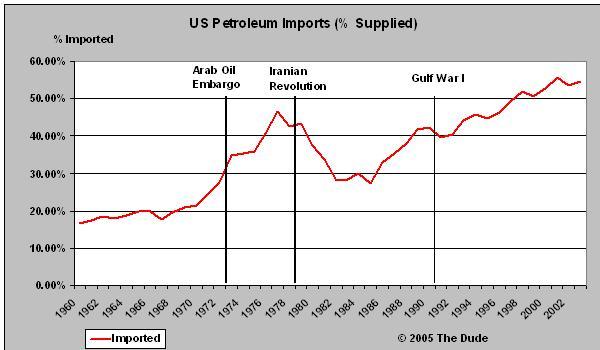
Even though Carter and the Democrats lost the White House in 1980, the spirit of conservation was awakened sufficiently to bring down US dependence on imported oil from over 45% in the mid 70s back down under 30% in the mid 1980s (oil products supplied to the US market declined from a peak of 18.8 mbd in 1978 to 15.2mbd in 1982 and an average of 15.8mbd from 1981-1987, currently 20.5mbd). However, it seems to me that the long run vision of Carter was ignored. In econo-jargon, oil dependency wasn't a cyclical issue but a structural one, the national response was cyclical.

US Oil Imports


source: US DOE, EIA click graph for bigger picture

As I watch Cindy Sheehan's protest re-awaken anti-war sentiments in the national consciousness I hope those sentiments are strong enough to face what, 25 years later, seems much more true, we either drastically reduce our dependence on imported petroleum or risk exporting our wealth away trying to fight for control of the resource. That to me is the elephant in the corner in the War Debate. In reading many of the left leaning opinion sites I often come across a sense of wonder that the left isn't going head to head with the right on the war. I believe this is because nobody is yet willing to go all the way. A coherent anti-war policy must embrace a reduction in oil import dependence.

25 years ago, in the same State of the Union speech, Carter argued:

But now the Soviet Union has taken a radical and an aggressive new step. It's using its great military power against a relatively defenseless nation. The implications of the Soviet invasion of Afghanistan could pose the most serious threat to the peace since the Second World War.

The vast majority of nations on Earth have condemned this latest Soviet attempt to extend its colonial domination of others and have demanded the immediate withdrawal of Soviet troops. The Moslem world is especially and justifiably outraged by this aggression against an Islamic people. No action of a world power has ever been so quickly and so overwhelmingly condemned. But verbal condemnation is not enough. The Soviet Union must pay a concrete price for their aggression.

The region which is now threatened by Soviet troops in Afghanistan is of great strategic importance: It contains more than two-thirds of the world's exportable oil. The Soviet effort to dominate Afghanistan has brought Soviet military forces to within 300 miles of the Indian Ocean and close to the Straits of Hormuz, a waterway through which most of the world's oil must flow. The Soviet Union is now attempting to consolidate a strategic position, therefore, that poses a grave threat to the free movement of Middle East oil.

This situation demands careful thought, steady nerves, and resolute action, not only for this year but for many years to come. It demands collective efforts to meet this new threat to security in the Persian Gulf and in Southwest Asia. It demands the participation of all those who rely on oil from the Middle East and who are concerned with global peace and stability.

25 years later, we are all still fighting the same war, only the names have been changed to confuse the young. Oh, one other thing has changed, 25 years ago this nation was still a creditor to the world, now it is its largest debtor in $ terms. While the nation has, in a sense, been living large, the foundations of wealth for future generations have been eroded. The higher oil prices go, the sooner that euphemistic "future generations" becomes "people living in the here and now." Oh, silly me, the Dude's mind wanders, there is one other small difference between 1980 and now. 25 years ago it was the evil Soviets who were trying to militarily dominate oil resources, now it is the US. The Soviets, of course, were spreading Communism in 1980 while we are currently spreading "democracy" ("capitalism" being such an old, cold war buzz phrase).

In the spirit of "you can't have your cake and eat it too" you can't coherently be anti-war without rejecting the reason for the conflict any more than a drug addict who feeds his addiction by theft can stop stealing without first kicking the habit. I've come to see the wisdom of the late 70s conservationism. Not only will a shift back to such measures significantly reduce the annual trade gap (given current trends the oil import bill for 2005 may well be over US$200B) but the government deficit would be smaller by at least the cost of the War in Iraq. I'll leave it to your good imagination to speculate as to other things which might have been had the US stayed on the path of a committed oil conservationist.

Assuming current trends in oil prices, national debt and casualty figures continue, at some point the wisdom of reducing oil dependency will be too obvious to ignore. I don't know if those signposts are $100 oil and 10,000 dead soldiers, $65 oil and roughly 2000 dead soldiers or $200 oil and 50,000 dead soldiers but I sure hope the answer is closer to choice B than choice C.

Sunday, August 14, 2005

The Plot Thickens or the President who cried Peace

Just when you thought it was safe to go back in the water, military force is now apparently an option on the table in US deliberations over Iranian Nuclear Fission ambitions. Of course, I breathed a sigh of relief when, upon carefully reading the text, I discovered; "The use of force is the last option for any president." Alas, I should have stopped reading there as President Bush finishes the sentence," and you know, we've used force in the recent past to secure our country."

There is an old expression, fool me once, shame on you, fool me twice, shame on me, which I imagine is running through the mind of German Chancellor, Gerhard Schroeder. Or, from a more cynical perspective, he might simply think this is the best tactic to help him retain his party's leadership position.

I too have been thinking about the shame on me thing. After all it was but 30 months ago, on Feb 20, 2003, that this same President, in reference to Iraq's supposed weapons program, told a group in Georgia, "
Military action is this nation's last option." Perhaps someone needs to go over the definition of "last" for these guys, as in final. Wasn't someone suggesting a few weeks back that the Iraqi insurgency was in its "last" throes. Oh well.

Alternatively, and this is where is the real fruits of mendacity are harvested, Iran might well be on their way to nuclear armaments. Getting the US population back on board the war bus will require some heavy lifting. We will see if the credibility account is still in surplus.

Memories of Ron Suskind reporting on the Bush White House in a NYTimes article, Without a Doubt, keep coming to mind these days, particularly this passage: The aide said that guys like me were ''in what we call the reality-based community,'' which he defined as people who ''believe that solutions emerge from your judicious study of discernible reality.'' I nodded and murmured something about enlightenment principles and empiricism. He cut me off. ''That's not the way the world really works anymore,'' he continued. ''We're an empire now, and when we act, we create our own reality. And while you're studying that reality -- judiciously, as you will -- we'll act again, creating other new realities, which you can study too, and that's how things will sort out. We're history's actors . . . and you, all of you, will be left to just study what we do.'' What strikes me is the amazing naiveté of the speaker. While it is true, in a sense, that each new administration is a new lease on life for United States government, past actions still have an effect on current operations. Further, once once "creates a new reality" in this case a radical new reality, the pre-emptive use of military force by the US, the world responds, national goals and aspirations re-align. Then when the empire crowd opts to create further new realities they are doing this is a still changing world. It's the Sorcerer's Apprentice all over again as the ripple effects of previous "realities" interact with the new.

One such ripple effect, Cindy Sheehan's protest, is still ongoing down there in Crawford Texas, while the indictments of leadership party affiliates and executive branch members keep rolling in, with perhaps more to come.

It should be an interesting fall.


Wednesday, August 10, 2005

The elephant in the corner

'Cause when you worry your face will frown
And that will bring everybody down
Don't worry, be happy.


Are the rules of "polite company" worth following? Let's get a little specific, are the rules which determine what you do and don't say in polite company worth following? Protocol, schmo-tocol, how about Cindy Sheehan enacting her own little psychology experiment in Crawford Texas, live on TV doing things you just don't do in polite company.

What kind of psychology experiment you talkin' 'bout, Dude?

Like all psychology experiments, the goal is to observe the human reaction to some phenomenon, in this case, the country's or perhaps even the world's reaction to the sight of a mother whose son was killed in the Iraq War trying to see the War President.. It's like a test of hierarchy, will people be more upset at the idea of some woman pestering the President on Vacation, or the idea of a President who won't come out and meet this bereaved mother of a slain soldier who can't take one more dead kid? Will the President's men panic, and arrest the woman? Will the woman lose her nerve and leave? This is 21st Century art, a real person on the world stage, trying to wake people from their dogmatic slumbers and make them think, fantastic.

Dogmatic slumbers, that old Kantian expression I love so much. Have you ever been driving the car and suddenly realize you don't remember driving the last 10 miles? How you doing Jack? OK, and you Fred? (all without looking up from the paper) What did you do at school today? Nothing. How much of our time every day is spent on, at least partially, auto-pilot? Ken Kesey's Merry Pranksters were playing with this a generation ago, poking some guy in a suit while wearing a crazy day-glo shirt-"square," they'd say. Oddly enough, we were at war a generation ago and trying to dodge our way around a necessary readjustment of the international system of exchange as well. It that old "suspension of disbelief" at work again, en masse.

I was reading a chat session given by the author of what appears to be a new book worth reading, Larry Diamond's Squandered Victory and came across this passage: I'm always reluctant to call this administration a failure, because I think that’s a kind of wishful thinking. It’s far more plausible, and also far less pleasant, to think they may have just lied totally about their goals, and have succeeded in their imperialist ambitions as certainly as they secured a first and second term, and have helped shape our FP (foreign policy) for decades. "Far less pleasant to think," hits the nail on the head. That's the problem, you see, polite company.

I guess it isn't polite to know history, or to read the news with a critical eye. And it isn't. Protocol. I used to do financial TV out in Asia and I was well aware that my critiques needed to be tempered or I wouldn't get back on the set. Everyone knew it, but nobody really talked about it. Shiny happy people with nice little air conditioned jobs ( a big plus in SE Asia) and that included me. Psychology experiment: If, say Larry King on CNN were to stop, turn to the camera and say, this War in Iraq must end, repeat with me, This War... , what do you think would happen? Tipping points in public consciousness are amazing times, eh?

Dogmatic slumbers, dreaming dreams of virtuous governments engaged in noble causes. You can almost see it coming into view, can't you...the elephant in the corner. Larry Diamond does, "What concerns me as much as anything is the listless state of our own democracy. Why have the Congress and the news media not effectively challenged the Administration on this issue? Why has the White House press corps not asked President Bush the obvious and urgent question, “Mr. President, do we seek long-term military bases in Iraq? If so, do you believe this strategic goal is worth the loss of more American lives in Iraq? If not, why don’t you declare that we will not do so, so as to remove one of the most powerful political mobilizing grounds for the insurgency?” Why have the Congress and the media not challenged Secretary Rumsfeld: “Mr. Secretary, are we building permanent military bases in Iraq? What are our intentions there?”

Monday, August 08, 2005

It's not Democracy, it's Commerce

Brad Setser seems to agree with me on China, although we take different paths to get there.

Diligence and frugality should be practised in running factories and shops and all state-owned, co-operative and other enterprises. The principle of diligence and frugality should be observed in everything. This principle of economy is one of the basic principles of socialist economics. China is a big country, but she is still very poor. It will take several decades to make China prosperous. Even then we will still have to observe the principle of diligence and frugality. But it is in the coming few decades, during the present series of five-year plans, that we must particularly advocate diligence and frugality, that we must pay special attention to economy.

Introductory note to "Running a Co-operative Diligently and Frugally" (1955), The Socialist Upsurge in China's Countryside, Chinese ed., Vol. I. - Chairman Mao


A few months ago President Bush spoke of Democracy as one of the great forces working on men. I think he is confused. It wasn't, at least as I see things, love of Democracy that brought forth this new nation, to quote Honest Abe, but love of commerce.

This isn't to argue that the framers were wholly motivated by money, but rather to suggest that commerce was the glue that brought them in and held them together. The general path of western society over the past 5 centuries has coincided, with setbacks from time to time, with the evolution of commerce. Governments that worked well with commercial enterprise thrived and those that bucked the trend for too long, failed. The reason, in my view, is this; trade really does improve the material well being of man. It isn't just a slogan, it's true.

Don't get me wrong here. This is no homage to the great God Commerce. I too believe that man does not live by bread alone and that the cause of true satisfaction is not material comfort. But that don't mean that a man don't want some nice stuff if he can git it, if you know what I mean. That is, however misguided one might view the excesses of the drive, that it is evident in man, the species, is clear.

It is with deep respect for the channeled desire of man to improve his material comfort that I watch China. If you want to see a fire lit in the minds of men, look at commerce in China. As Jung might have warned Chairman Mao, the commercial archetype is buried deep in your people, they have thousands of years of history.

There is an idea economists speak of called the "self sustaining recovery" usually in connection with some government intervention. The sense I have of it is that some spark is added to a flammable substance and once lit, the fire burns on its own accord, a virtuous cycle. China turns away from its hermetic communal existence under Mao, on his death, right when the West decides to switch to the wide open capital account model and one generation later, WHAM-O, huge self-sustaining growth. I can't keep thoughts of the Sorcerer's Apprentice out of my head when I think of it.

It's an entirely new ball game...how this mess gets sorted out is going to be fun to watch.

Sunday, August 07, 2005

oops...A Tale of Two Nations

I guess if you want to wax poetic on China when it is fairly apparent that its leaders are remaking its imagine in the minds of world decision makers you can't take a few days off or a bunch of people will steal all the obvious allusions. For instance here's my Zheng He allusion in the Asia Times. I guess I'll just have to pick a different approach....

Strictly from the perspective of a quantitative economist, China, in 1978, was marginally visible on the world stage. It seems kind of strange to me as I think of it now, but there really was a time when China didn't much enter into consideration, in the world of western finance, that is. Of course, once one shifts perspective outside of that particular myopia, China has always been a vast, populous and dynamic place. Let's take a look at the relative choices of Chinese and American policy makers since the IMF's 1978 liberalization of international exchange rate policies. I choose the date because, in hindsight, the 1978 decision of the Chinese to open its markets to trade and investment dovetails so nicely with the IMF policy shift.

For most of the world the first few years of the new exchange rate regime was tough sledding. As an old FX guy myself, it is hard to imagine that prior to this time FX desks at banks had been more clerical than profit center oriented (then again, from what I hear, things may be coming full circle, but that is another story). The infrastructure, if you will, of floating exchange rates had yet to be built. Indeed, the entire infrastructure of unrestricted finance was in its infancy back then. Volatility was rife for the first 3 years of the new regime as inflation, exchange and interest rates fluctuated wildly trying to find equilibrium levels.

By 1983 the US$ based prices of commodities finally seemed to find that equilibrium level, holding there until 1999 (as per US PPI raw materials index). Besides the most pressing agenda of stabilizing US$ based inflation, broad US policy directives included increasing military investments financed from abroad. China also took advantage of capital account liberalization, although far less aggressively than many other developing nations.

By the mid 80s a sense that certain financial trends had become "unsustainable" led to the first real test of the new system, by which I mean the first attempt to bring the anchor nation back into external account equilibrium. The 1985 Plaza Accord announced US$ devaluation eventually created enough pressure in the capital markets to engender the crash of 1987. It is from this point that the differences between US and Chines economic policy are, in my view, particularly relevant for understanding today's state of play.

In the US, the policy choice was to paper over as much of the pain as possible. Newly appointed Fed Chairman Greenspan led the decision to flood the credit markets with money to avoid the "cascading defaults." An economic downturn, as measured by GDP statistics was avoided for a few years and, in my view, reduced dramatically. That is, US policy makers opted to insulate the economy from market pressures. Civil unrest, while flaring up on occasion, most notably in connection with the Rodney King trial, was by and large avoided in the US.

The Chinese, however, chose a very different path-that of strict economic orthodoxy. From 1987-1989, domestic prices subsidies were removed, import and credit controls were tightened, state investment levels were cut dramatically and the RMB was devalued by roughly 25%. This led to the lowest rate of GDP growth since 1982 and was in part responsible for the Tiananmen Square confrontation between the students and the state. While US politicians made hay moaning about Chinese repression, US corporation heads started to see a great place to do business. By 1993, the inauguration of Bill Clinton set the stage for an amazing economic transformation.

Was it but 12 short years ago that the papers were filled with woe about the "jobless recovery"? It is amazing, for me at least, to recall that while the 90s ended with an economic roar in much of the West, they began with a whimper. Faith in the equity market had been dented but not broken by the crash of '87, but that faith was nothing like what was to be seen later in the decade. As Americans have been seeing now only on a larger scale, the price for keeping the equity market afloat was a series of bubbles in financial markets from Milken's Junk Bonds, via the Savings and Loans to Real Estate. To the credit of the first Bush Administration, policy makers did eventually opt to force some sort of resolution. For their troubles they were voted out of office.

Bill Clinton may have run on a platform which included being tough on China, but off the public radar his administration ran a very open trade and investment policy with the Middle Kingdom. The last devaluation of the RMB occurred early in 1994 and from then on investment poured into China. I remember Phil Knight of Nike, one of the more prominent visionaries of a corporatized China telling the world that 1 Billion Chinese means 2 Billion feet!

Of course, it wasn't just the US that was in need of an economic shot in the arm in the early 90s, Japan's corporations too decided they needed cheap labor. The Asian Crisis we recall was the fruit of those investment flows in the early to mid 90s, as European, US and Japanese corporate forms, and cash, were exported to China and the Asian Tigers.

As the Asia Crisis tore through the region, the earlier evidenced ability of China's leaders to stick with economic orthodoxy and keep their external accounts balanced over the long haul paid handsome dividends. I can remember when market players and policy makers were fearful of yet another RMB devaluation in 97-99. Yet, unlike some other Asian nations, by the time the crisis hit in 1997, China's FX reserves equaled its external debt, most of which was long term, not the short term, hot money that flowed quickly out of Korea, Thailand and Indonesia.

By the time the Asian Crisis began to spill over into the rest of the world, the US solution was already a decade old ingrained habit, flood the market with money, mitigate the effects of the resolution. The result was a brief dip in measured US growth, a significant expansion of the US trade deficit and ignition of the late 90s equity boom. A secondary result of this policy choice was the emergence of China on the world stage as a real economic player- the producer of last resort, if you will.

The attacks of 9/11 and consequent fears of economic decline were met once again with the tried and true method of flooding the market with money and letting the trade deficit widen still further. The sensibilities that informed the implementation of some mechanism to settle international imbalances were left to the growing hordes of western economic bloggers and the Asians.

Over the years between 1978 and today, Chinese and US leaders have chosen very different paths. The Chinese throughout have acted as if external account balances matter, even to the point of a willingness to brutally repress dissent while forcing their resolution, while US leaders have grown increasingly cavalier, as VP Cheney's "deficits don't matter" comment makes abundantly clear. In Washington pundit-speak, changing Social Security used to be known as the "third rail" of political issues, "touch it and you die", an allusion to the third rail on a subway track. In my view the real third rail issue in American politics is economic adjustment to market forces.

This isn't to argue that the eventual resolution of current international imbalances will only hurt the US while leaving China unscathed. Rather, I think the Chinese economy will adjust to the new reality much more quickly than will that of the US. China now has a quarter century old habit of adjustment when necessary while the US has exactly the opposite, ergo the "drug addicted economy" characterization from James Grant et alia.

A century ago, the British Empire was the economic envy of the world. Yet, with the benefit of hindsight that economy was, in fact, dying, living on its past glories and very unwilling to adjust to the changing world. It was the US that was the nimble newcomer, firmly committed to liquidating imbalances when necessary and the swing producer on the world stage. This is the way of things in the world.

Over the past 500 years, the Spanish, French, English and Americans have justifiably laid claim to being the dominant nation on the planet, thus setting the stage for the decline. The signs of the inevitable decay; deficit finance, military expansion and a cultural superiority complex which makes adjustment difficult were all evident in the first three on our list, and in my view, in America as well. Continued competition for oil resources will force economic adjustments. Those economies which react to those force nimbly will outperform those that do not. There is a Buddhist saying that goes, thought becomes word, word becomes deed, deed becomes habit and habit becomes character. The relative economic characters of the US and China have been a long time in the making. We will see which type thrives in the new environment.

Wednesday, August 03, 2005

The Return of China

I've had a fascination with Asia for decades now-a fascination that eventually led me to move, work and marry in the Orient, although I have since relocated back to the US. Of the many cultures I encountered in Asia, the one that most captivated my attention was that of China. Of course, in order to learn, I first had to unlearn my assumptions. China was not a backward country full of starving communist peasants, rather the culture is one of the oldest still surviving on the earth, binding many people together in country or scattered throughout the world, and the people within the culture are as diverse as those you find in the west.

I won't spend too much time on the history, both due to its length and my lack of expertise, except to make a few points. China has gone through many phases of organization, vacillating between periods of no central authority to strong centrally run governments. Within those phases China has at times been engaged with the outside world and at times closed to it. The current opening of China to trade, if one ignores the forced opening by the West during the latter stages of the Manchu Dynasty, is the first since the early stages of the Ming Dynasty (early 15th century). At that point in time, as the story of Zheng He attests, China was the dominant maritime, if not other respects, power on the earth-a fact which is part of the secondary school curriculum in China. That is, there is both a precedent for a dominant China on the world stage and an awareness of the fact among the population, in stark contrast to the lack of awareness of that history during the Manchu or early communist government.

a power outage interrupted today's work, I should have the rest of this post up tomorrow

Tuesday, August 02, 2005

Under pressure, US$ peg to Yuan terminated

Chinese Economics Book from the year 4798 (2101 AD) (trans. by Aburns)

Chapter 18: US internal disintegration picks up pace

In the sixth month of the year of the Rooster (4702) a collision of long extant forces came to the fore. As noted in previous chapters, the appetites of US industry had in previous decades outgrown the productive ability of its citizens to finance. Despite a clear warning from their 34th President, Eisenhower, the military industrial complex was rarely second in line for access to the nation's savings, leading to the steady erosion of goods production employment and welfare spending despite tremendous assistance from the rest of the world.

The attack on the World Trade Center in New York City accelerated the process. Although Chinese leaders clearly saw the coming demise, they recalled the saying, butcher the donkey after it has finished its job on the mill and being desirous of international harmony, and thus continued their financial support.

By the year of the Rooster, this support was taking its toll on the still emerging Chinese economy. US leaders, perhaps confused by the Japanese experience, assumed that a free floating Yuan would soon hobble China as the strong Yen had hobbled Japan. However, at the time of the Yen revaluation, Japanese corporate productive capacity far exceeded domestic consumption capacity. That is, they too had outgrown their base. China, meanwhile was just beginning to grow and had as its citizen base, the single largest block of potential consumers and savers in the world.

In the sixth month of the year of the Rooster, China tested the waters with an attempted purchase of the oil company Unocal. Despite the dire need for finance due to the failed war in Mesopotamia, US leaders rejected the bid. Finally, having demonstrated to the world that the US would not accept exported $ back in trade for true corporate ownership, and seeing that further assistance was futile the Chinese, on the 16th day of the sixth month set in motion the slow but steady removal of financial support for the US. Within days pressures with the USA credit system began to build as US interest rates and $ denominated commodity prices began to rise.

In the next chapter we will examine the aftermath of this momentous month.

>>>>>>>>>>>>>>>>>>>>>>>>>>>

History, they say, is written by the winners and who knows, the blurb above could be one version. According to this statement from CNOOC, some officials in China are concluding that the US is no longer playing by established rules: The unprecedented political opposition that followed the announcement of our proposed transaction, attempting to replace or amend the CFIUS process that has been successfully in operation for almost two decades, was regrettable and unjustified. This is especially the case in light of CNOOC's purely commercial objectives and the extensive commitments that CNOOC was prepared to make to address any legitimate concerns U.S. officials may have had regarding our acquisition. This political environment has made it very difficult for us to accurately assess our chance of success, creating a level of uncertainty that presents an unacceptable risk to our ability to secure this transaction. Accordingly we are reluctantly abandoning our higher offer to the clear disadvantage of Unocal shareholders and employees.

tomorrow: a look at China
Question: What was the RMB/US$ exchange rate in 1981?

1.75 RMB per $ (avg)

What was the RMB/US$ exchange rate in 1991?

5.3 RMB per $ (avg)