
A recent article from Livescience.com detailed the results of an international survey.
The researchers combined data from public surveys on evolution collected from 32 European countries, the United States and Japan between 1985 and 2005. Adults in each country were asked whether they thought the statement “Human beings, as we know them, developed from earlier species of animals,” was true, false, or if they were unsure.
The study found that over the past 20 years:
* The percentage of U.S. adults who accept evolution declined from 45 to 40 percent.
* The percentage overtly rejecting evolution declined from 48 to 39 percent, however.
* And the percentage of adults who were unsure increased, from 7 to 21 percent.
The aim of the article, in my reading, was to expose the silliness, in the opinion of the author, and on that small point I don't disagree, of Protestant Fundamentalism.
Yet, the question of evolution doesn't seem to me to be so simple. That question being, how did humans develop? Was the essential development biological alone or was it spiritual, i.e. cognitive, having to do with man's sense of the world.
Some of the more radical fundamentalist beliefs do make simple straw men to knock over. Some of my scientists friends will laugh and say, the world is older than the 7000 years these evolution deniers claim. Man has lived on this planet far longer than that, so evolution is proven.
What if, I ask, the essential quality that makes humans human isn't the ability to walk upright, or use tools but the ability to think about the self and the external world. That is, what if the essential quality of man is the ability to abstract, and change's one's behavior accordingly. Apes are not what we would call civilized, and (sometimes at least) humans are.
It seems to me that our ability to think, and communicate those thoughts is the reason behind this. Men are not biologically ants or bees who seem designed to form large communities, yet we do and our biological ancestors, the early hominids, like the Australopithicines apparently did not.
In a speech to the UN in 1985, J. Krisnamurti, spoke on the issue of evolution:
Mankind, man, has lived on this earth over fifty thousand years, and perhaps much longer, or for less duration. During all this long evolution man has not found peace on earth - 'pacem in terris' has been preached long before Christianity, by the ancient Hindus and the Buddhists. And during all this time man has lived in conflict, not only conflict with his neighbour but with people of his own community, with his own society, with his own family, he has fought, struggled against man for the last five thousand years, and perhaps more. Historically there have been wars practically every year. And we are still at war. I believe there are forty wars going on at the present time. And the religious hierarchy, not only the Catholics but the other groups have talked about 'pacem in terris', peace on earth, goodwill among men. It has never come about - to have peace on earth. And they have talked about peace when you die and go to heaven and you have peace there.
And in a Q&A following the speech
24 QUESTION: At the end you said that we need to break the pattern of conflict between man. My question to you is, do you see that as something of an evolutionary process that inevitably will happen? Or do you see it as something that we all have to work very hard to achieve? And there is an expression that goes something like this: in times of darkness the eye begins to see. And why I am throwing this at you because in a sense it is either going to happen, or it is not going to happen, but how do you see it happening?
25 K: I don't quite understand your question, sir.
26 Q: All right. You talk about breaking the pattern, man has a pattern, the brain has a pattern, and that pattern has to be broken in order for there to be peace in the world.
27 K: Of course.
28 Q: Now do you see the breaking of that pattern being an active movement, or a natural progression in the evolution of man?
29 K: Sir, have we evolved at all?
30 Q: I think we are continuously evolving.
31 K: So you accept evolution - psychological evolution, we are not talking about biological or technical evolution - psychological evolution. After a million years, of fifty thousand years, have we changed deeply? Aren't we very primitive, barbarous? So I am asking if you will consider whether there is psychological evolution at all? I question it. Personally, to the speaker, there is no psychological evolution: there is only the ending of sorrow, of pain, anxiety, loneliness, despair and all that. Man has lived with it for a million years. And if we rely on time, which is thought - time and thought go together - if we rely on evolution then another thousand years or more, and we will still be barbarous.
32 Q: My question is: what would have to happen for there to begin to be psychological evolution as the speaker understands it?
33 K: What about psychological evolution? I don't quite understand the question.
34 Q: You have said that you do not think there has been psychological evolution. My question is: what can happen so that there will be, so that there can be, psychological evolution.
35 K: Madam, I am afraid we haven't understood each other. We have lived on this earth from the historical, as well as ancient enquiry, on this earth for fifty thousand years or more or less. And during that long period of evolution psychologically, inwardly, subjectively, we have remained more or less barbarous - hating each other, killing each other. And time is not going to solve that problem, which is evolution. And is it possible, we are asking, for each human being, who is the rest of the world, whether that psychological movement can stop and see something afresh?
To me, blind faith in the "evolution" evidenced by the questioner to solve man's ills as silly, and perhaps more dangerous than the Protestant Fundamentalist view.
Humans can think, although as William James puts it so well, many think they are thinking when really they are just rearranging their prejudices. We can think and choose, but sometimes, (Krisnamurti would likely have said, often) we choose barbarism.
I don't know which is sillier, praying to the God of evolution, which is to wait for time to solve man's ills or praying to "an eye for an eye" Jehovah. Civilization is, in my view, a choice, a change of mind, from barbarism. To paraphrase Ben Franklin, it's a civilization, if you can keep it.
I'm still working on the King Canute piece, most likely it will be ready tomorrow.
Monday, August 14, 2006


Friday, August 11, 2006
Does "divide and conquer" always work? et. al.
While working on a longer piece, tentatively titled, King Canute on the spiritual shore, I thought to keep the daily blog entry thing going with a few brief notions to ponder.
Firstly, I assume some (most, all) of you are familiar with the strategy of divide and conquer. The theory goes that you divide your enemy and he fights himself more than he fights you.
This theory leads some to draw comfort from the ongoing split between Sunnis and Shi'ites. So long as they fight each other, the theory goes, they won't be strong enough to fight the West.
Yet, the history of Western Civilization gives us a counter to that theory. The expansion of Western Civ, both vs. the Islamic Ottoman Empire and around the world occurred while the Protestant Reformation and Counter Reformation was occurring. Perhaps religious debate taken seriously is a sign of intellectual vigor in a culture, not a sign of weakness.
Secondly, in response to the Terror Plot, I wonder what the world would be like, if, instead of invading Iraq, the US and UK had directed those funds ($100s of Billions at this point) towards rebuilding Afghanistan as was done with Germany and Japan after WWII. Would Nasrallah's and bin Laden's words fit as easily in people's minds?
I wonder, in that case, if these supposedly Pakistani and other South Asian youths would have been plotting?
It seems to me that a few hundred billion spent building hospitals, roads and schools would sway far more hearts and minds in the West's favor than blowing up the same. If genecide isn't an option, (and I hope it isn't) then eventually we will have to get along.
The "beat them until they submit" policy doesn't seem to be generating much in the way of positive results.
I just hope we haven't waited too long to show another face. The father who beats his son for 5 years may find that a compensating car and credit card at 16 still leaves him with a hateful child.
On a lighter note, or at least a look at tragedy through a comic lens check out this You-Tube of a recent Daily Show: one joke: every day the cafes and shops of the Middle East literally explode with excitement at the idea of a new Middle East.
Firstly, I assume some (most, all) of you are familiar with the strategy of divide and conquer. The theory goes that you divide your enemy and he fights himself more than he fights you.
This theory leads some to draw comfort from the ongoing split between Sunnis and Shi'ites. So long as they fight each other, the theory goes, they won't be strong enough to fight the West.
Yet, the history of Western Civilization gives us a counter to that theory. The expansion of Western Civ, both vs. the Islamic Ottoman Empire and around the world occurred while the Protestant Reformation and Counter Reformation was occurring. Perhaps religious debate taken seriously is a sign of intellectual vigor in a culture, not a sign of weakness.
Secondly, in response to the Terror Plot, I wonder what the world would be like, if, instead of invading Iraq, the US and UK had directed those funds ($100s of Billions at this point) towards rebuilding Afghanistan as was done with Germany and Japan after WWII. Would Nasrallah's and bin Laden's words fit as easily in people's minds?
I wonder, in that case, if these supposedly Pakistani and other South Asian youths would have been plotting?
It seems to me that a few hundred billion spent building hospitals, roads and schools would sway far more hearts and minds in the West's favor than blowing up the same. If genecide isn't an option, (and I hope it isn't) then eventually we will have to get along.
The "beat them until they submit" policy doesn't seem to be generating much in the way of positive results.
I just hope we haven't waited too long to show another face. The father who beats his son for 5 years may find that a compensating car and credit card at 16 still leaves him with a hateful child.
On a lighter note, or at least a look at tragedy through a comic lens check out this You-Tube of a recent Daily Show: one joke: every day the cafes and shops of the Middle East literally explode with excitement at the idea of a new Middle East.
Thursday, August 10, 2006
The Greater Pie Theory of Economics
From William Greider's Conversation with Robert Rubin
Rubin: Bob [Reich] and I used to have a discussion--if you could trade off some part of growth to have some better distribution, would you do that? I always said I wouldn't, because I figured you want to get maximum growth and then try to figure out how to get the distribution. Bob used to feel--and look, it was a reasonable position, it wasn't where I was--that if you have somewhat less growth and better distribution, that was a better place to be.
Greider: Did you change your mind about that?
Rubin: No, because I still think that once you get the better growth, you can figure out the other part, the distribution. I still think I'd get the most pie I could and then figure how to get the distribution that results in everybody getting it--broad participation in it instead of the very limited participation we've had.
I seem to remember back when I started studying economics most definitions of the study included some reference to managing limited resources. Today when I search for definitions I don't find that reference as often as I recall but perhaps I'm just getting old and my memory is fading.
One definition I found had me laughing, the science that deals with the production, distribution, and consumption of wealth. I guess the poor don't practice economics.
Yesterday when I suggested that I couldn't tell if, in the event of a radical changing of the guard, things would improve, it was, in part, with Rubin's "greater pie theory" in mind.
If Mr. Rubin is one of the Democrats' shining stars and his economic philosophy is as stated, I can't see how things will get better, particularly if things like oil and water become, relative to growing populations, scarcer and scarcer.
I wonder if widespread belief in the "greater pie theory" is what aligns the elite of the right and the left in the US...and what is, in my view, driving us over the cliff.
Perhaps I am naive but if you can't be happy with what you have, and your major products are financial innovations and armaments, eventually you will have to take somebody else's stuff. If too many people play that game, well, you get what we see now. If even more people play then the planet will become very small indeed.
I much prefer the old definition of economics.
Not knowing the power of flame, the insect falls into it.
The fish swallows the bait, not knowing the hook inside.
That, well aware of the vanity and dangers of the world,
We cannot give it up —
Such is the power of Delusion.
Bhartrihari
Rubin: Bob [Reich] and I used to have a discussion--if you could trade off some part of growth to have some better distribution, would you do that? I always said I wouldn't, because I figured you want to get maximum growth and then try to figure out how to get the distribution. Bob used to feel--and look, it was a reasonable position, it wasn't where I was--that if you have somewhat less growth and better distribution, that was a better place to be.
Greider: Did you change your mind about that?
Rubin: No, because I still think that once you get the better growth, you can figure out the other part, the distribution. I still think I'd get the most pie I could and then figure how to get the distribution that results in everybody getting it--broad participation in it instead of the very limited participation we've had.
I seem to remember back when I started studying economics most definitions of the study included some reference to managing limited resources. Today when I search for definitions I don't find that reference as often as I recall but perhaps I'm just getting old and my memory is fading.
One definition I found had me laughing, the science that deals with the production, distribution, and consumption of wealth. I guess the poor don't practice economics.
Yesterday when I suggested that I couldn't tell if, in the event of a radical changing of the guard, things would improve, it was, in part, with Rubin's "greater pie theory" in mind.
If Mr. Rubin is one of the Democrats' shining stars and his economic philosophy is as stated, I can't see how things will get better, particularly if things like oil and water become, relative to growing populations, scarcer and scarcer.
I wonder if widespread belief in the "greater pie theory" is what aligns the elite of the right and the left in the US...and what is, in my view, driving us over the cliff.
Perhaps I am naive but if you can't be happy with what you have, and your major products are financial innovations and armaments, eventually you will have to take somebody else's stuff. If too many people play that game, well, you get what we see now. If even more people play then the planet will become very small indeed.
I much prefer the old definition of economics.
Not knowing the power of flame, the insect falls into it.
The fish swallows the bait, not knowing the hook inside.
That, well aware of the vanity and dangers of the world,
We cannot give it up —
Such is the power of Delusion.
Bhartrihari
Wednesday, August 09, 2006
The revolt of the Guelphs
Nothing appears more surprising to those who consider human affairs with a philosophical eye, than the ease with which the many are governed by the few. David Hume
Having spent much of the decade of the 90s traveling around the world, living in alien cultures, I have shared Hume's bemusement at the ease by which the many are governed by the few. Lately, as I watch that control weaken, I'm coming to see just how such a thing comes to pass, as I imagine Hume would have had he not died before the American and French Revolutions. It is, I believe, through the actions of those in what Daniel Dafoe calls "the middle station of life" that such control is maintained or lost. I bring this to your attention as it seems to me that those in this middle station, Dante lovers like myself might prefer "Guelphs", appear to be in revolt against the Empire or, to retain the Dante metaphor, the "Ghibellines."
When I refer to the Guelphs or those in the middle station I'm not referring to the entire middle class, but rather to the working aristocracy, if you will. That is, I refer to those who own, not at a distance, but hands on; the restaurant owner who cooks or tends bar, the grocer who will move boxes if other labor is not available, and the contractor who will pick up a nail gun are some examples. I'm referring to people who can survive in both worlds of ownership and labor, the bridge, if you will between the two classes.
Before I proceed, let me note that people slide in and out of such classes over the course of their lives as their changing sensibilities align with this or that group. Let me also note that these shifts are not always altruistic. Often the Guelphs simply take advantage of their increased awareness of popular discontent to grab some of the pure, isolated aristocracy's power. Yet, by virtue of their need to harness popular discontent, Guelph revolts more often than not leave the common man better off, if for no other reason than to forestall a new batch of Guelphs usurping their newfound power by the same mechanism.
In the United States, the last significant, successful Guelph revolt, in my opinion, occurred in the 30s. With the then aristocracy deaf to Herbert Hoover's calls to share the wealth, Volunteerism was the motto of his plea, a large segment of Guelphs saw an opportunity to upend the Gilded Age aristocracy.
This revolt was fairly vigorous as many of the Guelphs got stung by the collapse of the equity market, one of the modern means by which the Ghibellines align their interests with the Guelphs. The decades of the 80s and 90s which saw real incomes for the common man languish while the equity market soared, are an example of the effectiveness of this strategy. Conversely, the lack of wealth sharing (i.e. greater concentration of wealth into fewer and fewer hands) over the past 5 years sets the stage for what I believe will be the next Guelph revolt.
"Enough preamble, Dude, you are probably thinking, "cut to the chase."
Sorry, I just got my hands on Dorothy Sayers translation of Dante's Inferno. I still prefer Longfellow's poetry but her analysis and explanatory notes left me with Guelphs and Ghibellines on the brain. Oops, another digression, OK...to quote the Commander in Chief, Let's Roll.
Specifically, I note a few recent developments that suggest to me a coming Guelph revolt:
1) the continuing and strengthening revolt in Mexico against the PAN led by Lopez Obrador
2) the Lieberman upset by Ned Lamont in yesterday's Democratic primary for US Senator
3) rising fears of the effects of a sustained anti-inflation campaign, which led the Fed to call and
end to its tightening campaign
4) rising popular dissent against the Iraq war in the US
5) rising international disgust with the heavy handed tactics of the Empire against civilian populations
6) reassessment of the limits of military power alone in dealing with civilian populations.
More generally, the pure aristocracy seems increasingly isolated from the common man, and seems, to me at least, to be caught in a prison of their own rhetoric, duped by the modern day Rasputins, the Neo-Cons. Propaganda is an effective means of controlling the masses, but a poor basis for effective policy. Eventually even the most disciplined minds who are forced to use propaganda fall prey to its effects. It's never good to believe your own bullsh*t.
Staying on the pragmatic track, how might this Guelph revolt manifest? Here's a few guesses from my very cloudy crystal ball:
1) The Lamont victory will embolden some to run on what the Ghibelline press now calls a "radical anti war platform" despite polls which show that the radicals are the war supporters.
2) The Democratic party which may take Congress, barring some Diebold election hijinks by Republicans which could ignite a Mexican type fury, will be more Gore-ish than Clinton-ish.
3) The Fed and eventually other Central Banks will tone down the war on inflation blaming the next round of price increases on "external events"
4) Gold and precious metals will increasingly be seen as safer than the fiat markets which are being looted to finance these apparently unwinnable and unpopular wars
5) Mexico will find its interests align more with Venezuela, Brazil and Argentina, than the US
6)The dream of reshaping the Middle East will be shelved for a generation, if not, expect a Shi'a revolution that mirrors the Chavez revolt
7)Russia and China will continue to grow in power
8) a new left-leaning mainstream press will emerge from the blogosphere
Whether these expected changes, if they do arrive, prove positive or negative I don't know.
Hopes for positive change will be high in the event of a Democratic takeover of one or both Houses of Congress, a forced resignation by Tony Blair in the UK or a cessation of hostilities in Iraq and Lebanon. Whether those hopes get fulfilled in the form of a rising gneral prosperity depends on the character and ability of those who find themselves with power. Efficient resource allocation tends to break down during revolts against the power structure.
I don't know Ned Lamont, Lopez Obrador or Gordon Brown, to name a few people who might find themselves in the driver's seat. My study of history leads me to believe you can see when change is in the air (here's someone much more respected than I who senses a slight foreboding). Whether that change results in a more or less robust civilization is beyond my ability to see. Sometimes conditions stay unsettled for decades.
I'll hope for the best.....and continue cutting wood for the winter...if you get my drift.
thanks for reading (if you got this far)
Having spent much of the decade of the 90s traveling around the world, living in alien cultures, I have shared Hume's bemusement at the ease by which the many are governed by the few. Lately, as I watch that control weaken, I'm coming to see just how such a thing comes to pass, as I imagine Hume would have had he not died before the American and French Revolutions. It is, I believe, through the actions of those in what Daniel Dafoe calls "the middle station of life" that such control is maintained or lost. I bring this to your attention as it seems to me that those in this middle station, Dante lovers like myself might prefer "Guelphs", appear to be in revolt against the Empire or, to retain the Dante metaphor, the "Ghibellines."
When I refer to the Guelphs or those in the middle station I'm not referring to the entire middle class, but rather to the working aristocracy, if you will. That is, I refer to those who own, not at a distance, but hands on; the restaurant owner who cooks or tends bar, the grocer who will move boxes if other labor is not available, and the contractor who will pick up a nail gun are some examples. I'm referring to people who can survive in both worlds of ownership and labor, the bridge, if you will between the two classes.
Before I proceed, let me note that people slide in and out of such classes over the course of their lives as their changing sensibilities align with this or that group. Let me also note that these shifts are not always altruistic. Often the Guelphs simply take advantage of their increased awareness of popular discontent to grab some of the pure, isolated aristocracy's power. Yet, by virtue of their need to harness popular discontent, Guelph revolts more often than not leave the common man better off, if for no other reason than to forestall a new batch of Guelphs usurping their newfound power by the same mechanism.
In the United States, the last significant, successful Guelph revolt, in my opinion, occurred in the 30s. With the then aristocracy deaf to Herbert Hoover's calls to share the wealth, Volunteerism was the motto of his plea, a large segment of Guelphs saw an opportunity to upend the Gilded Age aristocracy.
This revolt was fairly vigorous as many of the Guelphs got stung by the collapse of the equity market, one of the modern means by which the Ghibellines align their interests with the Guelphs. The decades of the 80s and 90s which saw real incomes for the common man languish while the equity market soared, are an example of the effectiveness of this strategy. Conversely, the lack of wealth sharing (i.e. greater concentration of wealth into fewer and fewer hands) over the past 5 years sets the stage for what I believe will be the next Guelph revolt.
"Enough preamble, Dude, you are probably thinking, "cut to the chase."
Sorry, I just got my hands on Dorothy Sayers translation of Dante's Inferno. I still prefer Longfellow's poetry but her analysis and explanatory notes left me with Guelphs and Ghibellines on the brain. Oops, another digression, OK...to quote the Commander in Chief, Let's Roll.
Specifically, I note a few recent developments that suggest to me a coming Guelph revolt:
1) the continuing and strengthening revolt in Mexico against the PAN led by Lopez Obrador
2) the Lieberman upset by Ned Lamont in yesterday's Democratic primary for US Senator
3) rising fears of the effects of a sustained anti-inflation campaign, which led the Fed to call and
end to its tightening campaign
4) rising popular dissent against the Iraq war in the US
5) rising international disgust with the heavy handed tactics of the Empire against civilian populations
6) reassessment of the limits of military power alone in dealing with civilian populations.
More generally, the pure aristocracy seems increasingly isolated from the common man, and seems, to me at least, to be caught in a prison of their own rhetoric, duped by the modern day Rasputins, the Neo-Cons. Propaganda is an effective means of controlling the masses, but a poor basis for effective policy. Eventually even the most disciplined minds who are forced to use propaganda fall prey to its effects. It's never good to believe your own bullsh*t.
Staying on the pragmatic track, how might this Guelph revolt manifest? Here's a few guesses from my very cloudy crystal ball:
1) The Lamont victory will embolden some to run on what the Ghibelline press now calls a "radical anti war platform" despite polls which show that the radicals are the war supporters.
2) The Democratic party which may take Congress, barring some Diebold election hijinks by Republicans which could ignite a Mexican type fury, will be more Gore-ish than Clinton-ish.
3) The Fed and eventually other Central Banks will tone down the war on inflation blaming the next round of price increases on "external events"
4) Gold and precious metals will increasingly be seen as safer than the fiat markets which are being looted to finance these apparently unwinnable and unpopular wars
5) Mexico will find its interests align more with Venezuela, Brazil and Argentina, than the US
6)The dream of reshaping the Middle East will be shelved for a generation, if not, expect a Shi'a revolution that mirrors the Chavez revolt
7)Russia and China will continue to grow in power
8) a new left-leaning mainstream press will emerge from the blogosphere
Whether these expected changes, if they do arrive, prove positive or negative I don't know.
Hopes for positive change will be high in the event of a Democratic takeover of one or both Houses of Congress, a forced resignation by Tony Blair in the UK or a cessation of hostilities in Iraq and Lebanon. Whether those hopes get fulfilled in the form of a rising gneral prosperity depends on the character and ability of those who find themselves with power. Efficient resource allocation tends to break down during revolts against the power structure.
I don't know Ned Lamont, Lopez Obrador or Gordon Brown, to name a few people who might find themselves in the driver's seat. My study of history leads me to believe you can see when change is in the air (here's someone much more respected than I who senses a slight foreboding). Whether that change results in a more or less robust civilization is beyond my ability to see. Sometimes conditions stay unsettled for decades.
I'll hope for the best.....and continue cutting wood for the winter...if you get my drift.
thanks for reading (if you got this far)
Tuesday, August 08, 2006
Western Civilization: Over a Barrel
I just can't get the climatic scene from Frank Herbert's Dune out of my head these days. (Plot spoiler ahead for those of you who have not read it, which at this point I would highly recommend).
******************
The novel is stuffed with details of political intrigue as many different clans vie for control of the key universal commodity, the spice. There are false flag operations, military oppression for mass psychological conditioning and, to quote Mr. Herbert, himself, "games within games." I loved it as a young teen when I thought it was fantasy, now it is a bit scary.
Anyway, the climax comes when the emperor brings his army to Arrakis, the only planet from which this key commodity can be "mined", to confront the clan which currently has been given the concession to mine there. The emperor is going to complain that the supply of spice is too low because the indigenous population is not being managed correctly. Meanwhile the clan with the concession has a plan to move up in the imperial hierarchy. Neither party has given much thought to the true power of the indigenous people, until...
The mythic leader of the indigenous people releases his battle hardened, by virtue of living under oppression on a desert planet, hordes, which to the surprise of the other leaders, defeat both the Imperial and concession holding clan's armies on the ground. They assumed that the indigenous population was a bunch of rabble, easily defeated.
Then, to add insult to injury, this "messiah", whose armies, while the largest force on the planet, are dwarfed by the Imperial armies, threatens to destroy the spice, to prove a point: He who can destroy a thing, controls a thing, the thing being civilization as they know it. As the universe needs this commodity to survive, and it is clear that the indigenous people can destroy the commodity, political control passes to their hands.
*************
Good thing it's fiction, right?
With the Alaska fields shutting down for potentially months, (talk about bad timing) it seems to me that now is not the best time to be poking the hornet's nest of the Middle East with a stick. I imagine this perspective is not lost on other Middle Eastern oil producers, nor the Russians, Chinese, Venezuelans, etc. The Alaska shut down has changed the assumptions of the game in a big way. Let's pray the Gulf stays hurricane free.
With winter approaching, and refinery capacity tight, time (total US petroleum stocks are about 130 days of imports) is not on the side of those who need oil, and intend to recast the politics of the Middle East by military means.
Meanwhile the irony of the focus on the Fed decision today will be lost on many financial market participants. Hey, the Fed paused...whee! buy stocks...oops Saudis, Russians, Iranians, Venezuelans (take your pick we've pissed them all off) say no oil unless Israel leaves Lebanon. Sell, Mortimer, SELL....(Trading Places allusion for those who didn't misspend their youth watching movies).
Imperial politics, what a hoot.
If I don't laugh about it I'm going to be really depressed.
Now I'm off to cut some firewood.
******************
The novel is stuffed with details of political intrigue as many different clans vie for control of the key universal commodity, the spice. There are false flag operations, military oppression for mass psychological conditioning and, to quote Mr. Herbert, himself, "games within games." I loved it as a young teen when I thought it was fantasy, now it is a bit scary.
Anyway, the climax comes when the emperor brings his army to Arrakis, the only planet from which this key commodity can be "mined", to confront the clan which currently has been given the concession to mine there. The emperor is going to complain that the supply of spice is too low because the indigenous population is not being managed correctly. Meanwhile the clan with the concession has a plan to move up in the imperial hierarchy. Neither party has given much thought to the true power of the indigenous people, until...
The mythic leader of the indigenous people releases his battle hardened, by virtue of living under oppression on a desert planet, hordes, which to the surprise of the other leaders, defeat both the Imperial and concession holding clan's armies on the ground. They assumed that the indigenous population was a bunch of rabble, easily defeated.
Then, to add insult to injury, this "messiah", whose armies, while the largest force on the planet, are dwarfed by the Imperial armies, threatens to destroy the spice, to prove a point: He who can destroy a thing, controls a thing, the thing being civilization as they know it. As the universe needs this commodity to survive, and it is clear that the indigenous people can destroy the commodity, political control passes to their hands.
*************
Good thing it's fiction, right?
With the Alaska fields shutting down for potentially months, (talk about bad timing) it seems to me that now is not the best time to be poking the hornet's nest of the Middle East with a stick. I imagine this perspective is not lost on other Middle Eastern oil producers, nor the Russians, Chinese, Venezuelans, etc. The Alaska shut down has changed the assumptions of the game in a big way. Let's pray the Gulf stays hurricane free.
With winter approaching, and refinery capacity tight, time (total US petroleum stocks are about 130 days of imports) is not on the side of those who need oil, and intend to recast the politics of the Middle East by military means.
Meanwhile the irony of the focus on the Fed decision today will be lost on many financial market participants. Hey, the Fed paused...whee! buy stocks...oops Saudis, Russians, Iranians, Venezuelans (take your pick we've pissed them all off) say no oil unless Israel leaves Lebanon. Sell, Mortimer, SELL....(Trading Places allusion for those who didn't misspend their youth watching movies).
Imperial politics, what a hoot.
If I don't laugh about it I'm going to be really depressed.
Now I'm off to cut some firewood.
Wednesday, July 26, 2006
The Bretton Woods trip
It wasn't until I was googling for golf courses around North Conway, NH that it hit me- I was going to visit Bretton Woods. Yes. That Bretton Woods.
 oops, my invite arrived 62 years too late
When I finally arrived at the place I was suitably impressed by the scenery. While much of the world was engulfed in war 62 years ago, hundreds of delegates from around the world met at this wonderful place to devise a new monetary system, with one aim of avoiding some of the causes of the then current war. Jung might have argued that the scenery evoked notions of Olympians looking down on the rest of the world planning the path ahead and in the bright sun light of my first visit, I wouldn't disagree.

Although much of the world's finances still flow through its remains, the essential elements of the system put in place by these delegates has long since been abandoned. Just as the financiers of the world removed the domestic check and balance of the classical gold standard, which gave the citizenry the right to withdraw real money (specie) from any bank to which they had lent, so too have they removed the international check and balance of the gold exchange standard, which gave sovereign nations the right to withdraw real money (specie) from any national banking system to which they had lent.
With the notion of the removal of the check and balance of specie redemption in mind, consider the recent exchange between William Greider, of Secrets of the Temple fame and Robert, strong $, Rubin.
In response to a question from Greider about rising external imbalances Rubin argues:
Rubin: But I don't think people thought--I'll speak for myself--I surely never thought, if you have the kinds of imbalances you have today, you'd have the kinds of exchange rates we have today, that exchange rates would have substantial adjustments. To put it differently, I never thought in the face of very substantial trade imbalances, you would have inflexible exchange rates. I don't think that was part of anybody's anticipation.
Greider: Does that suggest something else should have happened in the design running up to the current situation?
Rubin: I don't think that's a design issue. I don't think that's actually a trade issue. I think it's a foreign exchange issue.... If you had had fully flexible exchange rates. Though I'm not advocating, by the way, that China go to that immediately because I think it might create a lot of chaos.... But I don't think it's anything in the design in the system. Maybe I'm missing something, but I don't think there's anything in the design of the system we would have done differently....
"So," your author mused to himself while admiring the view at Bretton Woods, "even though the lack of FX adjustment in the face of rising imbalances is a surprise to Rubin, he doesn't think this suggests a design flaw."
Yet, 62 years ago, when the then economic solons of the world designed the system whose remains we currently use, they foresaw the need to have a check and balance to forestall the growth of just such imbalances, in the form of gold redemption. Having removed that check and balance, by changing the system's design, the imbalances, surprisingly to some, grow unchecked and it isn't a design flaw?
On my Bretton Woods trip I began to wonder if the view of humanity that informed the crafters of the system 62 years ago or more to my liking, the view of humanity that informed the founders of this country more than 2 centuries ago, was just that, a trip, a delusion.
Expanding my scope I begin to wonder if it was all just a trip.
Is the US Constitution just a piece of paper? Can unchecked finance produce better results than a regulated (and the rule of specie is one such regulation) system? Should humanity try to adhere to the Geneva Conventions? Is coercion a better method than persuasion coupled with patience while "the penny drops" as the Brits put it? Are systems of morality just the means by which the elite milk their charges?
Or is there something to it? Are there better and worse ways to maintain and further civilization? Civilization, after all, is the goal we seek, not wealth or power which does not exist outside of that context.
I, for one, don't believe it was all just a trip. I believe in the virtue of checks and balances. Power unchecked runs amok, as we see today in many aspects of human relations.
The United States has, correctly in my view, been called an experiment in self-government. Hopefully the experiment can continue before the civilization train leaves the station.

 oops, my invite arrived 62 years too late
When I finally arrived at the place I was suitably impressed by the scenery. While much of the world was engulfed in war 62 years ago, hundreds of delegates from around the world met at this wonderful place to devise a new monetary system, with one aim of avoiding some of the causes of the then current war. Jung might have argued that the scenery evoked notions of Olympians looking down on the rest of the world planning the path ahead and in the bright sun light of my first visit, I wouldn't disagree.

Although much of the world's finances still flow through its remains, the essential elements of the system put in place by these delegates has long since been abandoned. Just as the financiers of the world removed the domestic check and balance of the classical gold standard, which gave the citizenry the right to withdraw real money (specie) from any bank to which they had lent, so too have they removed the international check and balance of the gold exchange standard, which gave sovereign nations the right to withdraw real money (specie) from any national banking system to which they had lent.
With the notion of the removal of the check and balance of specie redemption in mind, consider the recent exchange between William Greider, of Secrets of the Temple fame and Robert, strong $, Rubin.
In response to a question from Greider about rising external imbalances Rubin argues:
Rubin: But I don't think people thought--I'll speak for myself--I surely never thought, if you have the kinds of imbalances you have today, you'd have the kinds of exchange rates we have today, that exchange rates would have substantial adjustments. To put it differently, I never thought in the face of very substantial trade imbalances, you would have inflexible exchange rates. I don't think that was part of anybody's anticipation.
Greider: Does that suggest something else should have happened in the design running up to the current situation?
Rubin: I don't think that's a design issue. I don't think that's actually a trade issue. I think it's a foreign exchange issue.... If you had had fully flexible exchange rates. Though I'm not advocating, by the way, that China go to that immediately because I think it might create a lot of chaos.... But I don't think it's anything in the design in the system. Maybe I'm missing something, but I don't think there's anything in the design of the system we would have done differently....
"So," your author mused to himself while admiring the view at Bretton Woods, "even though the lack of FX adjustment in the face of rising imbalances is a surprise to Rubin, he doesn't think this suggests a design flaw."
Yet, 62 years ago, when the then economic solons of the world designed the system whose remains we currently use, they foresaw the need to have a check and balance to forestall the growth of just such imbalances, in the form of gold redemption. Having removed that check and balance, by changing the system's design, the imbalances, surprisingly to some, grow unchecked and it isn't a design flaw?
On my Bretton Woods trip I began to wonder if the view of humanity that informed the crafters of the system 62 years ago or more to my liking, the view of humanity that informed the founders of this country more than 2 centuries ago, was just that, a trip, a delusion.
Expanding my scope I begin to wonder if it was all just a trip.
Is the US Constitution just a piece of paper? Can unchecked finance produce better results than a regulated (and the rule of specie is one such regulation) system? Should humanity try to adhere to the Geneva Conventions? Is coercion a better method than persuasion coupled with patience while "the penny drops" as the Brits put it? Are systems of morality just the means by which the elite milk their charges?
Or is there something to it? Are there better and worse ways to maintain and further civilization? Civilization, after all, is the goal we seek, not wealth or power which does not exist outside of that context.
I, for one, don't believe it was all just a trip. I believe in the virtue of checks and balances. Power unchecked runs amok, as we see today in many aspects of human relations.
The United States has, correctly in my view, been called an experiment in self-government. Hopefully the experiment can continue before the civilization train leaves the station.

Tuesday, July 11, 2006
Who's paying for the War on Terror?
Late last week I came across the first of what is now a collection of articles proclaiming an improvement in the US fiscal deficit. Being a skeptical sort I did a bit of cross checking, using government figures, mind you, and discovered there is both more and less to this tale than meets the eye.
On the "less" side of the tale I find the "improvement" in the deficit. The term "deficit", at least as I understand it, is a flow figure. It refers to a shortfall of income relative to expenditure over the course of a period of time, usually a year. The sum of these deficits is a "stock" figure, the debt. I bore you with this remedial accounting as preamble to my rather curious discovery. If, as the President, inter alios, avers, the deficit is shrinking, why is the debt still rising at a rapid pace?
The graph below depicts the annual change of the public debt for the past few years. As you can see, the public debt has risen just under $500B ($478B to be precise) thus far this year and the final quarter of the fiscal year (which ends 9/30) usually results in further increases in the debt on the order of $60-100B. I think it is quite possible that the public debt could increase the same this year as it did last.
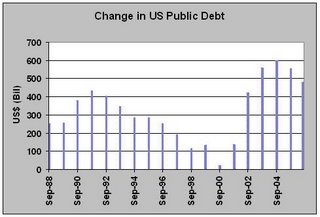
So, is the Prez just pulling another Mission Accomplished or is the deficit really shrinking? It depends on how one defines deficit.
If, as many Presidents before him, particularly Bill Clinton, have done, President Bush includes the Social Security (and other government administered "trust" funds) surplus in the general government accounts, the deficit appears smaller than it is in the sense that the Social Security funds are not tax revenues but funds held in trust to be repaid. This trick of hiding general government deficits behind trust fund surplusses, an artifact of the post WWII baby boom, has about run its course.
Within a decade, the Social Security surplus will be too small to hide much of anything. A few years after that, assuming extrapolations from current data hold, Social Security will be competing with Treasury to sell bonds into the open market. Of course, this assumes the government intends to pay out Social Security benefits, instead of pulling an Enron, looting the funds by placing them at risk in a Texas Hedge which goes awry, and then claiming innocence.
This brings us to the "more" side of the tale. While looking through the debt data, I realized that "intragovernmental holdings" of public debt had risen much faster than debt held by the public for the past decade. While much has been made of Asian and more recently OPEC holdings of US debt notably rising the much less heralded rise in intragovernmental holdings beats that hands down.
Since 1997, debt held by the public has risen about $1Tln ($1,000B) while over the same period, intragovernmental holdings have risen about $2Tln ($2,000B). Since the War on Terror began, debt held by the public has risen $1.4Tln (yes, it is higher than the increase since 1997 as Clinton paid down a chunk of debt held by the public) while intragovernmental holdings have risen about $1.2Tln.
In other words, the single largest financier of recent deficits, including those associated with the War on Terror, are not the Chinese, Japanese or Saudis but the US government administered trust funds for the people of the United States. That means the people taking the biggest risk are those betting on returns from those funds, and those betting on the social harmony which, it is hoped, such programs were designed to promote.
Tragically, in my view, very few people are aware of this bet, made with their money...or its implications.
Of course, I don't think the War would have been such an easy sell if people had been informed that their Social Security funds were at risk.
p.s. Worse, it isn't as if these funds are buying an equity share in any winnings, given the recent low Treasury rates, the best people can expect is 5% annually. In the event of default....let's not think about that.
On the "less" side of the tale I find the "improvement" in the deficit. The term "deficit", at least as I understand it, is a flow figure. It refers to a shortfall of income relative to expenditure over the course of a period of time, usually a year. The sum of these deficits is a "stock" figure, the debt. I bore you with this remedial accounting as preamble to my rather curious discovery. If, as the President, inter alios, avers, the deficit is shrinking, why is the debt still rising at a rapid pace?
The graph below depicts the annual change of the public debt for the past few years. As you can see, the public debt has risen just under $500B ($478B to be precise) thus far this year and the final quarter of the fiscal year (which ends 9/30) usually results in further increases in the debt on the order of $60-100B. I think it is quite possible that the public debt could increase the same this year as it did last.
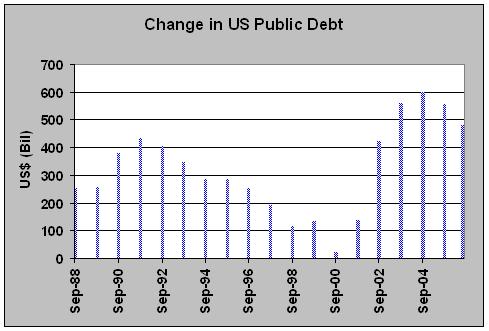
sources: Bureau of the Public Debt (and here)
So, is the Prez just pulling another Mission Accomplished or is the deficit really shrinking? It depends on how one defines deficit.
If, as many Presidents before him, particularly Bill Clinton, have done, President Bush includes the Social Security (and other government administered "trust" funds) surplus in the general government accounts, the deficit appears smaller than it is in the sense that the Social Security funds are not tax revenues but funds held in trust to be repaid. This trick of hiding general government deficits behind trust fund surplusses, an artifact of the post WWII baby boom, has about run its course.
Within a decade, the Social Security surplus will be too small to hide much of anything. A few years after that, assuming extrapolations from current data hold, Social Security will be competing with Treasury to sell bonds into the open market. Of course, this assumes the government intends to pay out Social Security benefits, instead of pulling an Enron, looting the funds by placing them at risk in a Texas Hedge which goes awry, and then claiming innocence.
This brings us to the "more" side of the tale. While looking through the debt data, I realized that "intragovernmental holdings" of public debt had risen much faster than debt held by the public for the past decade. While much has been made of Asian and more recently OPEC holdings of US debt notably rising the much less heralded rise in intragovernmental holdings beats that hands down.
Since 1997, debt held by the public has risen about $1Tln ($1,000B) while over the same period, intragovernmental holdings have risen about $2Tln ($2,000B). Since the War on Terror began, debt held by the public has risen $1.4Tln (yes, it is higher than the increase since 1997 as Clinton paid down a chunk of debt held by the public) while intragovernmental holdings have risen about $1.2Tln.
In other words, the single largest financier of recent deficits, including those associated with the War on Terror, are not the Chinese, Japanese or Saudis but the US government administered trust funds for the people of the United States. That means the people taking the biggest risk are those betting on returns from those funds, and those betting on the social harmony which, it is hoped, such programs were designed to promote.
Tragically, in my view, very few people are aware of this bet, made with their money...or its implications.
Of course, I don't think the War would have been such an easy sell if people had been informed that their Social Security funds were at risk.
p.s. Worse, it isn't as if these funds are buying an equity share in any winnings, given the recent low Treasury rates, the best people can expect is 5% annually. In the event of default....let's not think about that.
Monday, June 12, 2006
Institutional policy and the veneer of civilization
You can read 1000 economic forecasts, particularly of western economies, without once encountering the question, what if people protest against the policy. Yet, this to me will be the key issue for the next decade. Can the institutions of society implement policies at both the required level of intensity and duration to bring the world economy back into balance, or at a minimum trending that way? I don't think so. Others, like Stephen Roach at MSDW, do.
Despite admitting that the denial he sees amongst attendees at MSDW's investment conferences might also be found in his own views, he sticks to his guns. Institutions and leadership, he believes, will alter the path of history.
Institutions, the people who run them and the people who are run by them (or not as the case may be) have been features of recorded history for as long as the record exists. Detachment or megalomania depending on your perspective is a feature of those who rise to lead long in the tooth institutions until crisis conditions put those institutions to the test. Throughout history established institutions have been reactive, not proactive. Expecting this time to be different is to me like waiting for the sun to rise in the west.
I'm not arguing that the current world leaders don't think they can pull it off, I imagine they do, as other leaders throughout history have. I just don't think they appreciate the current thinness of the veneer of civilization, particularly in the US.
A people propagandized into accepting the virtue of fighting those with whom they disagree is a powder keg waiting to explode. I note with some concern the just released FBI data on violent crime which showed a jump in 2005-a year, mind you with a housing boom that made economic conditions more pleasant than currently exist.
If the long hot summer progresses with $3 gas, rising interest rates induced foreclosures and bankruptcies, a few hurricanes and perhaps a war with Iran to boot, the people will not be happy. When push comes to shove, I think the first option will be to ease up on monetary tightening.
But let's get a bit more specific and less abstract as we contemplate Mr. Roach's faith that institutions and leadership will alter the path of history.
Which institutions, I wonder. The same Central Banks who allowed the inflation of the 70s to appear, or the depression of the 30s? Is Ben Bernanke the next incarnation of Paul Volcker? I can't imagine Paul Volcker having a problem communicating with Maria Bartiromo, he would most likely have just walked past. No. Academic, politically correct Ben is a long way away from the brusque, cigar chompin' Volcker.
What leadership, I wonder. The Bush team, whose credibility, despite the killing of al-Zarqawi, is on par with Nixon's. Does Mr. Roach really believe that after being told the Iraq war would reduce oil prices among other untruths, that the people of the US will calmly accept the bursting of the housing bubble, which will be far more painful than the Nasdaq deflation, without a fight? While CEOs earn 200-400 times their wages? Not now, I think.
It is a feature of the leading institutions of any empire to look the wrong way at the wrong time- to try an old technique when its time has past. 6 years ago I think the US population would have accepted (with some grumbling) a cleansing recession that restored a degree of balance to international trade. In the event, the Neo-cons beat out the Larry Lindsey's and Paul O'Neill's and the military option, one of the oldest tricks in the book, was the policy option on which the Bush Presidency's credibility was spent.
One of the ironies of history is summed up by this quote from Jean de La Fountaine: A person often meets his destiny on the path he took to avoid it. It will be ironic indeed is those who claimed the end of history will have been instrumental in reviving the cycle, if such proves to be the case.
Despite admitting that the denial he sees amongst attendees at MSDW's investment conferences might also be found in his own views, he sticks to his guns. Institutions and leadership, he believes, will alter the path of history.
Institutions, the people who run them and the people who are run by them (or not as the case may be) have been features of recorded history for as long as the record exists. Detachment or megalomania depending on your perspective is a feature of those who rise to lead long in the tooth institutions until crisis conditions put those institutions to the test. Throughout history established institutions have been reactive, not proactive. Expecting this time to be different is to me like waiting for the sun to rise in the west.
I'm not arguing that the current world leaders don't think they can pull it off, I imagine they do, as other leaders throughout history have. I just don't think they appreciate the current thinness of the veneer of civilization, particularly in the US.
A people propagandized into accepting the virtue of fighting those with whom they disagree is a powder keg waiting to explode. I note with some concern the just released FBI data on violent crime which showed a jump in 2005-a year, mind you with a housing boom that made economic conditions more pleasant than currently exist.
If the long hot summer progresses with $3 gas, rising interest rates induced foreclosures and bankruptcies, a few hurricanes and perhaps a war with Iran to boot, the people will not be happy. When push comes to shove, I think the first option will be to ease up on monetary tightening.
But let's get a bit more specific and less abstract as we contemplate Mr. Roach's faith that institutions and leadership will alter the path of history.
Which institutions, I wonder. The same Central Banks who allowed the inflation of the 70s to appear, or the depression of the 30s? Is Ben Bernanke the next incarnation of Paul Volcker? I can't imagine Paul Volcker having a problem communicating with Maria Bartiromo, he would most likely have just walked past. No. Academic, politically correct Ben is a long way away from the brusque, cigar chompin' Volcker.
What leadership, I wonder. The Bush team, whose credibility, despite the killing of al-Zarqawi, is on par with Nixon's. Does Mr. Roach really believe that after being told the Iraq war would reduce oil prices among other untruths, that the people of the US will calmly accept the bursting of the housing bubble, which will be far more painful than the Nasdaq deflation, without a fight? While CEOs earn 200-400 times their wages? Not now, I think.
It is a feature of the leading institutions of any empire to look the wrong way at the wrong time- to try an old technique when its time has past. 6 years ago I think the US population would have accepted (with some grumbling) a cleansing recession that restored a degree of balance to international trade. In the event, the Neo-cons beat out the Larry Lindsey's and Paul O'Neill's and the military option, one of the oldest tricks in the book, was the policy option on which the Bush Presidency's credibility was spent.
One of the ironies of history is summed up by this quote from Jean de La Fountaine: A person often meets his destiny on the path he took to avoid it. It will be ironic indeed is those who claimed the end of history will have been instrumental in reviving the cycle, if such proves to be the case.
Tuesday, June 06, 2006
How's that rebalancing call working for you, Mr. Roach?
On May 1 of this year, Stephen Roach announced that the world, in an economic sense, was on the mend because world financial authorities were ready to take their medicine. The USDX had just fallen from 90 to 85, the Yuan was strengthening and interest rates were rising the world over.
Over the past month, however, these same authorities are starting to realize that the medicine does not taste good. Employment growth, according to the BLS has slowed appreciably and the US equity markets, along with those of other nations, have declined, in some cases substantially. Suddenly, there is talk that the Fed might need to pause. The Republican majority can ill afford a summer economic swoon going into November elections.
Also in the last month, Mr. Paulson has been named Treasury Secretary. Strangely, at least if we are to believe Mr. Roach's view of the authorities' willingness to take their medicine, the US$, the fulcrum for Mr. Roach's rebalancing, has stopped falling and rallied back to roughly where it was on May 1. Rising commodity prices in $ terms, to me a necessary consequence of a falling $, seem to have spooked the same authorities, who have trotted out the now very tired strong dollar mantra.
So are the authorities willing to take their medicine or not, now that they can see that there will be no rebalancing gain without consumer (a.k.a. voting citizen) pain? Perhaps in theory, but theory is not reality. We will see just how resolved the authorities are in the coming weeks.
Of course, things could get out of hand despite institutional support for the status quo, indeed, in my view, it takes just such a set of circumstances or constantly promising to get one's house in order, but just as constantly failing to follow through to produce such an outcome. Despair can drive men to do previously unthinkable things.
Going back a half millennia, it was widely known that the Vatican needed to reform (Jan Hus had railed against Church policies a century before Luther, and was burned at the stake for his efforts) and many promises were made to that effect, albeit only to be broken. I wonder when the monetary incarnation of Luther will appear posting his 95 theses on the doors of the Monetary Authorities' 21st Century Church.
Over the past month, however, these same authorities are starting to realize that the medicine does not taste good. Employment growth, according to the BLS has slowed appreciably and the US equity markets, along with those of other nations, have declined, in some cases substantially. Suddenly, there is talk that the Fed might need to pause. The Republican majority can ill afford a summer economic swoon going into November elections.
Also in the last month, Mr. Paulson has been named Treasury Secretary. Strangely, at least if we are to believe Mr. Roach's view of the authorities' willingness to take their medicine, the US$, the fulcrum for Mr. Roach's rebalancing, has stopped falling and rallied back to roughly where it was on May 1. Rising commodity prices in $ terms, to me a necessary consequence of a falling $, seem to have spooked the same authorities, who have trotted out the now very tired strong dollar mantra.
So are the authorities willing to take their medicine or not, now that they can see that there will be no rebalancing gain without consumer (a.k.a. voting citizen) pain? Perhaps in theory, but theory is not reality. We will see just how resolved the authorities are in the coming weeks.
Of course, things could get out of hand despite institutional support for the status quo, indeed, in my view, it takes just such a set of circumstances or constantly promising to get one's house in order, but just as constantly failing to follow through to produce such an outcome. Despair can drive men to do previously unthinkable things.
Going back a half millennia, it was widely known that the Vatican needed to reform (Jan Hus had railed against Church policies a century before Luther, and was burned at the stake for his efforts) and many promises were made to that effect, albeit only to be broken. I wonder when the monetary incarnation of Luther will appear posting his 95 theses on the doors of the Monetary Authorities' 21st Century Church.
Sunday, June 04, 2006
Ouch, that statistic just bit me!
Guns don't kill people, people kill people, is one of the key retorts from the gun lobby in America, and one with which I agree. While reading Daniel Gross' When sweet statistics clash with a sour mood in the NYTimes a paraphrasing of the above retort came to mind. Statistics don't mislead people, people mislead people.
But wait, you might be thinking, didn't Mark Twain (Benjamin Disraeli if you happen to be reading this in the UK) opine that there are three kinds of lies: lies, damn lies and statistics. Yes they did but I don't think either Disraeli or Twain meant that the statistics themselves are the problem but rather the people who present them. I'd like to go one step further though and add that readers allow themselves to be bamboozled by statistics.
Let me share a memory to highlight what I mean. When I was 12 my father went back to school, first studying Philosophy en route to a Law degree. Thus our home library was soon augmented by the works of Descartes, Berkeley, Locke and Hume, to name a few. As children are wont to do, I emulated my father and read, perhaps tried to read would be a better description, some of these works. My impression was that these books were confusing.
When I began my own studies in Philosophy as an undergraduate a few years later, I was surprised to find that these once confusing works were now understandable. Indeed, each time I have revisited these works I have come to find more and more meaning. Yet the texts were unchanged from the first time I had picked them up. That is, the books themselves weren't confusing. I just didn't have enough background and life experience the first time I picked them up to discern much meaning in them.
The conclusion I drew from this was that meaning is subjective. As Thomas Carlyle put it, In every object there is inexhaustible meaning; the eye sees in it what the eye brings means of seeing.
This is not to argue that words don't have an objective meaning, but rather that unless a person acquaints themselves with those meanings, they may confuse themselves. John Locke's notion of each new mind as a "tabula rasa" or "blank slate" comes to mind.
I am reminded of this need to fill in the blanks in my head each time I begin to study a new field or era in history. Just recently I began a study of the Middle East and had to slog through quite a few books before I had what I call a Rosetta Stone moment- a sense that I had just found the key to unlock the mysteries hidden in the texts.
From that point on, I wasn't slogging through the texts but reading them with enough background to divine the broader outlines. Names like Selim, Osman, Suleiman, Mohammed, Ali, and Saladin which had once been empty markers in my head began to evoke times, events and effects on further acquaintance.
During my slogging periods I need to keep reminding myself that I need first to crawl before I can walk. I need to know that I don't know to learn. Thus the same sense that might lead a person to say that a book is confusing or a statistic is misleading leads me to say that I need to do further study.
The above is not meant to argue that people don't cherry pick among statistics to paint a picture that fits their view, they do. So do I. Rather I am arguing that each person can, if they choose, educate themselves sufficiently to avoid being permanently confused or misled.
Knowing, for instance, that 23.4% of the CPI measure of US inflation uses owner's equivalent rent of primary residence, rather than the cost of a home or that the employment data assumes some degree of continuity in new business creation and related employment helps in demystifying the gap between the picture these numbers, taken at face value, might suggest and the world of your experience.
This type of due diligence may well have other effects, to wit, one might begin to wonder why the data are presented as they are. This too, it seems to me, is a fruitful avenue of personal research.
We all, thank God, have minds. What we think with them is, at least in part, up to us, for good or for ill. Evolution may well have increased man's capacity to think over the millennia, but evolution won't read the books for you.
But wait, you might be thinking, didn't Mark Twain (Benjamin Disraeli if you happen to be reading this in the UK) opine that there are three kinds of lies: lies, damn lies and statistics. Yes they did but I don't think either Disraeli or Twain meant that the statistics themselves are the problem but rather the people who present them. I'd like to go one step further though and add that readers allow themselves to be bamboozled by statistics.
Let me share a memory to highlight what I mean. When I was 12 my father went back to school, first studying Philosophy en route to a Law degree. Thus our home library was soon augmented by the works of Descartes, Berkeley, Locke and Hume, to name a few. As children are wont to do, I emulated my father and read, perhaps tried to read would be a better description, some of these works. My impression was that these books were confusing.
When I began my own studies in Philosophy as an undergraduate a few years later, I was surprised to find that these once confusing works were now understandable. Indeed, each time I have revisited these works I have come to find more and more meaning. Yet the texts were unchanged from the first time I had picked them up. That is, the books themselves weren't confusing. I just didn't have enough background and life experience the first time I picked them up to discern much meaning in them.
The conclusion I drew from this was that meaning is subjective. As Thomas Carlyle put it, In every object there is inexhaustible meaning; the eye sees in it what the eye brings means of seeing.
This is not to argue that words don't have an objective meaning, but rather that unless a person acquaints themselves with those meanings, they may confuse themselves. John Locke's notion of each new mind as a "tabula rasa" or "blank slate" comes to mind.
I am reminded of this need to fill in the blanks in my head each time I begin to study a new field or era in history. Just recently I began a study of the Middle East and had to slog through quite a few books before I had what I call a Rosetta Stone moment- a sense that I had just found the key to unlock the mysteries hidden in the texts.
From that point on, I wasn't slogging through the texts but reading them with enough background to divine the broader outlines. Names like Selim, Osman, Suleiman, Mohammed, Ali, and Saladin which had once been empty markers in my head began to evoke times, events and effects on further acquaintance.
During my slogging periods I need to keep reminding myself that I need first to crawl before I can walk. I need to know that I don't know to learn. Thus the same sense that might lead a person to say that a book is confusing or a statistic is misleading leads me to say that I need to do further study.
The above is not meant to argue that people don't cherry pick among statistics to paint a picture that fits their view, they do. So do I. Rather I am arguing that each person can, if they choose, educate themselves sufficiently to avoid being permanently confused or misled.
Knowing, for instance, that 23.4% of the CPI measure of US inflation uses owner's equivalent rent of primary residence, rather than the cost of a home or that the employment data assumes some degree of continuity in new business creation and related employment helps in demystifying the gap between the picture these numbers, taken at face value, might suggest and the world of your experience.
This type of due diligence may well have other effects, to wit, one might begin to wonder why the data are presented as they are. This too, it seems to me, is a fruitful avenue of personal research.
We all, thank God, have minds. What we think with them is, at least in part, up to us, for good or for ill. Evolution may well have increased man's capacity to think over the millennia, but evolution won't read the books for you.
Friday, June 02, 2006
The limits of finance
Henry Paulson's appointment to the position of Treasury Secretary brings yet another Goldman Sachs player (Joshua Bolton was recently made Chief of Staff) to the Bush team. Upon hearing the news of Paulson's appointment my first thought was that the US has been declared bankrupt and Goldman Sachs has been appointed receiver. Perhaps holders of US debt are getting a bit antsy with the "deficits don't matter" approach of Cheney et. al.
This is to invert the arrow of causation described in most press reports. Rather than thinking the Bush team chose Mr. Paulson, perhaps it was the global financiers, worried about the most recent spike in commodity prices, inter alia, who are driving the changes. Most press reports suggest that Mr. Paulson will have a much greater voice in policy than his predecessors, which fits with the inverted arrow of causation model. Goldman Sachs will now be driving US financial policy.
Alas, but at least in my view, the problems the US faces are not financial but political, although the political miscalculations have financial repercussions. That is, the corporation that is the US government is not a well run ship that has unfortunately been unable to navigate the financial waters but rather seems to me more and more like one of those never profitable internet companies that were the rage in the late 90s.
The collective sigh of relief press reports describe emanating from Wall St. is to me a sign of confusion as to the power of finance. A well run finance department can extract more profit from an already profitable corporation, and can put off the day of reckoning for a non profitable one but it can't turn the latter into the former.
Moreover, the ability of the financial wizards to obfuscate the underlying financial facts on the ground (think Enron) tends to lead to a reduction in pressure to get the underlying business in shape in much the same way as as an ability to forge a report card tends to lead to a reduction in pressure to actually do well in school. Financial legerdemain then becomes counter productive to the true goal.
And it is the true goal that ultimately matters. In the case of a commercial corporation, the true goal is underlying profitability. In the case of a governmental corporation, the true goal is a sound economy which includes such features as ultimately balanced fiscal and trade accounts.
So, while Mr. Paulson may well be a financial wizard, he will likely not have the answers to the underlying problems of current US policy. He will not be able to help win the wars in either Afghanistan or Iraq and without victory on those fronts, the US will eventually have to deal with the failed experiment in imperialism.
You see, when President Bush says that it is imperative that we win the War on Terror I believe him. The US is, as they say in games of Texas Hold 'em, all in on a hand of military dominance. If the Afghanis and Iraqis prove as tough as the Vietnamese to subdue, the hand the US is playing with will not take the pot. And then the markers will come due, regardless of who runs Treasury.
This is to invert the arrow of causation described in most press reports. Rather than thinking the Bush team chose Mr. Paulson, perhaps it was the global financiers, worried about the most recent spike in commodity prices, inter alia, who are driving the changes. Most press reports suggest that Mr. Paulson will have a much greater voice in policy than his predecessors, which fits with the inverted arrow of causation model. Goldman Sachs will now be driving US financial policy.
Alas, but at least in my view, the problems the US faces are not financial but political, although the political miscalculations have financial repercussions. That is, the corporation that is the US government is not a well run ship that has unfortunately been unable to navigate the financial waters but rather seems to me more and more like one of those never profitable internet companies that were the rage in the late 90s.
The collective sigh of relief press reports describe emanating from Wall St. is to me a sign of confusion as to the power of finance. A well run finance department can extract more profit from an already profitable corporation, and can put off the day of reckoning for a non profitable one but it can't turn the latter into the former.
Moreover, the ability of the financial wizards to obfuscate the underlying financial facts on the ground (think Enron) tends to lead to a reduction in pressure to get the underlying business in shape in much the same way as as an ability to forge a report card tends to lead to a reduction in pressure to actually do well in school. Financial legerdemain then becomes counter productive to the true goal.
And it is the true goal that ultimately matters. In the case of a commercial corporation, the true goal is underlying profitability. In the case of a governmental corporation, the true goal is a sound economy which includes such features as ultimately balanced fiscal and trade accounts.
So, while Mr. Paulson may well be a financial wizard, he will likely not have the answers to the underlying problems of current US policy. He will not be able to help win the wars in either Afghanistan or Iraq and without victory on those fronts, the US will eventually have to deal with the failed experiment in imperialism.
You see, when President Bush says that it is imperative that we win the War on Terror I believe him. The US is, as they say in games of Texas Hold 'em, all in on a hand of military dominance. If the Afghanis and Iraqis prove as tough as the Vietnamese to subdue, the hand the US is playing with will not take the pot. And then the markers will come due, regardless of who runs Treasury.
Friday, May 19, 2006
Random thoughts, roughly presented
Having been gently reprimanded for my lack of output lately (call it a golf mentality where less (strokes) is more) I've taken the lazy man's out and cobbled together some of the notes I take during my morning reads. It's rough but perhaps better than nothing...then again perhaps not.
Sticky Expectations and Gold
Anyone who has bought a stock and watched it rally can attest to the temptation of mentally booking profits at the highest recent price. When markets go on a tear, the temptation is even harder to resist. For those long Gold or Gold equity, past weeks were pure joy. On almost a daily basis, speculators could calculate their profits and reset their mental benchmarks of the price $600....$650...$700...$725. Then the correction sets in.
Prices fall back from recent highs. The small door problem (far more currency than real world deals at current prices) which led to the stunning rise of Gold and Gold equities comes into play for the sellers. As an aside, I expect the small door problem to get worse in the coming years. Margin traders will have to be even more nimble than usual.
After a $75 drop in the price of Gold, those who reset their benchmarks to $725 are likely feeling a bit low. Imagine though, assuming you are a long term holder like myself, that the price of Gold had never rallied to $725 but instead had been gently rising a few dollars a week and now sat at $655, a 56% gain on the year. That's not a bad trade.
Although I've long ago conceded my inability to guess exactly when markets get ahead of themselves, I accept that such phenomenon occur. This is not to argue that I think the current price of gold represents an durable equilibrium just that, in similar fashion to the way a person who suffers a terrible shock is likely to mentally digest the news in pieces, so too do collections of people digest reality at their own pace with lots of wishful thinking as a side dish.
To the extent one believes, as I do, that American economic dominance is giving way to an ascendant China, one should not expect a graceful transition. The last transition from Britain to the US took two world wars to sort out.
Return on investment of military spending
A few months ago, back when I couldn't golf every day and thus had more time to write silly notes the better to amuse my 3 readers, I wrote a piece which asked when investment becomes consumption. My answer was the investment becomes consumption when returns are zero or less.
With that in mind consider US military spending, which, according to this site, is about 43% of the world total (China and Russia's defense spending accounts for 6% each, who knows they might come out of this looking pretty sharp for not trying to keep up with the Jonses). Despite this disparity in spending, which has been going on for many years, the US military cannot bring rebels in Afghanistan and Iraq to submit. Moreover the carnage caused by the US military may poison the minds of those with whom US corporates will want to do business in the future. Thus far at least, the return on investment of military spending in those two endeavors is nil.
Just as a rise in the price of oil will reduce the value of a oil importing nation's capital stock, so too will military failures reduce the value of a nation's military capital stock. While it might warm the heart of a die hard militarist, being able to blow up the world 6 times over isn't much use if the prize you seek is a functioning world.
The health of the financial system
One of the dogmas of the modern economy is the preeminent need to maintain the health of the financial system. But the financial system is not the real economy, it is but a piece with a goal of facilitating trade. To the extent the financial system is not facilitating trade but is instead inhibiting it (what economists call disintermediation) then a healthy financial system will not lead to a healthy real economy.
As the Austrians would put it, the financial system directs the real sector. When the direction is poor, the results will follow suit.
Sticky Expectations and Gold
Anyone who has bought a stock and watched it rally can attest to the temptation of mentally booking profits at the highest recent price. When markets go on a tear, the temptation is even harder to resist. For those long Gold or Gold equity, past weeks were pure joy. On almost a daily basis, speculators could calculate their profits and reset their mental benchmarks of the price $600....$650...$700...$725. Then the correction sets in.
Prices fall back from recent highs. The small door problem (far more currency than real world deals at current prices) which led to the stunning rise of Gold and Gold equities comes into play for the sellers. As an aside, I expect the small door problem to get worse in the coming years. Margin traders will have to be even more nimble than usual.
After a $75 drop in the price of Gold, those who reset their benchmarks to $725 are likely feeling a bit low. Imagine though, assuming you are a long term holder like myself, that the price of Gold had never rallied to $725 but instead had been gently rising a few dollars a week and now sat at $655, a 56% gain on the year. That's not a bad trade.
Although I've long ago conceded my inability to guess exactly when markets get ahead of themselves, I accept that such phenomenon occur. This is not to argue that I think the current price of gold represents an durable equilibrium just that, in similar fashion to the way a person who suffers a terrible shock is likely to mentally digest the news in pieces, so too do collections of people digest reality at their own pace with lots of wishful thinking as a side dish.
To the extent one believes, as I do, that American economic dominance is giving way to an ascendant China, one should not expect a graceful transition. The last transition from Britain to the US took two world wars to sort out.
Return on investment of military spending
A few months ago, back when I couldn't golf every day and thus had more time to write silly notes the better to amuse my 3 readers, I wrote a piece which asked when investment becomes consumption. My answer was the investment becomes consumption when returns are zero or less.
With that in mind consider US military spending, which, according to this site, is about 43% of the world total (China and Russia's defense spending accounts for 6% each, who knows they might come out of this looking pretty sharp for not trying to keep up with the Jonses). Despite this disparity in spending, which has been going on for many years, the US military cannot bring rebels in Afghanistan and Iraq to submit. Moreover the carnage caused by the US military may poison the minds of those with whom US corporates will want to do business in the future. Thus far at least, the return on investment of military spending in those two endeavors is nil.
Just as a rise in the price of oil will reduce the value of a oil importing nation's capital stock, so too will military failures reduce the value of a nation's military capital stock. While it might warm the heart of a die hard militarist, being able to blow up the world 6 times over isn't much use if the prize you seek is a functioning world.
The health of the financial system
One of the dogmas of the modern economy is the preeminent need to maintain the health of the financial system. But the financial system is not the real economy, it is but a piece with a goal of facilitating trade. To the extent the financial system is not facilitating trade but is instead inhibiting it (what economists call disintermediation) then a healthy financial system will not lead to a healthy real economy.
As the Austrians would put it, the financial system directs the real sector. When the direction is poor, the results will follow suit.
Friday, May 12, 2006
Is America really the knowledge economy?
The recent nationalization of Bolivia's energy assets by the government of Evo Morales calls into question one of the main beliefs of current economic orthodoxy, i.e. the preeminence of American or more broadly western "knowledge" workers. Is America really the knowledge economy without which the rest of the world cannot prosper?
The answer to the question will determine the eventual resolution of the current conflict over resource profit flow. To the extent American or more broadly western "know how" is still required to manage resource extraction and export, the flow of funds associated with such activities will not change dramatically. However, if nations seeking to gain greater control of profits associated with resource extraction are capable of managing their assets then the future flow of funds associated with such activities are likely to shift dramatically, with the west losing out in the deal.
A century ago, western technological superiority in the field of resource extraction was evident. Whether the issue was mining in South America or pumping petroleum in the Middle East, western techniques were a quantum leap ahead. However, a century of contact including educational reform has eroded the gap in the intervening decades. Moreover, it is far easier to copy something you have seen working than to invent it yourself. People in non-western resource rich countries have been watching and learning western techniques for generations now.
Beyond the technology question there is the trade component. When the west was the biggest consumer of such exports even if a nation had the know how, they were stuck with their customers. The ascension of China, both with respect to the nation itself and the Asian nations which are commercially dominated by the Chinese, Singapore, Malaysia and Indonesia to name a few, has changed that dynamic. There's a new customer in town.
As China's growth continues to raise demand for raw materials, China, flush with dollars which the US will not accept in trade for key assets, will more and more be the swing consumer. On the trade front, the prospects for resource nationalization are robust.
This leaves the open question of western technological superiority as the swing factor. I don't know the answer to the question, but having traveled around the world quite a bit, I think the gap between the west and the rest of the world is less than a read of popular rhetoric suggests.
As was the case in the inflationary seventies, the terms of trade between the west and the rest of the world is under negotiation. The west will soon learn if the rhetoric of technological superiority is matched by the facts on the ground.
The answer to the question will determine the eventual resolution of the current conflict over resource profit flow. To the extent American or more broadly western "know how" is still required to manage resource extraction and export, the flow of funds associated with such activities will not change dramatically. However, if nations seeking to gain greater control of profits associated with resource extraction are capable of managing their assets then the future flow of funds associated with such activities are likely to shift dramatically, with the west losing out in the deal.
A century ago, western technological superiority in the field of resource extraction was evident. Whether the issue was mining in South America or pumping petroleum in the Middle East, western techniques were a quantum leap ahead. However, a century of contact including educational reform has eroded the gap in the intervening decades. Moreover, it is far easier to copy something you have seen working than to invent it yourself. People in non-western resource rich countries have been watching and learning western techniques for generations now.
Beyond the technology question there is the trade component. When the west was the biggest consumer of such exports even if a nation had the know how, they were stuck with their customers. The ascension of China, both with respect to the nation itself and the Asian nations which are commercially dominated by the Chinese, Singapore, Malaysia and Indonesia to name a few, has changed that dynamic. There's a new customer in town.
As China's growth continues to raise demand for raw materials, China, flush with dollars which the US will not accept in trade for key assets, will more and more be the swing consumer. On the trade front, the prospects for resource nationalization are robust.
This leaves the open question of western technological superiority as the swing factor. I don't know the answer to the question, but having traveled around the world quite a bit, I think the gap between the west and the rest of the world is less than a read of popular rhetoric suggests.
As was the case in the inflationary seventies, the terms of trade between the west and the rest of the world is under negotiation. The west will soon learn if the rhetoric of technological superiority is matched by the facts on the ground.
Monday, May 08, 2006
When lying becomes a habit
I'm passing along a tidbit from another blog.
Recently President Bush declared that catching a 7.5 pound perch in his lake, which, as Crawford is more than 100 miles from the Gulf, is presumably a fresh water lake, was his best moment in office.
The only problem is that the biggest freshwater perch caught on record is a 4 lb. 3 oz. perch caught in New Jersey in 1865.
So either the Prez just broke the record by a significant margin or lying is so habitual for him that he is always telling fish stories.
I'm waiting for him to start talking about the big WMD fish that go away.
Recently President Bush declared that catching a 7.5 pound perch in his lake, which, as Crawford is more than 100 miles from the Gulf, is presumably a fresh water lake, was his best moment in office.
The only problem is that the biggest freshwater perch caught on record is a 4 lb. 3 oz. perch caught in New Jersey in 1865.
So either the Prez just broke the record by a significant margin or lying is so habitual for him that he is always telling fish stories.
I'm waiting for him to start talking about the big WMD fish that go away.
Sunday, May 07, 2006
Where the rubber meets the road
It seems to me, after reading the latest from Stephen Roach, that critiques similar to mine found their way to him. He acknowledges that deciding to do a thing is not the same as doing it or as he put it; It’s one thing to have a framework that allows for shared responsibility in fixing an unbalanced world. It’s another thing altogether for individual nations to do the heavy lifting on economic policies that such responsibilities require.
Yet, I still believe Mr. Roach's sanguinity on the expected rebalancing of international accounts is premature. I am less confident than he that the current US administration will allow financial solvency arguments to trump security arguments in their deliberations.
This perspective shifts the argument from one of policy recommendation, i.e. the job of a pure economist, to one of policy execution, i.e. where the rubber meets the road. I agree with Mr. Roach's prescription, the dollar needs to fall to a more realistic level, but I don't agree that such considerations will be very influential if President Bush thinks we are fighting World War III and Vice President Cheney thinks Reagan taught us deficits don't matter. The buck, after all, stops with them.
(Blogosphere debate note: whether they actualy said such things is less important than whether they believe them, as their policy choices seem to indicate.)
While the esteem in which Central Bankers are held has risen markedly during the Greenspan era, this was, I contend, mainly a function of his easy money policies. And even Greenspan's suggestions of fiscal discipline fell on deaf ears with this administration. They are, as they have repeatedly said, on a mission to which other concerns are subordinated. As Arthur Burns related in his Anguish of Central Banking, it is easy to accomodate in a monetary sense, very difficult to restrict.
This development is not unique to the Bush administration. Each President's focus varies. Moreover, the virtues accruing to the issuer of the world's reserve currency have lent empirical credence to the view that deficits are easily sustainable much as a few decades without major hurricanes lend empirical credence to the view that hurricanes aren't a problem. Of course, issuing the world's reserve currency is not a birthright.
It will, I contend, take both a fear of losing dollar hegemony and faith that restoring trade and fiscal imbalances is the best means of achieving this goal to generate a sustained rebalancing policy. In my view, while this faith is likely generally accepted in economic policy circles, it is not shared by the current executive or legislative branches. They have chosen another path to maintain dollar supremacy.
None of the above is meant to diminish the importance of the shift in economic policy circles. I applaud the exorcism of the "new economics" demon from official economics. But I believe it will take time and a crisis or two before this faith leads to anything other than cosmetic changes.
Some might recall the 1993 meeting between President elect Clinton, Robert Rubin and Fed Chairman Greenspan on budget deficits and bond rates. It was portrayed in the press as if sound economics had imposed its will on the executive. I just don't see Fed Chairman Bernanke and John Snow or any other Bush administration member laying down the economic law for President Bush.
Not yet at any rate.
Yet, I still believe Mr. Roach's sanguinity on the expected rebalancing of international accounts is premature. I am less confident than he that the current US administration will allow financial solvency arguments to trump security arguments in their deliberations.
This perspective shifts the argument from one of policy recommendation, i.e. the job of a pure economist, to one of policy execution, i.e. where the rubber meets the road. I agree with Mr. Roach's prescription, the dollar needs to fall to a more realistic level, but I don't agree that such considerations will be very influential if President Bush thinks we are fighting World War III and Vice President Cheney thinks Reagan taught us deficits don't matter. The buck, after all, stops with them.
(Blogosphere debate note: whether they actualy said such things is less important than whether they believe them, as their policy choices seem to indicate.)
While the esteem in which Central Bankers are held has risen markedly during the Greenspan era, this was, I contend, mainly a function of his easy money policies. And even Greenspan's suggestions of fiscal discipline fell on deaf ears with this administration. They are, as they have repeatedly said, on a mission to which other concerns are subordinated. As Arthur Burns related in his Anguish of Central Banking, it is easy to accomodate in a monetary sense, very difficult to restrict.
This development is not unique to the Bush administration. Each President's focus varies. Moreover, the virtues accruing to the issuer of the world's reserve currency have lent empirical credence to the view that deficits are easily sustainable much as a few decades without major hurricanes lend empirical credence to the view that hurricanes aren't a problem. Of course, issuing the world's reserve currency is not a birthright.
It will, I contend, take both a fear of losing dollar hegemony and faith that restoring trade and fiscal imbalances is the best means of achieving this goal to generate a sustained rebalancing policy. In my view, while this faith is likely generally accepted in economic policy circles, it is not shared by the current executive or legislative branches. They have chosen another path to maintain dollar supremacy.
None of the above is meant to diminish the importance of the shift in economic policy circles. I applaud the exorcism of the "new economics" demon from official economics. But I believe it will take time and a crisis or two before this faith leads to anything other than cosmetic changes.
Some might recall the 1993 meeting between President elect Clinton, Robert Rubin and Fed Chairman Greenspan on budget deficits and bond rates. It was portrayed in the press as if sound economics had imposed its will on the executive. I just don't see Fed Chairman Bernanke and John Snow or any other Bush administration member laying down the economic law for President Bush.
Not yet at any rate.
Monday, May 01, 2006
The first step is key...so are all the others
Have you ever woken up one morning and decided you needed to go on a diet, stop drinking, stop smoking, spend less and save more, or spend more time with your children? I'm not referring to one of those momentary pangs of conscience that is quickly set aside but a real decision that eventually results in a change in lifestyle.
I have endured a few of these life changes and in my experience while the decision itself is important, it is only the beginning of an initially painful process as old mental associations are broken and new ones are formed. To paraphrase the catcher-sage Yogi Berra, the mission isn't accomplished until the mission is accomplished.
These thoughts were inspired by Stephen Roach's most recent optimistic research notes. While I agree with Mr. Roach that world leaders seem more vocal in noting not only that a problem exists but also that they need to do something about it, whether this proves to be another "South Beach" or fad policy that will only be followed until it is painful, i.e. when it begins to work, remains to be seen. In my experience, I've usually had to "make the resolution" quite a few times before it sticks.
Changing one's lifestyle, and the economic adjustments necessary to return to some degree of balance in international trade will require substantial lifestyle changes for many, tends to work best when the end goal is kept firmly in mind and the travails of getting there are admitted.
Resolving to stop drinking is easy while nursing a hangover on New Years Day. Not going to the bar after work the next Thursday when the hangover is gone is hard.
Resolving to spend less and save more is easy when you've just opened your Christmas season credit card bill. Not buying a new car when all your neighbors have recently bought new models is hard.
You get the picture.
Changing one's lifestyle means not only doing or not doing the chosen or prohibited activity that day, but every day forward, even when it is uncomfortable. To the extent the "fix" to what ails international finance includes a substantial increase in US savings, time periods of weeks, months or quarters, even in the event of a price discontinuity (a euphemism for a $ crash, for instance) are too short. It will require years. As they used to say in Econ 101 classes, change occurs on the margin.
During a recent phone conversation with a few friends in finance I likened the current period to the early 70s (or late 30s) when the realization that something needed to change in international finance was clear but just how to fix it, and how to apportion the pain was some years away. Nixon closed the Gold window in 1971, in recognition of the problem. The IMF didn't complete amending the relevant Articles of Agreement until 1978. Paul Volcker didn't adopt money supply targets as policy until 1979 and it wasn't until 1982 that Fed Funds rates came back down under 10%.
To avoid misunderstanding, I think it is better to admit there is a problem than to ignore it. I agree with Lao-tzu, a journey of a thousand miles begins with the first step. However, that first step is but one of many.
Given that most recent economic problems have been quickly "solved" by easing credit conditions, many seem to believe that this fix will be just as easy.
I don't think it will. It seems to me as if we are still in the fad economic policy phase. Barring a crisis, I expect it will be years before a true commitment to reform emerges.
I have endured a few of these life changes and in my experience while the decision itself is important, it is only the beginning of an initially painful process as old mental associations are broken and new ones are formed. To paraphrase the catcher-sage Yogi Berra, the mission isn't accomplished until the mission is accomplished.
These thoughts were inspired by Stephen Roach's most recent optimistic research notes. While I agree with Mr. Roach that world leaders seem more vocal in noting not only that a problem exists but also that they need to do something about it, whether this proves to be another "South Beach" or fad policy that will only be followed until it is painful, i.e. when it begins to work, remains to be seen. In my experience, I've usually had to "make the resolution" quite a few times before it sticks.
Changing one's lifestyle, and the economic adjustments necessary to return to some degree of balance in international trade will require substantial lifestyle changes for many, tends to work best when the end goal is kept firmly in mind and the travails of getting there are admitted.
Resolving to stop drinking is easy while nursing a hangover on New Years Day. Not going to the bar after work the next Thursday when the hangover is gone is hard.
Resolving to spend less and save more is easy when you've just opened your Christmas season credit card bill. Not buying a new car when all your neighbors have recently bought new models is hard.
You get the picture.
Changing one's lifestyle means not only doing or not doing the chosen or prohibited activity that day, but every day forward, even when it is uncomfortable. To the extent the "fix" to what ails international finance includes a substantial increase in US savings, time periods of weeks, months or quarters, even in the event of a price discontinuity (a euphemism for a $ crash, for instance) are too short. It will require years. As they used to say in Econ 101 classes, change occurs on the margin.
During a recent phone conversation with a few friends in finance I likened the current period to the early 70s (or late 30s) when the realization that something needed to change in international finance was clear but just how to fix it, and how to apportion the pain was some years away. Nixon closed the Gold window in 1971, in recognition of the problem. The IMF didn't complete amending the relevant Articles of Agreement until 1978. Paul Volcker didn't adopt money supply targets as policy until 1979 and it wasn't until 1982 that Fed Funds rates came back down under 10%.
To avoid misunderstanding, I think it is better to admit there is a problem than to ignore it. I agree with Lao-tzu, a journey of a thousand miles begins with the first step. However, that first step is but one of many.
Given that most recent economic problems have been quickly "solved" by easing credit conditions, many seem to believe that this fix will be just as easy.
I don't think it will. It seems to me as if we are still in the fad economic policy phase. Barring a crisis, I expect it will be years before a true commitment to reform emerges.
Wednesday, April 26, 2006
End of History...my a$$
Aside from playing a few (OK, quite a few) rounds of golf the past 2 weeks I've been doing some reading and thinking about the Middle East. The reading included a few books by British or American authors about recent (150 years) history, with a focus on oil concessions and the related political developments. The thinking included quite a few moments wondering just what the current US administration and oil industry execs think they are doing in Iraq. Have they so quickly forgotten how the US found itself in the driver's seat in the region following WWII?
For those to whom the universe of their senses, of the here and now, overwhelms the thought that the present is but one small part of a story still unfolding, it might be difficult to imagine that but a few decades previously the British were in almost complete control of Middle Eastern oil following the collapse of the Ottoman Empire. But they were.
The various rulers of the region had sold concessions to explore for and extract oil to quite a few individuals and companies on terms that demonstrated the rulers' ignorance of western business and the potential for oil. For instance, William D'Arcy in 1900-01 bought an oil exploration and export concession from Persia with a term of 60 years covering most of Iraq except a few northern provinces, for £20,000 cash, £20,000 in shares in the company and 16% of annual net profits. These payments covered all tax and customs duties. This concession was the basis for the Anglo-Persian Oil Company.
I won't bore you with further examples but suffice it to write that the British government, as preeminent power in the region was able to drive a hard bargain. Despite this, the regional rulers would intermittently agitate for and receive improved deals over time. Barring genocide, the people in the region were and as Iraq demonstrates, are still capable of shutting down oil exports, admittedly at the risk of losing those revenues.
The trend, since those first concessions led to oil exports in the early 20th century has been for the regional governments to get a greater and greater share of the profits and control of the resource. This trend was accelerated when the US made it big move in the region, modifying its deal with the former Emir of Nejd, then King of Arabia, ibn Saud, to split profits of Aramco 50-50.
Think about this for a moment. While the British were involved in an acrimonious dispute with Iran that eventually led to Mossadeq's nationalization of the Anglo Iranian Oil Company and cessation of Iran's oil exports for a few years, the United States' oil execs agree to a 50-50 split with Saudi Arabia that leap frogged them into the driver's seat in the region.
Stepping back from the history for a moment, I'm a big believer in win-win deals. If you give the person with whom you are negotiating more than he expects, and more than the norm, that person is likely to work hard to hold up his end of the deal. If, on the other hand, you try to screw the person with whom you are negotiating, perhaps because you are a big guy or have a powerful military machine behind you, you may get the deal done, but the other guy just isn't going to work as hard.
So, my question is, why are US oil execs and the Bush administration trying to unwind the clock of these oil deals by getting Iraq to take much less than the norm? Do they really believe this "end of history" flatulence, as if history began with the Cold War between Capitalism and Communism?
Before the Bolsheviks rose in Russia, the Tsars were interested in oil and as is clear, Putin's non-communist Russia is also interested in oil. The same forces (locals wanting more control and profit, other powers out of the loop wanting in, regional leaders looking to expand territory) which were at work in the region for a century are still in operation today. End of a chapter in history, yes, end of history....nonsense. The great game continues.
Only now there is a new player on the field, China. Wouldn't it be funny, in a tragic sense, if, while the US was trying to roll back the clock a century and get these backward people to accept much less for their oil, first in Iraq and then, as the Neo-Cons put it, the rest of the Middle East, China puts its hundreds of billions of dollars and ever growing thirst for oil to work in the region on the regional rulers' terms. At that point, why not resist occupation, the payday will be huge? Why not overthrow governments that signed bad deals? Yes, the great game continues.
Pop quiz: Where did Chinese President Hu go after having China's national anthem introduced as that of the Republic of China (Taiwan) and being heckled by a Falun Gong member at the White House? Saudi Arabia, where he was actually treated to a state dinner, instead of a lunch.
This war in Iraq, it seems to me, can be ended quite quickly, by agreeing to a reasonable deal. Unless, that is, we have put a cloud on the US' name in the reqion, much as Britain found it had a few decades ago.
For those to whom the universe of their senses, of the here and now, overwhelms the thought that the present is but one small part of a story still unfolding, it might be difficult to imagine that but a few decades previously the British were in almost complete control of Middle Eastern oil following the collapse of the Ottoman Empire. But they were.
The various rulers of the region had sold concessions to explore for and extract oil to quite a few individuals and companies on terms that demonstrated the rulers' ignorance of western business and the potential for oil. For instance, William D'Arcy in 1900-01 bought an oil exploration and export concession from Persia with a term of 60 years covering most of Iraq except a few northern provinces, for £20,000 cash, £20,000 in shares in the company and 16% of annual net profits. These payments covered all tax and customs duties. This concession was the basis for the Anglo-Persian Oil Company.
I won't bore you with further examples but suffice it to write that the British government, as preeminent power in the region was able to drive a hard bargain. Despite this, the regional rulers would intermittently agitate for and receive improved deals over time. Barring genocide, the people in the region were and as Iraq demonstrates, are still capable of shutting down oil exports, admittedly at the risk of losing those revenues.
The trend, since those first concessions led to oil exports in the early 20th century has been for the regional governments to get a greater and greater share of the profits and control of the resource. This trend was accelerated when the US made it big move in the region, modifying its deal with the former Emir of Nejd, then King of Arabia, ibn Saud, to split profits of Aramco 50-50.
Think about this for a moment. While the British were involved in an acrimonious dispute with Iran that eventually led to Mossadeq's nationalization of the Anglo Iranian Oil Company and cessation of Iran's oil exports for a few years, the United States' oil execs agree to a 50-50 split with Saudi Arabia that leap frogged them into the driver's seat in the region.
Stepping back from the history for a moment, I'm a big believer in win-win deals. If you give the person with whom you are negotiating more than he expects, and more than the norm, that person is likely to work hard to hold up his end of the deal. If, on the other hand, you try to screw the person with whom you are negotiating, perhaps because you are a big guy or have a powerful military machine behind you, you may get the deal done, but the other guy just isn't going to work as hard.
So, my question is, why are US oil execs and the Bush administration trying to unwind the clock of these oil deals by getting Iraq to take much less than the norm? Do they really believe this "end of history" flatulence, as if history began with the Cold War between Capitalism and Communism?
Before the Bolsheviks rose in Russia, the Tsars were interested in oil and as is clear, Putin's non-communist Russia is also interested in oil. The same forces (locals wanting more control and profit, other powers out of the loop wanting in, regional leaders looking to expand territory) which were at work in the region for a century are still in operation today. End of a chapter in history, yes, end of history....nonsense. The great game continues.
Only now there is a new player on the field, China. Wouldn't it be funny, in a tragic sense, if, while the US was trying to roll back the clock a century and get these backward people to accept much less for their oil, first in Iraq and then, as the Neo-Cons put it, the rest of the Middle East, China puts its hundreds of billions of dollars and ever growing thirst for oil to work in the region on the regional rulers' terms. At that point, why not resist occupation, the payday will be huge? Why not overthrow governments that signed bad deals? Yes, the great game continues.
Pop quiz: Where did Chinese President Hu go after having China's national anthem introduced as that of the Republic of China (Taiwan) and being heckled by a Falun Gong member at the White House? Saudi Arabia, where he was actually treated to a state dinner, instead of a lunch.
This war in Iraq, it seems to me, can be ended quite quickly, by agreeing to a reasonable deal. Unless, that is, we have put a cloud on the US' name in the reqion, much as Britain found it had a few decades ago.
Monday, April 10, 2006
Friday, April 07, 2006
Another Bank of the United States?
During the transformation from economic worry wart to gold bug a person almost invariably reads about the English "South Sea Bubble" and the French "Mississippi Bubble." Those of us who felt the Nasdaq was something of a bubble were quick to point out the similarities between the United States of 1999 and France and England of the early 18th Century. After a few years of reading I now believe the comparison was far less strong than I previously thought. While each instance was an example of excess liquidity fueled equity market madness, there were significant differences.
The South Sea Bubble had its South Sea Company. The MIssissippi Bubble had its Mississippi Company (La Compagnie d'Occident). But the Nasdaq bubble did not have a company or corporation that played the same role.
In both France and England of the early 18th Century, the two respective companies ended up taking ownership of the national public debt in exchange for shares of stock. In that regard, the Mississippi Company and the South Sea Company share similarities with the First Bank of the United States, admittedly with different endings.
In early 18th Century France and England, as in late 18th Century America the need to repay war debts loomed large over the respective governments. In the case of early 18th Century Europe the War of the Spanish Succession had depleted French and English Treasuries while the American Revolution left the new nation deep in debt.
Hamilton's controversial Bank of the United States, like the South Sea and Mississippi Companies assumed the national debt. Unlike the European examples, Hamilton's Bank stayed on the path of what relative to today would be very sound money.
When I read the executive summary of the Hamilton Project yesterday and its evocation of the nation's first Treasury Secretary as a genius with Larry Summers' idea of a "hedge fund" to manage excess foreign reserves in mind, I couldn't help but wonder if the new plan to deal with a war increased national debt would be a rehash of the old, but successful plan.
To the extent the Federal Government of the United States proves as incapable of repaying the debt as the French Monarchy and English Parliament of the early 18th Century, perhaps the next step is ceding control of the debt to a private institution, like another Bank of the United States, although I imagine it would be easier to use, as per Mr. Summers, the IMF or perhaps, the Federal Reserve Bank of NY after modifying its charter.
When I wrote of an approaching end game yesterday it was with this view in mind. At some point, either the US will admit it will repudiate its debt, foreign holders of that debt will decide for themselves that the US won't repay or a political decision needs to be made to return to fiscal solvency. Given the scope of the problem, in my view, cosmetic changes to the budget or debt process, like the now silly "debt ceiling" legislation will not be enough.
But, you might be thinking, the US public sector debt problem is not so big. I disagree. While the US debt to GDP ratio as currently calculated is not at the levels of, say, Iceland, it is much higher than the Treasury numbers suggest if expected entitlement payments are to be paid over the next few decades.
More importantly, the US Treasury Bond market is the focal point of all other US debt markets. An out of control Treasury Bond market will lend itself to greater volatility in all debt markets and vice versa. I have previously noted that the biggest single contributor to the widening current account deficit is the federal government. Bringing that corporation back in the fold of fiscal solvency would likely go a long way to weaning the nation off its abuse of the dollar as world reserve currency.
While I'm not an advocate of financial consolidation, I can see the virtues of the approach. Big problems often require big solutions. But big solutions sometimes create even bigger problems as France and England discovered.
In the end the ultimate outcome will depend upon the ethics and integrity of the people put in charge, the legal foundation upon which the new or modified institution stands and the willingness of the nation states involved to stay the course. To use a sports term, it's crunch time from a financial sense. I can't say I am hopeful but I do think it better to start throwing solutions out rather than burying our heads in the sand. There is, I believe, a cancer in the monetary system. The sooner it is dealt with the better.
The South Sea Bubble had its South Sea Company. The MIssissippi Bubble had its Mississippi Company (La Compagnie d'Occident). But the Nasdaq bubble did not have a company or corporation that played the same role.
In both France and England of the early 18th Century, the two respective companies ended up taking ownership of the national public debt in exchange for shares of stock. In that regard, the Mississippi Company and the South Sea Company share similarities with the First Bank of the United States, admittedly with different endings.
In early 18th Century France and England, as in late 18th Century America the need to repay war debts loomed large over the respective governments. In the case of early 18th Century Europe the War of the Spanish Succession had depleted French and English Treasuries while the American Revolution left the new nation deep in debt.
Hamilton's controversial Bank of the United States, like the South Sea and Mississippi Companies assumed the national debt. Unlike the European examples, Hamilton's Bank stayed on the path of what relative to today would be very sound money.
When I read the executive summary of the Hamilton Project yesterday and its evocation of the nation's first Treasury Secretary as a genius with Larry Summers' idea of a "hedge fund" to manage excess foreign reserves in mind, I couldn't help but wonder if the new plan to deal with a war increased national debt would be a rehash of the old, but successful plan.
To the extent the Federal Government of the United States proves as incapable of repaying the debt as the French Monarchy and English Parliament of the early 18th Century, perhaps the next step is ceding control of the debt to a private institution, like another Bank of the United States, although I imagine it would be easier to use, as per Mr. Summers, the IMF or perhaps, the Federal Reserve Bank of NY after modifying its charter.
When I wrote of an approaching end game yesterday it was with this view in mind. At some point, either the US will admit it will repudiate its debt, foreign holders of that debt will decide for themselves that the US won't repay or a political decision needs to be made to return to fiscal solvency. Given the scope of the problem, in my view, cosmetic changes to the budget or debt process, like the now silly "debt ceiling" legislation will not be enough.
But, you might be thinking, the US public sector debt problem is not so big. I disagree. While the US debt to GDP ratio as currently calculated is not at the levels of, say, Iceland, it is much higher than the Treasury numbers suggest if expected entitlement payments are to be paid over the next few decades.
More importantly, the US Treasury Bond market is the focal point of all other US debt markets. An out of control Treasury Bond market will lend itself to greater volatility in all debt markets and vice versa. I have previously noted that the biggest single contributor to the widening current account deficit is the federal government. Bringing that corporation back in the fold of fiscal solvency would likely go a long way to weaning the nation off its abuse of the dollar as world reserve currency.
While I'm not an advocate of financial consolidation, I can see the virtues of the approach. Big problems often require big solutions. But big solutions sometimes create even bigger problems as France and England discovered.
In the end the ultimate outcome will depend upon the ethics and integrity of the people put in charge, the legal foundation upon which the new or modified institution stands and the willingness of the nation states involved to stay the course. To use a sports term, it's crunch time from a financial sense. I can't say I am hopeful but I do think it better to start throwing solutions out rather than burying our heads in the sand. There is, I believe, a cancer in the monetary system. The sooner it is dealt with the better.
Thursday, April 06, 2006
Andrew Jackson on the Bank of the United States
It is to be regretted that the rich and powerful too often bend the acts of government to their selfish purposes. Distinctions in society will always exist under every just government. Equality of talents, of education, or of wealth can not be produced by human institutions. In the full enjoyment of the gifts of Heaven and the fruits of superior industry, economy, and virtue, every man is equally entitled to protection by law; but when the laws undertake to add to these natural and just advantages artificial distinctions, to grant titles, gratuities, and exclusive privileges, to make the rich richer and the potent more powerful, the humble members of society the farmers, mechanics, and laborers who have neither the time nor the means of securing like favors to themselves, have a right to complain of the injustice of their Government. There are no necessary evils in government. Its evils exist only in its abuses. If it would confine itself to equal protection, and, as Heaven does its rains, shower its favors alike on the high and the low, the rich and the poor, it would be an unqualified blessing. In the act before me there seems to be a wide and unnecessary departure from these just principles.
President Jackson on his veto of the Charter of the Second Bank of the United States
President Jackson on his veto of the Charter of the Second Bank of the United States
Been thinkin'
I took a few days off from blogging to think a bit.
The more I thought about Larry Summers' suggestion that emerging market nations should hand over their excess reserves to the IMF or other institution to manage to possibly insulate their politicians from the ultimate result of their acquisition of reserves the more I came to the view that the end game is near. The financial problems are too big to ignore for much longer.
It is one thing to forecast the end of a financial era and quite another to live through the process. I feel as if we sit on the edge of an intellectual event horizon, about to be pulled into a new universe, or more precisely a new understanding of the same universe-a revolution in thought.
I'll be spending the next few weeks taking a fresh look at the US, its relations with the world, and at the new proposals for running it, like Rubin's Hamilton Project.
In practical terms, that means that I should begin posting again tomorrow. The topic, financial centralization and Bob Rubin's Hamilton Project.
Is a Third Bank of the United States in the cards?
The more I thought about Larry Summers' suggestion that emerging market nations should hand over their excess reserves to the IMF or other institution to manage to possibly insulate their politicians from the ultimate result of their acquisition of reserves the more I came to the view that the end game is near. The financial problems are too big to ignore for much longer.
It is one thing to forecast the end of a financial era and quite another to live through the process. I feel as if we sit on the edge of an intellectual event horizon, about to be pulled into a new universe, or more precisely a new understanding of the same universe-a revolution in thought.
I'll be spending the next few weeks taking a fresh look at the US, its relations with the world, and at the new proposals for running it, like Rubin's Hamilton Project.
In practical terms, that means that I should begin posting again tomorrow. The topic, financial centralization and Bob Rubin's Hamilton Project.
Is a Third Bank of the United States in the cards?
Thursday, March 30, 2006
Fox wants to guard chicken coop
Would you hire a fox to guard your chicken coop? Probably not. Given that foxes eat chickens, anyone who hired a fox to watch his chickens would probably lose all of his chickens in the process.
Would you re-hire a fund manager who had invested your current portfolio in such a way that exiting the trade would result in disaster? Probably not. Why would you believe that people who had created the problem could now fix the problem?
A more intriguing issue to me is, why would a fox think he could con his way into a chicken coop? Why would a fund manager who had created a booby trapped portfolio think he could con his way into fixing the problem? Perhaps the fox doesn't know he is a fox.
Yesterday I wrote about what I call the "hiding behind a universal" form of argument with respect to a statement from President Bush. Presidents, however, are not the only people who use this argument form. People of all stripes deny wrong doing by asserting they are a parent, spouse, friend or lover, to name a few, or always do this or never do that and thus are incapable, by definition, of doing whatever they were accused of.
Those who use this argument form exhibit symptoms of what I call an "out of body" state. The idealistic self image to which these people seem to cling, good parent, spouse, friend, President, USTreasurer or University President, will eventually bear little resemblance to the person they are. More troubling, these individuals may find that people, with a lag, react to the person they are, not who they claim to be, leaving them confused. Thus a fox, having convinced himself he is something else, can entertain hopes of guarding a chicken coop and be surprised when the job is not offered.
Larry Summers, it seems to me, is exhibiting signs of being in just such an out of body state both in an individual sense and a collective sense.
In a recent speech, the ex-US Treasury Secretary argues that the international financial architecture needs to be reformed, citing the likely unsustainable and even if not, undesirable build-up in emerging market nation reserves as evidence. He argues, by virtue of the substantial portion of the imbalance being outside the G7/G8, that the G7/G8 is now an obsolete forum for solving the problem. He goes on to argue that emerging market nations should "invest" their excess reserves, in what I can best describe as an IMF managed hedge fund.
In his words: Perhaps it is time for the IMF and World Bank to think about how they can contribute to deploying the funds of major emerging markets rather than lending to major emerging markets. More ambitious than simply providing surveillance and monitoring that would support most ambitious investments by emerging markets would be the creation of an international facility in which countries could invest their excess reserves without taking domestic political responsibility for the process of investment decision and ultimate result.
I'll leave for a later post this very strange idea that national leaders will be able to avoid political responsibility for the ultimate result of their build up in reserves. Suffice it to write that it won't matter which acronym gets the blame, when the money is gone, people will be pissed.
Curiously, to me at least, this build up in reserves, particularly in emerging market nations was a result of policies Mr. Summers was intimately involved in crafting. He was Chief Economist for the World Bank from 1991-93 and then working first as Deputy to Robert Rubin and then as Treasury Secretary himself, Mr. Summers was there when the "strong dollar" policy was implemented and "excess" reserve accumulation commenced. During his time at Treasury Japan's reserves climbed from just under US$100B to to US$355B, China's reserves climbed from US$22B to US$168B, Hong Kong's reserves climbed from US$43B to US$107B and S. Korea's reserves climbed from US$20B to US$96B, all without a word of complaint.
What are we going to see next, Dick Cheney setting up a school for hunting safety without the hint of even a small mea culpa?
At some point, if it hasn't already happened, the rest of world's leaders will begin to note that the west set up the international financial architecture they now claim is flawed and didn't follow the rules of the system. The current gang running the show, from both sides of the aisle, has yet to come forward with a realistic plan for solving the problem other than suggesting that the world should continue to trust their ability, despite evidence that they are incapable of doing just that.
The idea that, having strong armed many emerging market economies into buying US Treasuries as a form of protection, the same economies should now hand over a large chunk of these reserves to be managed by the very guys who have put the US in the financial straits it currently finds itself, seems absurd to me. It's kind of like a fox wanting to guard a chicken coop.
Perhaps the problem also reflects a bit of extended adolescence. When you are a teenager or young twenty something you have your life ahead of you. You can speak truthfully about the person you hope to be and might become without too much of your past intruding on the view. Young people and young institutions have little to no track records as adults and working institutions.
At some point, however, time catches up to you. While I hopefully have a few decades of life left, I have decades of track record behind me. Thus I often find myself, when suggesting a course of action to another, qualifying my opinion with a, " I didn't do this or did do that and now regret it." I find the need to temper the youthful language of idealism with references to my own experience failing to live up to those ideals.
The Bretton Woods institutions, the IMF and World Bank, are not new institutions nor are the current gang in charge young people. The Clinton team, which still seems to control part of the DLC and the Bush team have track records. The current mess is their track record. They might paint a nice picture of the future but given the past, I wonder how they plan to get there. They already had their turn at the wheel even though they seem to be reluctant to have anyone focus on it. In Buddhist terms, they are people forever trying to run away from their karma, which is about as easy as running away from your shadow.
William James wrote, Sow an action & you reap a habit; sow a habit & you reap a character; sow a character and you reap a destiny. Young people have yet to establish adult habits, their characters are unformed. Older people's characters are formed, change is difficult without a mea culpa, and even then destiny awaits. Yes, destiny awaits, even for such august institutions like the IMF and World Bank, who would now like to be thought of as hipster hedge funds.
It's worse than a fox wanting to guard a chicken coop, it's like your grandmother getting her belly button pierced and buying the clothing to show it off.
Would you re-hire a fund manager who had invested your current portfolio in such a way that exiting the trade would result in disaster? Probably not. Why would you believe that people who had created the problem could now fix the problem?
A more intriguing issue to me is, why would a fox think he could con his way into a chicken coop? Why would a fund manager who had created a booby trapped portfolio think he could con his way into fixing the problem? Perhaps the fox doesn't know he is a fox.
Yesterday I wrote about what I call the "hiding behind a universal" form of argument with respect to a statement from President Bush. Presidents, however, are not the only people who use this argument form. People of all stripes deny wrong doing by asserting they are a parent, spouse, friend or lover, to name a few, or always do this or never do that and thus are incapable, by definition, of doing whatever they were accused of.
Those who use this argument form exhibit symptoms of what I call an "out of body" state. The idealistic self image to which these people seem to cling, good parent, spouse, friend, President, USTreasurer or University President, will eventually bear little resemblance to the person they are. More troubling, these individuals may find that people, with a lag, react to the person they are, not who they claim to be, leaving them confused. Thus a fox, having convinced himself he is something else, can entertain hopes of guarding a chicken coop and be surprised when the job is not offered.
Larry Summers, it seems to me, is exhibiting signs of being in just such an out of body state both in an individual sense and a collective sense.
In a recent speech, the ex-US Treasury Secretary argues that the international financial architecture needs to be reformed, citing the likely unsustainable and even if not, undesirable build-up in emerging market nation reserves as evidence. He argues, by virtue of the substantial portion of the imbalance being outside the G7/G8, that the G7/G8 is now an obsolete forum for solving the problem. He goes on to argue that emerging market nations should "invest" their excess reserves, in what I can best describe as an IMF managed hedge fund.
In his words: Perhaps it is time for the IMF and World Bank to think about how they can contribute to deploying the funds of major emerging markets rather than lending to major emerging markets. More ambitious than simply providing surveillance and monitoring that would support most ambitious investments by emerging markets would be the creation of an international facility in which countries could invest their excess reserves without taking domestic political responsibility for the process of investment decision and ultimate result.
I'll leave for a later post this very strange idea that national leaders will be able to avoid political responsibility for the ultimate result of their build up in reserves. Suffice it to write that it won't matter which acronym gets the blame, when the money is gone, people will be pissed.
Curiously, to me at least, this build up in reserves, particularly in emerging market nations was a result of policies Mr. Summers was intimately involved in crafting. He was Chief Economist for the World Bank from 1991-93 and then working first as Deputy to Robert Rubin and then as Treasury Secretary himself, Mr. Summers was there when the "strong dollar" policy was implemented and "excess" reserve accumulation commenced. During his time at Treasury Japan's reserves climbed from just under US$100B to to US$355B, China's reserves climbed from US$22B to US$168B, Hong Kong's reserves climbed from US$43B to US$107B and S. Korea's reserves climbed from US$20B to US$96B, all without a word of complaint.
What are we going to see next, Dick Cheney setting up a school for hunting safety without the hint of even a small mea culpa?
At some point, if it hasn't already happened, the rest of world's leaders will begin to note that the west set up the international financial architecture they now claim is flawed and didn't follow the rules of the system. The current gang running the show, from both sides of the aisle, has yet to come forward with a realistic plan for solving the problem other than suggesting that the world should continue to trust their ability, despite evidence that they are incapable of doing just that.
The idea that, having strong armed many emerging market economies into buying US Treasuries as a form of protection, the same economies should now hand over a large chunk of these reserves to be managed by the very guys who have put the US in the financial straits it currently finds itself, seems absurd to me. It's kind of like a fox wanting to guard a chicken coop.
Perhaps the problem also reflects a bit of extended adolescence. When you are a teenager or young twenty something you have your life ahead of you. You can speak truthfully about the person you hope to be and might become without too much of your past intruding on the view. Young people and young institutions have little to no track records as adults and working institutions.
At some point, however, time catches up to you. While I hopefully have a few decades of life left, I have decades of track record behind me. Thus I often find myself, when suggesting a course of action to another, qualifying my opinion with a, " I didn't do this or did do that and now regret it." I find the need to temper the youthful language of idealism with references to my own experience failing to live up to those ideals.
The Bretton Woods institutions, the IMF and World Bank, are not new institutions nor are the current gang in charge young people. The Clinton team, which still seems to control part of the DLC and the Bush team have track records. The current mess is their track record. They might paint a nice picture of the future but given the past, I wonder how they plan to get there. They already had their turn at the wheel even though they seem to be reluctant to have anyone focus on it. In Buddhist terms, they are people forever trying to run away from their karma, which is about as easy as running away from your shadow.
William James wrote, Sow an action & you reap a habit; sow a habit & you reap a character; sow a character and you reap a destiny. Young people have yet to establish adult habits, their characters are unformed. Older people's characters are formed, change is difficult without a mea culpa, and even then destiny awaits. Yes, destiny awaits, even for such august institutions like the IMF and World Bank, who would now like to be thought of as hipster hedge funds.
It's worse than a fox wanting to guard a chicken coop, it's like your grandmother getting her belly button pierced and buying the clothing to show it off.
Tuesday, March 28, 2006
Word games and the study of philosophy
The past few philosophy posts have been a bit heavy on the jargon and light on real world applications so I've decided to get into the practical today. One of the reasons I believe the study of philosophy has fallen into disfavor is the emphasis on the jargon and de-emphasis on real world application. It is as if the ability to quote Plato or Aristotle is seen as more valuable than gaining a sense of how the ideas history credits them, and other philosophers, with popularizing might help people understand the world around them.
No President Wants War
Consider the following statement from President Bush in response to a question from Helen Thomas:
Q I'd like to ask you, Mr. President, your decision to invade Iraq has caused the deaths of thousands of Americans and Iraqis, wounds of Americans and Iraqis for a lifetime. Every reason given, publicly at least, has turned out not to be true. My question is, why did you really want to go to war? From the moment you stepped into the White House, from your Cabinet -- your Cabinet officers, intelligence people, and so forth -- what was your real reason? You have said it wasn't oil -- quest for oil, it hasn't been Israel, or anything else. What was it?
THE PRESIDENT: I think your premise -- in all due respect to your question and to you as a lifelong journalist -- is that -- I didn't want war. To assume I wanted war is just flat wrong, Helen, in all due respect --
Q Everything --
THE PRESIDENT: Hold on for a second, please.
Q -- everything I've heard --
THE PRESIDENT: Excuse me, excuse me. No President wants war. Everything you may have heard is that, but it's just simply not true.
So, according to the President, No President wants war, regardless of what you may have heard. I call this hiding behind universals, in this case, President-ness. According to this particular President, the act of becoming a President makes one undesirous of war.
This makes me wonder why the nation ever went to war or why no President has ever resigned in protest of war.
Of course, this particular President waged a war. His administration led both the UN and Congress in that direction and according to numerous memos from the British Government, among other sources, was trying to fix the facts around the already decided policy of war, instead of trying to avoid it, a behavior one might expect from those who don't want it.
Despite these memos, and other reports from administration insiders to the contrary, President Bush would like the citizens of his nation to accept his vision of President-ness. The modern habit of branding might come to mind. Just as modern commercial corporations would have you believe that corporation XYZ always has their customers' needs in mind, despite specific evidence to the contrary, the President would have you believe that Presidents don't want war, despite specific evidence to the contrary.
If I've explained this adequately you can see that there are two approaches to the issue. The top down approach of President Bush, and my bottom up approach. The top down approach takes Presidential qualities as a given, and asks that you disregard evidence to the contrary. The bottom up approach takes the raw data of Presidential desires and actions and tries to discover some generalities. The top down approach is called radical idealism and the bottom up approach is called empiricism.
Inflation expectations remain contained
The above statement can be found in many recent monetary policy press releases. It can also be heard on TV and read in many commentaries. Let's consider what it means.
Expectations are mental. To discover them one would could ask those whose expectations you are trying to qualify. More importantly, you can see what people do. People who expect inflation, in the current usage higher prices, will tend to buy early, carry inventory and budget accordingly.
Just yesterday, while riding home with a friend from 9 holes of wonderful early season golf, I heard an expectation of inflation. My friend, who owns a construction company, looked at the prices at the gas pump and said, "gas prices are going up again." He didn't say, "gas prices are high today so I'll wait until they come down again." His sense was that just as gas prices have risen recently so they will continue to rise. This sounded to me like an expectation of inflation.
Among people I know, admittedly a very small sample, most expect higher prices in the future and are acting accordingly. So who doesn't expect rising prices in the future?
The Federal Reserve Bank of Philadelphia surveys forecasters quarterly. According to the latest report, Beyond the very short term, the forecasters see little threat of accelerating inflation. One answer to our question is that the number crunchers don't expect accelerating inflation. Of course, this group takes as a given the government's measure of current inflation which makes their perspective a little suspect in my view.
I wish the survey included a question about the forecasters buying habits. To wit, of the forecasters who think inflation will remain modest, how many have purchased or plan to purchase a car that gets better gas mileage or perhaps a wood stove for the house.
The economy is strong
The above statement is so ubiquitous it is almost a mantra. I wonder what it means.
Is the economy a thing-in-itself, as Kant might have asked or is the economy the totality of the economic choices and experiences of all those whose actions comprise it?
The top down approach leads us to to aggretive measures like GDP, while the bottom up approach leads us to unpopular reports like changes in household income and spending habits. While recent GDP measures lead one to a view of a strong economy, a more pluralist perspective which takes into account individual households leads us at best to a view of a stagnant economy for the majority.
In other words, before one qualifies the economy as strong or weak, or more generally qualifies anything as anything, one must first define what you mean by the term in question.
The top down approach of radical idealism which holds that ideas of think trump the experience of the thing would lead you to believe that Presidents don't want war, inflation expectations remain contained and the economy is strong. The bottom up approach of empiricism would lead you to believe; given the United States' history of wars, that the commander in chief, on some level, wanted war, the expectations of inflation among the many might not be as contained as the number crunchers spread sheets suggest, and that the economy as experienced by the many might not be as strong as the aggretive figures suggest.
William James defined truth as that, the belief in which, improves one's life in some way. Truth is discovered in living life. Faith in untrue statements confuses. Faith in true statements clarifies. We will see if the top down or bottom up approach leads to a more accurate view.
No President Wants War
Consider the following statement from President Bush in response to a question from Helen Thomas:
Q I'd like to ask you, Mr. President, your decision to invade Iraq has caused the deaths of thousands of Americans and Iraqis, wounds of Americans and Iraqis for a lifetime. Every reason given, publicly at least, has turned out not to be true. My question is, why did you really want to go to war? From the moment you stepped into the White House, from your Cabinet -- your Cabinet officers, intelligence people, and so forth -- what was your real reason? You have said it wasn't oil -- quest for oil, it hasn't been Israel, or anything else. What was it?
THE PRESIDENT: I think your premise -- in all due respect to your question and to you as a lifelong journalist -- is that -- I didn't want war. To assume I wanted war is just flat wrong, Helen, in all due respect --
Q Everything --
THE PRESIDENT: Hold on for a second, please.
Q -- everything I've heard --
THE PRESIDENT: Excuse me, excuse me. No President wants war. Everything you may have heard is that, but it's just simply not true.
So, according to the President, No President wants war, regardless of what you may have heard. I call this hiding behind universals, in this case, President-ness. According to this particular President, the act of becoming a President makes one undesirous of war.
This makes me wonder why the nation ever went to war or why no President has ever resigned in protest of war.
Of course, this particular President waged a war. His administration led both the UN and Congress in that direction and according to numerous memos from the British Government, among other sources, was trying to fix the facts around the already decided policy of war, instead of trying to avoid it, a behavior one might expect from those who don't want it.
Despite these memos, and other reports from administration insiders to the contrary, President Bush would like the citizens of his nation to accept his vision of President-ness. The modern habit of branding might come to mind. Just as modern commercial corporations would have you believe that corporation XYZ always has their customers' needs in mind, despite specific evidence to the contrary, the President would have you believe that Presidents don't want war, despite specific evidence to the contrary.
If I've explained this adequately you can see that there are two approaches to the issue. The top down approach of President Bush, and my bottom up approach. The top down approach takes Presidential qualities as a given, and asks that you disregard evidence to the contrary. The bottom up approach takes the raw data of Presidential desires and actions and tries to discover some generalities. The top down approach is called radical idealism and the bottom up approach is called empiricism.
Inflation expectations remain contained
The above statement can be found in many recent monetary policy press releases. It can also be heard on TV and read in many commentaries. Let's consider what it means.
Expectations are mental. To discover them one would could ask those whose expectations you are trying to qualify. More importantly, you can see what people do. People who expect inflation, in the current usage higher prices, will tend to buy early, carry inventory and budget accordingly.
Just yesterday, while riding home with a friend from 9 holes of wonderful early season golf, I heard an expectation of inflation. My friend, who owns a construction company, looked at the prices at the gas pump and said, "gas prices are going up again." He didn't say, "gas prices are high today so I'll wait until they come down again." His sense was that just as gas prices have risen recently so they will continue to rise. This sounded to me like an expectation of inflation.
Among people I know, admittedly a very small sample, most expect higher prices in the future and are acting accordingly. So who doesn't expect rising prices in the future?
The Federal Reserve Bank of Philadelphia surveys forecasters quarterly. According to the latest report, Beyond the very short term, the forecasters see little threat of accelerating inflation. One answer to our question is that the number crunchers don't expect accelerating inflation. Of course, this group takes as a given the government's measure of current inflation which makes their perspective a little suspect in my view.
I wish the survey included a question about the forecasters buying habits. To wit, of the forecasters who think inflation will remain modest, how many have purchased or plan to purchase a car that gets better gas mileage or perhaps a wood stove for the house.
The economy is strong
The above statement is so ubiquitous it is almost a mantra. I wonder what it means.
Is the economy a thing-in-itself, as Kant might have asked or is the economy the totality of the economic choices and experiences of all those whose actions comprise it?
The top down approach leads us to to aggretive measures like GDP, while the bottom up approach leads us to unpopular reports like changes in household income and spending habits. While recent GDP measures lead one to a view of a strong economy, a more pluralist perspective which takes into account individual households leads us at best to a view of a stagnant economy for the majority.
In other words, before one qualifies the economy as strong or weak, or more generally qualifies anything as anything, one must first define what you mean by the term in question.
The top down approach of radical idealism which holds that ideas of think trump the experience of the thing would lead you to believe that Presidents don't want war, inflation expectations remain contained and the economy is strong. The bottom up approach of empiricism would lead you to believe; given the United States' history of wars, that the commander in chief, on some level, wanted war, the expectations of inflation among the many might not be as contained as the number crunchers spread sheets suggest, and that the economy as experienced by the many might not be as strong as the aggretive figures suggest.
William James defined truth as that, the belief in which, improves one's life in some way. Truth is discovered in living life. Faith in untrue statements confuses. Faith in true statements clarifies. We will see if the top down or bottom up approach leads to a more accurate view.
Sunday, March 26, 2006
Pluralism
Two bothers were walking home from school on a path in the woods, discussing their latest philosophy lesson. About 50 paces in front of them a bird waits in a tree.
Startled by their conversation the bird takes flight, first away from the brothers and then towards them. Flying quickly, the bird passes between the two such that each sees but one side of the bird.
The younger brother, walking on the right side of the path asks his elder brother if he has even seen a cardinal as big as the one that just flew past. "All I saw was a blur of red."
The elder brother, with a patronizing expression of his face says that all he saw was a blur of black. "It was a raven," he asserts.
"Nonsense," the younger brother retorts, offended. "It was clearly a red bird. Are you color blind?"
"You know I'm not," the elder brother replies. "What do you know about birds anyway, you aren't a student of nature like I am."
Silenced by their rebukes, the two boys walked along nursing thoughts of the others' foolish obstinacy.
Upon reaching home and seeing their father outside the two brothers ran to him each proclaiming their story in renewed argument. Talking turned to shouting and the argument degenerated into name calling.
The father quieted his two boys and then, in an attempt to change the topic, asked them what they studied in school that day.
"Philosophy," they said in one voice. "We talked about pluralism vs monism."
"How interesting," the father responded. "And were you persuaded to take a side in the debate?"
"We are both pluralists," said the elder brother. "Haven't you been telling us for years that only God could see the universe as a unity."
Holding back a chuckle, the father told him he was correct. "Yes, I did say that. But it seems you missed some of my meaning."
"Perhaps," he went on, "one or both of you are incorrect in your perceptions. However, you might also both be correct."
"What?," they responded, totally bemused.
"Perhaps the bird was black on one side and red on the other. You are both trying to extend your limited perspective to the entire object and perhaps obscuring the truth as you do. Sometimes the truth of the matter is neither left nor right, nor a synthesis of the views both both together."
Startled by their conversation the bird takes flight, first away from the brothers and then towards them. Flying quickly, the bird passes between the two such that each sees but one side of the bird.
The younger brother, walking on the right side of the path asks his elder brother if he has even seen a cardinal as big as the one that just flew past. "All I saw was a blur of red."
The elder brother, with a patronizing expression of his face says that all he saw was a blur of black. "It was a raven," he asserts.
"Nonsense," the younger brother retorts, offended. "It was clearly a red bird. Are you color blind?"
"You know I'm not," the elder brother replies. "What do you know about birds anyway, you aren't a student of nature like I am."
Silenced by their rebukes, the two boys walked along nursing thoughts of the others' foolish obstinacy.
Upon reaching home and seeing their father outside the two brothers ran to him each proclaiming their story in renewed argument. Talking turned to shouting and the argument degenerated into name calling.
The father quieted his two boys and then, in an attempt to change the topic, asked them what they studied in school that day.
"Philosophy," they said in one voice. "We talked about pluralism vs monism."
"How interesting," the father responded. "And were you persuaded to take a side in the debate?"
"We are both pluralists," said the elder brother. "Haven't you been telling us for years that only God could see the universe as a unity."
Holding back a chuckle, the father told him he was correct. "Yes, I did say that. But it seems you missed some of my meaning."
"Perhaps," he went on, "one or both of you are incorrect in your perceptions. However, you might also both be correct."
"What?," they responded, totally bemused.
"Perhaps the bird was black on one side and red on the other. You are both trying to extend your limited perspective to the entire object and perhaps obscuring the truth as you do. Sometimes the truth of the matter is neither left nor right, nor a synthesis of the views both both together."
Subscribe to:
Posts (Atom)
