Friday, October 13, 2006

ex-Nixonites get a do-over

There are no do-overs in life, goes the old adage.

But even old adages have their caveats. For some, apparently, there are do-overs in life.

Consider the group of Nixon era hold-overs who currently hold many of the reins of US power, such as: Donald Rumsfeld, Richard Cheney and Henry Kissinger, to name a few. For these people the current wars in Iraq and Afghanistan provide a do-over of the Vietnam War.

To their credit, these men admit mistakes were made in the late 60s and early 70s. To their detriment, in my view, the mistake they admit is a lack of executive resolve. For these men, the mistake was not the decision to go to war in the first place, always a hazardous endeavor, but the decision to listen to the will of the populace and leave.

Alas for these men, but fortunately for us, the remains of representative government are still in place, even if only in slightly better shape than was the case in Rome when Augustus became Emperor. For those unfamiliar with that period in Roman history, Augustus learned from the experience of his grand-uncle and adopted father, Julius that he needed to maintain the outward form of government the people wished, i.e. the Republic, even if the true power resided in his person. The nasty eventual effects of this policy of government by gross deception can be seen in a review of the reigns of the later Tiberius, Caligula, Claudius and Nero.

Returning our attention to the present moment, what can a group of men do who believe the problem lies with a reluctant population? One possible solution: lie.

Enter Henry Kissinger, stage left, repeating a favorites maxim:
It is not a matter of what is true that counts, but a matter of what is perceived to be true.

Thus, if you wish people to agree with your policies, you must make them believe things which beg those policies, and those in positions of power have the ability to, in the words of Noam Chomsky, manufacture consent. The temptations of power, and credibility recall the wise words of Voltaire, those who can make you believe absurdities can make you commit atrocities.

Thus the torturing of statistics becomes as legal and desirable as waterboarding, at least to those not on the receiving end.

If too many domestic wartime casualties leads people to demand an end to war then such statistics needs to be downplayed or outright fudged.

If too many civilian casualties in the theater of operations leads people to demand an end to the war then statistics portraying such a reality need to be deemed, not credible.

If the projected cost of the wars leads people to think twice about the venture, then one avers that the wars will be self financing.

If the effects of the war on the domestic economy lead people to demand an end to the war then the domestic economy, and most importantly the financial expressions thereof
must be supported even if it results in a bigger problem down the road.

Of course, the key question of whether this view that the problem during the Vietnam War was a lack of resolve remains unanswered, for now.

Kissinger's view that perception trumps reality is, in my view, only valid in a local sense. While I agree that people act on their beliefs and not on reality, whether they are aware of this or not, men can change their beliefs while reality remains what it is. You can lead people to believe that hugging rattlesnakes prolongs life but this faith will quickly change once put to the test in the real world. Reality can, and does, bite.

"Life," quoth the bard, Forest Gump, "is like a box of chocolates. You never know what you're gonna' get." Paraphrased, life is an experiment for testing ideas, or so the Pragmatists put it. The truth, argued William James, has a cash value in the walk of life. Faith in the truth improves one's life while faith in the false has the opposite effect.

So I sit and watch the experiment in greater executive branch resolve run its course. Unlike the Nixon version, there will be no "cutting and running". There will be no open discussions of increasing casualties or costs. Economic and financial controls will not be lifted and nobody will ever resign. As Donald Rumsfeld put it the other day, you can bank it.

Yet the theorist in me yearns to speculate on the end result of this experiment, in the, to some, unlikely event that the guiding view of the executive branch proves false.

Let us, dear readers (dare I use the plural after so long an absence from the screen) try to imagine a world in which reality trumps perception- in which obscuring, embellishing and even outright lying about the effects of one's actions makes problems worse.

In a world where hugging rattlesnakes is a bad idea regardless of what people believe, wars which kill lots of people and impoverish populations lead to a lack of state credibility. In that world continued denial and obfuscation by the executive branch only makes the eventual reckoning that much worse. That is, the people's skepticism of the state and institutions in general during the 70s might pale in comparison to the coming skepticism.

For my financial minded readers, in that world where reality trumps perception the current efforts to revive the myth of the goldilocks economy and deny the view of an economy caught between the Scylla of an imploding housing bubble that could make the 30s seem tame and the Charybdis of an inflationary spiral might, if the view is believed, as seems to be the case, catch the markets off sides.

For it is in the world of finance that perceptions with the most tenuous relation with reality quickly manifest as large scale bets- bets which, as an rather large aside, beg the emergence of the reality forecast by the perceptions in order to not have deleterious effect. And the bigger the bet, and the further from reality the perception, the more deleterious the effects of those bets will prove to be.

In the event that the Goldilocks economy proves as accurate an assessment as the view that the wars in Iraq and Afghanistan are going well, the backlash could get violent. The months long trend favoring bonds and equities over commodities might reverse, and quickly.

In a recent phone conversation with some players in the financial markets I expressed my fear that quite a few funds were, given my sense of current conditions, in a very risky position- long things which can be easily produced, bonds and equities and short things much harder to produce, commodities. Bonds and equities can lose all their value, in some cases quite quickly, like those of Enron while commodities are never valueless, and sometimes cannot be got for any amount of currency, such as in the Weimar Republic.

As I cut my teeth, so to write, in the commodity markets, I very early on learned that there were two things to avoid as a commodity speculator, taking delivery and getting caught short in a squeeze and the latter was far worse than the former. While I don't know too many people who would wish to have 5,000 bushels of soybeans sitting in their driveway it would be far worse to owe those same 5,000 bushels while the price keeps rising. In the first case, the downside is limited to the cost of the beans, and mitigated by the possession thereof, while in the latter case the downside can be many multiple of the original price and in certain rare cases, virtually unlimited.

In a world where reality eventually trumps perception, revelation follows denial. Thus as an adherent to that faith, I wait for the moment of revelation when the veil of denial is pierced and the sun shines brightly. These wars have not been self financing and as of this writing have not produced anything but negative returns for the many. Commerce, argued Bastiat, is not assisted by breaking windows. When the veil of denial is pierced I expect to see a rather violent correction in fund positioning.

In the meantime, I'm enjoying the scenery of upstate NY in the fall.

Friday, September 22, 2006

Crazy like foxes

  1. All warfare is based on deception.

  2. Hence, when able to attack, we must seem unable; when using our forces, we must seem inactive; when we are near, we must make the enemy believe we are far away; when far away, we must make him believe we are near.

  3. Hold out baits to entice the enemy. Feign disorder, and crush him. If he is secure at all points, be prepared for him. If he is in superior strength, evade him.

  4. If your opponent is of choleric temper, seek to irritate him. Pretend to be weak, that he may grow arrogant. If he is taking his ease, give him no rest.

    If his forces are united, separate them.

  5. Attack him where he is unprepared, appear where you are not expected.
Sun Tzu - The Art of War

While self-righteous indignation seems to permeate much of the nation in the aftermath of recent UN speeches by Iranian President Ahmadenijad and Venezuelan President Chavez, I can't help but think of Sun Tzu's Art of War.

Another commentator I enjoy reading is also thinking along the same lines so I will express the view briefly and direct you to his site for further explanation. While I don't think Iran wants to be attacked at all, if an attack must come maybe now while domestic support for such an affair in the US is so low is best.

Perhaps Ahmedinejad and Chavez, seeing that Bush is of choleric temper, are seeking to irritate him. If Iran can withstand the first strike, then like Nasrallah in Lebanon, they win the war in world opinion.

On the topic of Nasrallah, one of his tactics (which is not to imply that it wasn't also his belief) was to keep arguing that Israel was going to attack and try to take territory. When they did, he looked quite smart, and was prepared. Chavez spoke of Imperialism...if the US attacks Iran he too will look smart.

Back to Nasrallah, I notice that suddenly the two state solution to Palestine is back on the agenda. So who won that war again?

Ah the dangers of giving in to the temptation to assume your enemies aren't as clever as you.

Somebody needs to tell these cowboys in Washington that there are other ways to win wars. As Sun Tzu wrote:

In the practical art of war, the best thing of all is to take the enemy's country whole and intact; to shatter and destroy it is not so good. So, too, it is better to recapture an army entire than to destroy it, to capture a regiment, a detachment or a company entire than to destroy them.

Hence to fight and conquer in all your battles is not supreme excellence; supreme excellence consists in breaking the enemy's resistance without fighting.

Thursday, September 14, 2006

No fuel, no fire....share the wealth

The fire is in the minds of men, not in the roofs of houses. Fyodor Dostoyevsky

The phrase, fire in the minds of men, recently repopularized by President Bush, originated in Dostoyevsky's The Possessed and also served as the title of a book by James Billington which chronicled the rise of the revolutionary ideology in Western civilization from the French through the Russian revolutions. It seems to me no mere coincidence that the science of economics with an increasing socialist bent was formalized and adopted by the new governments during this period.

While I take Billington's point that the fomenters of revolution were less than savory characters who often had only their own gain in mind, e.g. Napoleon who was lauded as a savior when he deposed the nobility but ran into difficulty when he wished to then become Emperor, I imagine that there are always nefarious characters wishing to overthrow the powers that be and jump into their place. Despite the perpetual presence of those wishing to overturn the power structure, revolutions remain reasonably rare events in human history. I contend that one needs fuel, in the case of an extremely dissatisfied population to make the fire.

Additionally, while Napoleon himself wasn't such a fun guy the reforms he imposed, in many cases, have endured. Sometimes even bad guys have positive effects or in Biblical terminology, the Lord moves in mysterious ways.

Going back a few centuries, I wonder why the anti-Vatican rhetoric of Jan Hus was easily quashed while that of Martin Luther a century later was heeded? One key difference between the two periods was the increased flow of funds from northern Europe to the south in Luther's time.

That is, while both Luther and Hus spoke of the evil of indulgences, it wasn't until the sales of indulgences were dramatically increased, in part to finance the rebuilding of Rome in general and Vatican City, e.g. the Sistine Chapel and St. Peters, specifically, that such critiques found open ears. One could argue that the Protestant Revolution was a case similar to today when the developing world (at that time northern Europe) was financing the developed world, (at that time Southern Europe). Just as Osama bin Laden complains about the Middle East financing the US, the citizens of the northern Europe complained about their financing of southern Europe.

The egalitarian drive which was in part an impetus behind the international schism in Christendom in the 16th and 17th centuries, continued intra-nationally as documented by Billington. If it was OK to complain about the Netherlands, for instance, financing Rome, it eventually became OK for the peasantry to complain about their financing of the nobility, particularly as Europe industrialized, the peasantry become literate and the new nobility, the industrialists' concentration of wealth on the sweat of a peasantry relocated to cities and thus removed from their little plots of food providing land, became evident

I find the period of Europe's industrialization and subsequent labor turmoil in the 19th Century particularly instructive at the present in the sense that globalization can be seen as the same process but on an international rather than intra-national scale. That is, the disputes between Manchester, one of the industrial centers of England, and London, for instance, can be expected between China, the current swing industrial producer, and the West, or as noted, between the Middle East and the West.

Returning to my point about the more than merely coincidental adoption of the newly formalized science of economics with an increasing socialist attitude as time passed by the new governments during the egalitarian revolutions, I contend that such actions were taken, at least in part, because it became important to ensure that the newly literate citizenry were at least well off enough to not add fuel to the revolutionary fire.
Fat, drunk and happy citizens are far less likely to complain than thin starving ones. To cite a current example, if gas was still $1.00/gallon and the housing boom was continuing far fewer people would be complaining about the War in Iraq.

The term laissez faire was coined by French Physiocrats who wished the Monarchy would stop interfering with the economy and just let it be. That is, in its origins, the term aimed at greater egalitarianism. The liberal movement among the newly powerful merchants in Europe, and notably the American revolutionaries which adopted the phrase can then be seen as the first steps in what later continued as the rise of more socialist governments.

The drive for freedom President Bush speaks of had its roots in the desire to get the nobility off their backs, only in the current instance President Bush would have us believe that the current nobility or corporatocracy which isn't sharing the wealth of globalization adheres to its credos. This seems to me to be a misapprehension of the historical trend.

In a recent essay George Soros called for a new rhetorical frame to combat the problems of the world as the War on Terror frame was not useful. I agree and not simply because one cannot make war on a tactic.

The War on Terror frame focuses on the fire in the roofs of the houses, the acts of the complainants, rather than their motivations, that which drove them to set the fires. It seems to me worth noting that Dostoyevsky lived in one of, if not the most oppressive state in Europe, Tsarist Russia. The Romanov family's refusal to give an inch, after Alexander II, in the wake of Napoleon's triumphs, began a reformation but was dissuaded from going further by inter alios, Metternich, played a large part in setting the stage for the most sweeping revolution of Europe. One can only hold the lid on a pot of boiling water for so long.

While I don't think any single frame can capture all the elements of dissatisfaction, an economic frame at least casts the problem in a practical form. If, as seems to be the case, one wishes to forestall the rise of a Middle Eastern Napoleon deposing the many Sheikdoms and Western financing governments in the region, a dose of economic egalitarianism might be the best ticket. A widely shared prosperity in the Middle East and Asia would remove fuel from the revolutionary fires burning in the Middle East and in my view soon to come in Asia.

Had the US, after ousting the Taliban, built up Afghanistan as a model for the Islamic World, as was promised in Iraq, the tensions of the world would be lower. It seems to me that the best way to immunize the Islamic street from jihadi rhetoric is not to blow up towns and villages but to build them.

The success of Hezbollah is a case in point. It isn't only by virtue of their military arm that Hezbollah has gained popularity but also by virtue of its economic support. Given their recent success I suspect there will be more movements in the Middle East modeled on their platform of being a more agreeable government from an economic perspective than those currently in power.

Saddam's rise to power in Iraq was on the back of just such a wealth sharing vision. Admittedly, while he began well, he too fell into Napoleon's trap. I also suspect that one of the key problems currently fomenting civil war in Iraq is the allocation of oil export wealth, as noted, one of Osama bin Laden's concerns.

But, just as the European Monarchies resisted egalitarianism even after Napoleon's stunning successes, so too are Western governments, led primarily by the US, resisting egalitarianism today. Just as the likes of Metternich persuaded some of Europe's monarchs to roll back the clock on Napoleonic reforms, so too are the neo-liberals, such as the Neo-Cons trying to roll back the clock on the welfare state and suppress emerging economies. I suspect that the current attempt to roll back the clock will fail just as spectacularly.

Before anyone decides to send me nasty-grams let me state that I am not in favor of wealth transfer systems except in the event that the elite are failing to maintain civil societies. It was, I contend the failure to heed Herbert Hoover's calls for volunteerism, to my mind the ideal option, which allowed FDR to impose the New Deal.

A return to the Gilded Age of Industrialists lording over their workers will, I argue, only serve to reignite the labor movement and given the international scope of the issue, possibly inflame what Henry Kissinger, an admirer of Metternich, would have you see as a war of civilizations.

The problem as I see it, is not between competing civilizations but within them. Who knows, Marx' vision of a global revolution might have needed industrialization on a global scale in order to be fomented. Not that I pine for such an event. Reform seems to me always a better option as revolutions tend to throw the baby out with the bathwater. Unfortunately, concentrated power tends to resist reform.

On the bright side, there are some, such as Robert Rubin, and even Ben Bernanke who have warned about the need to ensure that the benefits of globalization flow to a larger portion of the population in order for the process to continue. This need will be one of the key topics discussed at the upcoming World Bank/IMF meetings in Singapore. Unfortunately I suspect that it will take more conflict before the War on Terror answer to the problems of the world is dropped and a more useful war on concentrations of power and wealth is adopted.

At some point people will begin to wonder why the jihadis haven't attacked Christian Latin and South America or Asia for that matter. Perhpas the flow of funds has something to do with jihadi attitudes.

Lest we forget, the American Revolution was sparked in part due to a flow of funds issue. "Why?," the American Revolutionaries asked, "should we pay taxes to England and have the English set the terms of trade." This same question is being pondered by others.

Friday, September 08, 2006

Iconography Wars: The meaning of 9/11

From the movie Wall St.

Bud Fox: So what do you see in this?

Darien Taylor: Purity. Innocence.


Bud Fox: A few thousand dollars down the tubes, if you ask me.

Beauty, they say, is in the eye of the beholder. I'd go further and suggest that meaning is as well. It isn't the world itself, which is as it has always (at least relative to human experience) been, but the perception thereof that, inter alia, distinguishes a Sumatran tribesman from a Wall St. stockbroker.... or not as the case may be. The meaning of life or any symbol thereof is, at least as I view the world, in the individual mind.

Meaning, of course, can be taught. While teaching my son mathematics, I've had to teach him the meaning of the symbols "+", "-", "x" and "÷". By "teaching him the meaning" I mean that I've taught him what he should think when he sees these symbols.

But, having taught him this meaning, I should not assume that for the rest of his life these symbols will always evoke the thoughts I have taught him. Fortunately, positive and negative reinforcement, given the existing consensus on the meaning of these symbols, should work to ensure that he thinks "divide" when he sees "÷".

Pause for a moment, and think about that notion- the ability to instruct a mind to think this or that when they recognize a symbol, be it a Coat of Arms, the Presidential Seal or a Stop sign. To control others' thoughts is about the highest form of power I know of. Fortunately, or so I believe, while it is not too difficult to impose a meaning on an image or symbol, the mind of man, over the long run is free to think of things as it will. Symbols and Icons that held the mind in thrall eventually come to have different meanings.

More complex symbols, like paintings or photographic images, can evoke more diverse meanings. Moreover, while the surface meaning of say, a picture of a young woman crying over a person lying on the ground, might be similar in many people, fewer likely recognize that the photo is of the Kent State shootings and fewer still likely recall how such a tragedy came to pass. I know I could sing (in a manner of speaking) the lyrics of "Ohio" long before the song evoked the image and the history of the event. It took a desire to understand the image and song to uncover its meaning and context.

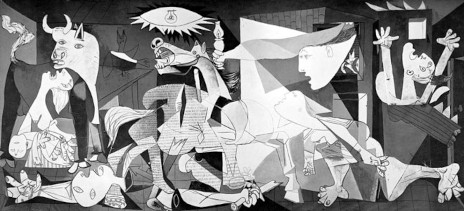
Look at the image below and consider the words of Bud Fox: What do you see in this?

click for larger view

The artist, Pablo Picasso, painted the mural "Guernica" in reaction to the Nazi bombing of the Spanish town of Guernica.

A tapestry copy of the mural hangs outside the entrance to the United Nations Security Council. Oddly enough, when Colin Powell argued for military action against Iraq in the spring of 2003, a blue curtain was hung over the tapestry. Now there's some symbolism.

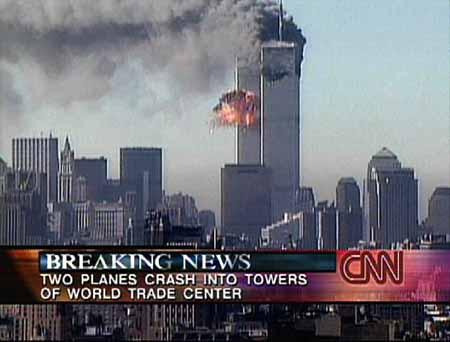
The image below is likely quite familiar.


As with a work of art, the meaning of the image varies from person to person and even within individual people, over time. Right after the event, many saw in it a call to do battle with those who would perpetrate such a deed. Over the next few days many will try to impose a meaning on the image. It will be interesting to see what meanings the image evokes as time passes.

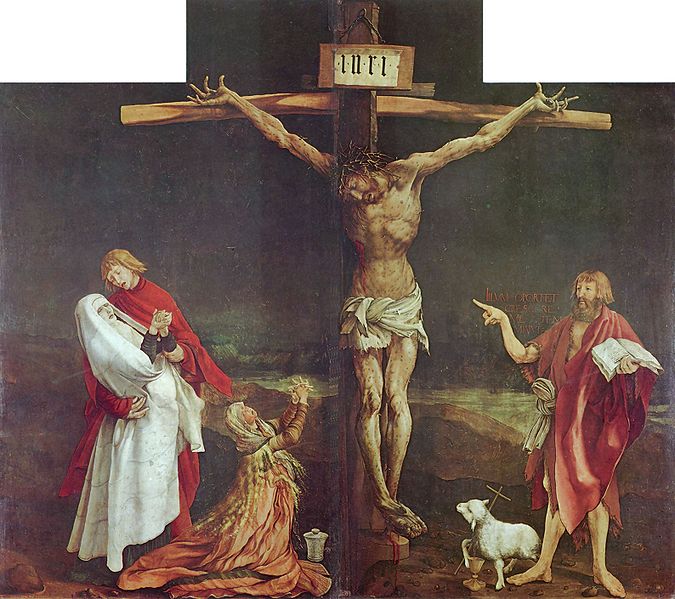
A few millennia ago, the Roman Empire used an image, in real life, to evoke fear of the wrath of the Empire. In the aftermath of a slave revolt, Marcus Lucinius Crassus ordered that the main road into Rome, the Appian Way, should be decorated with the crucified corpses of the thousands of captured slaves.


Today, many people see something quite different in the image of a crucifixion.

Tuesday, September 05, 2006

Does the Shoe fit?

I'm sure there are people who thought it was a mistake to fight the Civil War to its end and to insist that the emancipation of slaves would hold. I know there were people who said, 'Why don't we get out of this now, take a peace with the South, but leave the South with slaves?' Condoleezza Rice US Secretary of State

The old adage, if the shoe fits, wear it, comes to mind when contemplating recent Bush administration attempts to find the fitting historic metaphor to describe the War in Iraq and those who argue against its continuation. The opening quote from Ms. Rice which equates the War in Iraq with the US Civil War is one attempt and Secretary Rumsfeld's recent attempt to paint war critics as Neville Chamberlain-esque "appeasers" is another. Let's contemplate for a moment, if such metaphoric shoes might fit.

In one sense I agree with Ms. Rice. The War in Iraq and the US Civil War are both examples of wars where the cause célèbre wasn't really causal. Lincoln, according to this view, was far less interested in abolishing slavery (the Emancipation Proclamation was issued almost 3 years into the War) than in assuring the Northern Industrialists retained economic dominance. President Bush, as recent debates arguing in favor of another dictatorship in Iraq indicate to me, seems far less interested in leading the Iraqis to a "free democracy" than in assuring that the US retain dominance over global petroleum flows.

Mr. Rumsfeld's attempt to paint Saddam with the Hitler brush only serves to remind me of Godwin's Law: as an online discussion grows longer, the probability of a comparison involving Nazis or Hitler approaches 1. Oddly enough, as I discovered reading this article from Harper's the Neo-Cons should be aware of what their intellectual godfather, Leo Strauss, called, Reductio ad Hitlerum- the absurd smearing of any opposing line of thought as Hitleresque. ....nuff said.

In my view, one of the more fitting historical metaphors describing the War on Terror is the Spanish Hapburg's War on Protestantism, which began (in one frame of mind) with the Thirty Years War, and ended with the sinking of the "Invincible Armada" in the attempt to break Elizabeth's England and the eventual bankrupting of Spain.

Spain, like the US, in my view, overestimated both the efficacy of its clearly superior war machine in changing hearts and minds- despite winning many battles Protestantism kept winning the war, and the economic advantage of monetary inflation.

Religious dogmatism, another Carlinesque word combo- religion seems to me about enlightening minds, not closing them behind repeated dogmatic mantras, fueled both leaders, Philip II and George Bush.

The economic aspect seems to me quite apt. Just as Spain found that the huge inflow of Gold from the Americas allowed them to, for a while, buy without working, so to may America find that issuing the world's reserve currency allows them to, for a while, buy without working. Ultimately, however, such actions only serve to weaken the underlying economy, in a way which is hidden from view, until it is too late.

The ideological rigidity of the Spanish Hapsburgs led them to sideline and then purge the nation of dissenting groups, like the Moors and the Jews, who just happened to be the a large portion of the entrepreneurs of the nation. I hope similar purging of dissenting groups doesn't occur here, but the signs at the moment are not promising.

Of course, one key element that distinguishes life in the present moment from history is the lack of completion. We'll have to wait and see which metaphoric shoes history deems fitting to describe the current adventures.

Thursday, August 31, 2006

Soros on the dis-utility of the "Terror" Frame

George Soros has popularized a well studied, but alas not well known feature of human awareness under the rubric of Reflexivity. That is, humans tend to view the world through common frames, which pre-sorts, in a sense, their perceptions of experience.

In the world of finance, if market participants become bullish, i.e. if they adopt a bullish frame of mind, they will tend to focus on the positive until it becomes too painful to continue.

In an editorial in today's Boston Globe, Blinded by a Concept, Mr. Soros applies his notion of reflexivity to the Terror frame of mine, and warns that the pain is going to get worse until we drop it.

For the financially minded, remember that reflexivity leads one to Soros' trading maxim- find the trend whose premise is false, and bet against it.

Worse than a conspiracy theory...

Thanks to the internet, one can find conspiracy theories under every virtual rock overturned. Like the printing press before it, which decentralized, dare we write, democratized, publication of the written word, the internet acts as an amplifier of non-mainstream ideas. It is the medium through which Dostoyevsky's fire currently jumps from mind to mind.

As one who believes that ultimately the truth (or whatever variant thereof which comfortably fits in the vessels of the times) wins out, I think we live in exciting, albeit dangerous times. Any idea can be amplified and the death throes of certain ideas have human costs.

But my focus today is not on the new medium but on the content therein. I've been thinking about causal factors behind government conspiracy theories. One, as noted above, is merely the ease, by virtue of the new medium, with which such ideas can be transmitted.

Another causal factor might be a desire for the world not to be the way it seems. That is, it may well be easier to imagine government involvement in, say, 9/11 than to imagine that a group of otherwise unspectacular humans pulled off such a tragic event. Contemplation of the latter leads one to accept the ease of repetition.

As Hitler seems to be a topic of conversation in the mass media these days let's use his example as foil. There were many "conspiracy theories" surrounding Hitler's Third Reich. I think some arose because it was easier to imagine a conspiracy with greed, revenge or other self-serving notion as driving factor than to take him seriously. Surely he couldn't believe what he wrote years before he came to power and what he was saying at rallies...it was all just a ploy to seize power....right?

Alas, in Hitler's case, it was worse than a conspiracy, it was the truth. He believed his own bullsh!t..(a.k.a. becoming one's own God)....and that is really scary.

Wednesday, August 30, 2006

The Greenspan Era is over

Further progress in global economic integration should not be taken for granted, however. Geopolitical concerns, including international tensions and the risks of terrorism, already constrain the pace of worldwide economic integration and may do so even more in the future. And, as in the past, the social and political opposition to openness can be strong. Although this opposition has many sources, I have suggested that much of it arises because changes in the patterns of production are likely to threaten the livelihoods of some workers and the profits of some firms, even when these changes lead to greater productivity and output overall. The natural reaction of those so affected is to resist change, for example, by seeking the passage of protectionist measures. The challenge for policymakers is to ensure that the benefits of global economic integration are sufficiently widely shared--for example, by helping displaced workers get the necessary training to take advantage of new opportunities--that a consensus for welfare-enhancing change can be obtained. Building such a consensus may be far from easy, at both the national and the global levels. However, the effort is well worth making, as the potential benefits of increased global economic integration are large indeed.
Ben Bernanke Aug 25, 2006

It is certainly true, as Mallaby notes, that Walmart’s efficient distribution of imported goods has lowered the retail price of many manufactured goods. Auto workers in the Mid-west may not have a job anymore, but the dollars they get from borrowing against their accumulated home equity go further than ever before.

Ok, that remark is a bit over the top. But I think it goes to the issue – if nominal wages were constant and prices were falling, the Walmart economy would be consistent with higher real wages across the board. Workers released from manufacturing would find other jobs – in construction, perhaps, or in the services sector. The composition of the economy would change. I would still worry about taking on external debt to support a boom in investment in non-tradables. But living standards for the median worker would be rising as the changing composition of the economy increased its overall productivity.

That obviously hasn’t happened. At least not recently. Cheap Chinese assembly, global supply chains and efficient big box retailing haven’t been associated with much of a rise in the real purchasing power of the median worker. Indeed Leonhardt and Greenhouse note in New York Times that real compensation (counting benefits as well as wages) fell over the past year.
Brad Setser

The Greenspan era, in my view, is officially over. Ben Bernanke has emerged from the shadow of "welfare state confiscation" hatin' Greenspan to raise the once verboten topic of distribution, and at Jackson Hole, of all places. That is, it seems the new Fed Chair wants to alert the powers that be to the importance of the trickle in the trickle down economy.

Rising political tensions between the haves and have nots may have been obscured by the US media's slavish adherence to the "Terror" frame but like the proverbial tree falling in the forest, lack of awareness of a thing is not the same as the lack of a thing.

Political upheaval in Mexico, which may lead to the creation of a shadow, tax receiving, government has likely raised alarm bells among the powers that be in the US. To the extent the current housing slowdown becomes more of a crash, cheap labor might not be the only thing that crosses the border, political upheaval may follow.

For the financially minded, the rising concern over distribution issues, evident in both Bernanke's recent speech and a number pf papers cited in Mr. Setser's blog post (whose analysis I highly recommend) rather than a sole focus on Rubin's bigger pies, suggests to me that in the event further inflation is the monetary policy choice, as I suspect, then the next round of wage and price increases will be a bit more widespread.

One of the impediments to a virtuous (in the self-sustaining, not positive, sense) inflation cycle in the US of late has been the failure of wages to rise. If social stability is feared, wages may well begin to rise, and the cycle will be completed, just in time for the costs of the adventures in the Middle East to be apportioned.

Sometimes putting off until tomorrow is not wise because then all problems must be dealt with at once. This recalls the line from the spoof film "Airplane"..."look's like I picked the wrong week to stop sniffing glue."

Tuesday, August 29, 2006

This ain't no game, Jack

The timer on the scoreboard flashed under 2:00 and astonishingly, this motley crew of aging hockey players from upstate NY was still clinging to a 2-1 lead in the finals. Our opponents were a tough bunch of cops from Toronto who out shot us by more than 2 to 1 but just couldn't slide them by our goalie who was, as we say, "standing on his head."

Suddenly a fluke goal is scored by the Toronto cops on a deflected pass through the crease. The clock now shows just under 20 seconds and all I am thinking after playing 4 games inside of 48 hours is "please, no overtime." I get my wish- our opponents break the puck out of their zone, beat our defenseman and score with 2 seconds left. The buzzer sounds and the trophy is handed to the guys from Toronto while we skate off the ice dejected.

It is difficult to "spin" the results of a game, although this difficulty apparently dissuades few. There is only one question involved in assessing the results of a hockey game; who put more pucks in the opposing team's goal within the allotted time.

Victory and defeat are far less easy to determine in other avenues of human endeavor. Take Wars for example.

Who won the recent war between Israel and Lebanon (perhaps more accurately Hezbollah)?

Who's winning the War in Iraq?

Who's winning the War in Afghanistan?

Scoring Wars is difficult. What should we count? People killed? Territory taken?

Scoring Wars is very difficult. Even if we could arrive at a consensus of what to count to determine a victor, we would find it extremely difficult to verify the count. Hockey has referees and judges to determine penalties and goals while Wars are "self-scored."

Who killed whom and what territory is held by whom are not only fought over in real life but in the media as well- the war within the war. The Germans and Japanese who trusted official media accounts were a bit shocked to discover they weren't winning as the bombs started to fall on their cities. The scoreboard they trusted was showing the Home team up 5-2 when the real score was 2-8.

This makes planning difficult, which is unfortunate. Unlike our hockey game, which decided who would take home a trophy, wars often determine a significant portion of national flow of funds. Knowing who is winning and losing is key to choosing the form in which one denominates one's savings.

Reparations, the modern variant of tribute, and a silly one at that (take two functioning civilizations, blow up some of each others stuff and then fight over who should pay for the mess) are a case in point.

Iraq, by virtue of losing the first Gulf War still owes Kuwait billions of $. Germany, by virtue of losing WWI, owed the victors so much money that their currency eventually became worthless. The United States, by virtue of its failure to impose its will on the Vietnamese, had to pay for that war itself, thus contributing to the inflation of the 70s.

So I wonder.

Who's winning the War in Iraq?

Who's winning the War in Afghanistan?

Who's going to pay for these experiments in "democracy?"

I still chuckle at the notion of "imposing democracy" i.e. self rule, on a people. As George Carlin would say, it's like jumbo shrimp or military intelligence, two words which just don't go together.

In my view, those who come up with the right answers to the above questions, and position themselves accordingly, will be the big winners in the game of financial speculation. I won't argue the case here as this is another issue (like exercise) where division of labor is not helpful. I will, however, caution one more time, don't trust the home team scoreboard, which sometimes takes the form of financial market prices. Think for yourself on this one.

If the US gains greater control of Middle Eastern oil exports, many of the fears over the growing deficits will be quieted. Conversely, if control over ME oil exports is lost, the effects of those deficits will be felt much more strongly.

Somebody is going to pay for the war and for rebuilding the Middle East such that the residents will continue to export their oil. And these costs are rising by the minute.

This ain't no game, Jack. This is War.

Thursday, August 24, 2006

Back Monday

I'm off to a Hockey Tournament in Montreal this weekend so I won't be updating again until Monday.

Wednesday, August 23, 2006

CATO suggests a gentler, more grounded frame for Terrorism

A False sense of insecurity?

Even with the Spetember 11 attacks included in the count, the number of Americans killed by international terrorism since the late 1960s (which is when the State Department began counting) is about the same as the number of Americans killed over the same period by lightning, accident-causing deer or sever allegeric reaction to peanuts.

Tuesday, August 22, 2006

Propagandizing one's self out of work

From the Financial Times:

First it was the typewriter, then the teleprinter. Now a US news service has found a way to replace human beings in the newsroom and is instead using computers to write some of its stories.

Thomson Financial, the business information group, has been using computers to generate some stories since March and is so pleased with the results that it plans to expand the practice.


The computers work so fast that an earnings story can be released within 0.3 seconds of the company making results public
.

Well, well, apparently there are limits to the virtue of being a corporate shill. If you are just going to be a mouth piece for the corporate view (and what else what you call a reporter who simply takes the corporation's view and data at face value) you are expendable.

Descartes wrote what has come to be known as the cogito, I think, therefore I am. He rejected the idea of simply repeating the lies others had told him. Reporters at Thomson might be finding new meaning in the cogito, or they would if it was ever found in a corporate news release.

Now, let's talk about a few of the guys who work for the major news organizations regurgitating press releases from the Department of Defense, Bureau of Labor Statistics and Bureau of Economic Analysis. I think replacing those who are willing to sell their souls with machines a step towards greater honesty in society.

The end of Terrorism as we know it

From Today's Guardian:

The Tories have gained over the last month while support for Labour has fallen heavily in the wake of the recent alleged terror plot against airlines. An overwhelming majority of voters appear to pin part of the blame for the increased threat on Tony Blair's policy of intervention in Iraq and Afghanistan. Ministers - including Mr Blair - have repeatedly denied that there is a connection. But 72%, including 65% of Labour voters, think government policy has made Britain more of a target for terrorists. Only 1% of voters believe the government's foreign policy has made Britain safer, a devastating finding given that action in Iraq and Afghanistan has been justified in part to defeat Islamist terrorism. The findings will shock many at Westminster who had expected Labour to gain ground following John Reid's high-profile handling of the alleged plot against transatlantic airlines. Carried out over the past weekend, following the series of terror arrests, the poll shows voters do not believe the government is giving an honest account of the threat facing Britain. Only 20% of all voters, and 26% of Labour voters, say they think the government is telling the truth about the threat, while 21% of voters think the government has actively exaggerated the danger. A majority, 51%, say the government is not giving the full truth and may be telling less than it knows.

Yesterday from CNN:

Just 35 percent of 1,033 adults polled say they favor the war in Iraq; 61 percent say they oppose it -- the highest opposition noted in any CNN poll since the conflict began more than three years ago. ....... Most Americans (54 percent) don't consider him [President Bush] honest, most (54 percent) don't think he shares their values and most (58 percent) say he does not inspire confidence.

The full survey results details the public's growing sense that the President is not honest. 77% of the public (according to this survey) believed him to be honest in late April 2002. Currently, only 47% believe him to be honest.

As I have been noting a bit in my musings of late, the human spirit is a fickle thing. Sometimes, as occurred in the US after 9/11 and recently in Lebanon, external threats drive people together, while at other times, they can lead to dissatisfaction with those in charge.

It may well be that another 9/11 type of a attack could lead people here in the US or in the UK to see their current leaders not as saviors but as part of the problem. At least that is one view I entertain after reading these latest poll numbers.

In that regard, I think we may be witnessing the beginning of the end of terrorism as we know it. The more that terrorism becomes a liability for the majority party, the more likely will its framing change.

Of course, the majority party needs to discover the truth of this for themselves.

Monday, August 21, 2006

Pricing power and inflation

Inflation cannot rise because firms don't have pricing power, goes one of the anti-inflation arguments I come across quite often.

It seems like a sound argument- If firms can't raise prices, inflation cannot occur. Yet, I lived through a period of time (the late 90s) in a region (SE Asia) where pricing power was very limited, but inflation rose dramatically anyway. The flaw in the argument recalls the over my dead body argument. The response being...if that's the way you want it.

If a firm cannot raise prices without severely reducing unit sales but the firm's input costs are rising it goes bankrupt depending on the amount of cash it can get its hands on. Other firms, whose financials are geared toward lower volumes or with deeper pockets will make up the slack, at higher prices.

With that thought in mind, I'm keenly watching the US auto industry. Bankruptcies could signal a round of inflation as competition declines, i.e. the pricing power of the industry as a whole gets divided amongst fewer hands.

Speaking (actually writing) of pricing power, it seems the Fed fears it no longer has any. They may be correct in that view. For the first time since 2000 (when the Fed removed $20 odd Billion from Dec. 1999 to Feb 2000), the monetary base is contracting, albeit slowly (less than $5B from the May peak).

Funny how rates could rise substantially (thus inflating interest profits at the banks) for many quarters without much complaint but when the monetary base contracts, people begin to worry.

The former action is, in my view, the Fed, i.e. the OPEC of money, acting as an agent for the banks, and giving it some room to cut later, the latter action is the Fed trying to keep a lid on inflation, or perhaps just trying to gin up a little equity/housing market sell off, which would get the world crying for some more money. (Gosh, I start writing about the Fed and I get verbal inflation, no simple sentences, just run on and on and ons).

Fortunately, Helicopter Ben will be there to bail us all out, likely to popular acclaim.

The line in the sand has been drawn

We're not leaving [Iraq] so long as I'm President. That would be a huge mistake. President Bush Aug 21, 2006

The Dude wonders which proposition is the huge mistake.

Saturday, August 19, 2006

The Authoritarian and the nature of the world

Intolerance of ambiguity is the mark of an authoritarian personality. - Theodor Adorno

see also John Dean

........................
President Bush answers a few questions - Aug 18, 2006

Q Mr. President, the federal ruling yesterday that declared your terrorist surveillance program unconstitutional -- the judge wrote that it was never the intent of the framers to give the President such unfettered control. How do you respond, sir, to opponents who say that this ruling is really the first nail in the coffin of your administration's legal strategy in the war on terror?

THE PRESIDENT: I would say that those who herald this decision simply do not understand the nature of the world in which we live. You might remember last week working with the -- with people in Great Britain, we disrupted a plot. People were trying to come and kill people. [Dude wonders to self....this murder stuff is new???]

Q Mr. President, on Lebanon, how can you say that Hezbollah has suffered such a bad defeat when it's rebuilding -- helping rebuild in southern Lebanon, and it remains intact? And secondly, are you disappointed at all about France's decision to scale back its support of the international force?

THE PRESIDENT: I think when people take a sober look at what took place in Lebanon, they'll realize that the destruction was caused by Hezbollah. Hezbollah caused the crisis. It was Hezbollah's kidnapping of Israeli soldiers, as well as Hezbollah's launching rockets that caused Israel to defend herself from an action that the Lebanese government didn't support.

The first reaction, of course, of Hezbollah and its supporters is, declare victory. I guess I would have done the same thing if I were them. [indeed] But sometimes it takes people a while to come to the sober realization of what forces create stability and which don't. [apparently so]

....................

The moral code depends for its validity upon a consensus of human opinion about what man's nature really is, and what it ought to be, when freed from this mysterious self-contradiction and enabled to run true to itself.

When there is a genuine conflict of opinion, it is necessary to go behind the moral code and appeal to natural law-to prove, that is, at the bar of experience, that St. Francis does in fact enjoy a freer truth to essential human nature than Caligula, and that a society of Caligulas is more likely to end in catastrophe than a society of Franciscans. [may the lesson be a short one]

Dorothy Sayers "The Laws of Nature and Opinion" The Mind of the Maker

'nuff said

Wednesday, August 16, 2006

The purpose of Education

Has it ever struck you as odd, or unfortunate, that today, when the proportion of literacy throughout Western Europe is higher than it has ever been, people should have become susceptible to the influence of advertisement and mass propaganda to an extent hitherto unheard of and unimagined? Do you put this down to the mere mechanical fact that the press and the radio and so on have made propaganda much easier to distribute over a wide area? Or do you sometimes have an uneasy suspicion that the product of modern educational methods is less good than he or she might be at disentangling fact from opinion and the proven from the plausible? Dorothy Sayers - The lost tools of learning

When I graduated from High School some 23 years ago I gave a speech titled The Purpose of Education. The topic was a bit (OK a lot) beyond my ability but I did come up with one memorable line: the purpose of education is to teach people to love learning.

Unfortunately I didn't catch the learning bug for another 15 years and ended up wasting a opportunity to lose myself in the wonderful libraries of Cornell. But this is not an essay on my misspent youth. I mention it only to note that I spent many years behaving as if education was about passing tests, getting a degree and perhaps putting that knowledge to work to make money. I did not take my own advice.

Like many of my fellow students I thought in terms of subjects, in my case Physics and Philosophy. Perhaps Dorothy Sayers described this viewpoint best when she wrote: Do you often come across people for whom, all their lives, a "subject" remains a "subject," divided by watertight bulkheads from all other "subjects," so that they experience very great difficulty in making an immediate mental connection between let us say, algebra and detective fiction, sewage disposal and the price of salmon--or, more generally, between such spheres of knowledge as philosophy and economics, or chemistry and art?

My problem, it seems to me now, was that I failed to see the unifying force in developing a sense of the world. That is, I did not understand the power of the word. Each subject, after all, is but an attempt to use language to describe, communicate and contemplate different aspects of human life.

The study of language per se, grammar, was, to my young mind, an exercise in drudgery which got worse as I began to study Latin. I can remember heckling my Latin teacher, to the chuckles of my classmates with quips like, "who had cared about the pluperfect tense." Being a kindly old man he would calmly respond, "people, unlike you, who wished to communicate effectively...please continue your conjugation of amare."

Yet without a solid understanding of language per se we are all like people who drive cars but have no idea how they work. Under those circumstances we don't appreciate the power of the car until it breaks down or doesn't start. Unfortunately, one cannot take one's understanding of language to a shop for repair. This is one instance where there can be no division of labor. A linguist within ear shot can correct your use of a verb, or offer a few alternative words that better advance your argument, but this is a one shot affair. The car will still be broken once you leave the shop.

It was, I believe, no mere coincidence that I caught the learning bug at the same time I began to appreciate the power of language per se while traveling around the world. There are few things more frustrating than needing to communicate an idea only to have one's ignorance of a language stand in the way. This same problem happens quite often internally, but often without notice, when contemplating an idea. It is very difficult to solve a problem if you don't frame the question to yourself precisely.

It is also, I believe, no mere coincidence that Dark Ages in history are associated with a decline in linguistic proficiency. A read of 8th Century Latin prose suggests to me that it must have been difficult for even the most educated to grasp the subtleties of Cicero. I view with dismay the fascination in American culture with sound bites today.

The lack of appreciation for language per se leaves us with a bunch of "experts" who cannot communicate with each other. The modern economist, who spends most of his time in school learning box-jenkins and other statistical tools, is almost amazed to learn that there was an economic world before 1945, when GDP accounting became the rage. He has difficulty communicating with the historian or philosopher who speak in terms of the waxing and waning of empires or ideas.

Worse, the common man, educated just enough to believe he understands, takes the views of these various experts as givens if they align with his prejudices. Who knows, perhaps the rise of the authoritarian personality is merely a sign of the lack of appreciation of language.

As Dorothy Sayers put it: For we let our young men and women go out unarmed, in a day when armor was never so necessary. By teaching them all to read, we have left them at the mercy of the printed word. By the invention of the film and the radio, we have made certain that no aversion to reading shall secure them from the incessant battery of words, words, words. They do not know what the words mean; they do not know how to ward them off or blunt their edge or fling them back; they are a prey to words in their emotions instead of being the masters of them in their intellects. We who were scandalized in 1940 when men were sent to fight armored tanks with rifles, are not scandalized when young men and women are sent into the world to fight massed propaganda with a smattering of "subjects"; and when whole classes and whole nations become hypnotized by the arts of the spell binder, we have the impudence to be astonished. We dole out lip-service to the importance of education--lip- service and, just occasionally, a little grant of money; we postpone the school-leaving age, and plan to build bigger and better schools; the teachers slave conscientiously in and out of school hours; and yet, as I believe, all this devoted effort is largely frustrated, because we have lost the tools of learning, and in their absence can only make a botched and piecemeal job of it.

Language, the word, is the basis of our sense of the world, and thus our non-conditioned behavior in it. The failure to appreciate this, leaving grammar to grammarians, risks a loss of our civilization.

My advice, pick up a Latin textbook. And learn to love learning.

Tuesday, August 15, 2006

King Canute on the spiritual shores

"What is he doing there?”

“He is putting the fire out, your Excellency.”

“Not likely. The fire is in the minds of men and not in the roofs of houses."

Dostoyevsky - The Possessed

Long ago, England was ruled by a king named Canute. Like many leaders and men of power, Canute was surrounded by people who were always praising him. Every time he walked into a room, the flattery began.

"You are the greatest man that ever lived," one would say.

"O king, there can never be another as mighty as you," another would insist.

............

The king was a man of sense, and he grew tired of hearing such foolish speeches.

One day he was walking by the seashore, and his officers and courtiers were with him, praising him as usual. Canute decided to teach them a lesson.

"So you say I am the greatest man in the world?" he asked them.

"O king," they cried, "there never has been anyone as mighty as you, and there never be anyone so great, ever again!"

"And you say all things obey me?" Canute asked.

"Absolutely!" they said. "The world bows before you, and gives you honor."

"I see," the king answered. "In that case, bring me my chair, and we will go down to the water."

"At once, your majesty!" They scrambled to carry his royal chair over the sands.

"Bring it closer to the sea," Canute called. "Put it right here, right at the water's edge." He sat down and surveyed the ocean before him. "I notice the tide is coming in. Do you think it will stop if I give the command?"

His officers were puzzled, but they did not dare say no. "Give the order, O great king, and it will obey," one of then assured him.

"Very well. Sea," cried Canute, "I command you to come no further! Waves, stop your rolling!. Surf, stop your pounding! Do not dare touch my feet!"

He waited a moment, quietly, and a tiny wave rushed up the sand and lapped at his feet.

"How dare you!" Canute shouted. "Ocean, turn back now! I have ordered you to retreat before me, and now you must obey! Go back!"

And in answer another wave swept forward and curled around the king's feet. The tide came in, just as it always did. The water rose higher and higher. It came up around the king's chair, and wet not only his feet, but also his robe. His officers stood before him, alarmed, and wondering whether he was not mad.

"Well, my friends," Canute said, "it seems I do not have quite so much power as you would have me believe. Perhaps you have learned something today. Perhaps now you will remember there is only one King who is all-powerful, and it is he who rules the sea, and holds the ocean in the hollow of his hand. I suggest you reserve your praises for him."

Inspirational Stories

In a sense, some of the greatest changes in the story of man are the effects of Dostoyevsky's fire in the minds of men.

What was the impetus which drove Alexander the Great to not only conquer much of the then known world but radically change the behavior of the conquered? Was it his military skill or the way in which Hellenistic views enflamed the minds of men once entertained? Military might, in my view, only goes so far. It is the ideas which truly conquer a people, or not as the case may be.

Consider the spread of Christianity, which prior to its adoption by Constantine enflamed the minds of adherents sufficiently that many of them were willing to be oppressed in some cases to the point of horrible deaths rather than accept the Emperor or the pagan Gods as God. While some doubt the existence of Christ the person, it is far more difficult to doubt the influence of the story, the myth, in its positive sense, of Christ.

Consider the spread of Islam. Even more astonishing than Alexander's many conquests, given their apparent lack of military prowess before him, Mohammed's followers surprised some of the great leaders of their time with their zeal. Within a century Islamic ideas captivated people stretching from the Straits of Gibraltar to the Indus river. The fire of Islam could not, as Dostoyevsky noted with respect to a different fire, be put out in the material world for it too was burning in the minds of men.

This is not to argue that such fires always lead to positive outcomes as a complete read of The Possessed will attest. What seems clearer to me is that such fires, such passions, once ignited often burn far hotter and far longer than some of the spiritual arsonists might have imagined.

When President Bush at his second inaugural spoke of igniting such a fire: By our efforts, we have lit a fire as well - a fire in the minds of men, I winced recalling the quote from an unnamed Bush team member via Ron Suskind, who spoke of creating reality as they go. Passion for the false has a habit of doubling back before setting out anew. As some of the early spiritual arsonists in the French and Russian Revolutions discovered, sometimes the fire burns so hot that the arsonists themselves are consumed. Perhaps "wildfire" would be a better term.

I agree with President Bush that a fire has been lit in the minds of men, but I don't share his certainty over its ultimate effects. The fire will burn hottest where the tinder is driest or in Christian terms, the seeds will grow best in fertile soil but blow away off rocky ground. Minds opened by oppression are often ready to ignite.

These days as the spiritual arsonists watch the events of the world I get the sense of King Canute standing at the spiritual shore commanding the tide to ebb, only in this case, they have yet to discover the impotence of which King Canute was so sure.

In a sense King Canute represents the effects of such a fire. While the Vikings were able to conquer militarily it was they who ended up leaving their Norse Myths of Valhalla and adopting Christianity. Some fires burn hotter than others, it seems.

Secretary Rice may well be correct that we are witnessing the birth pangs of a new Middle East. But as the old adage goes, be careful what you ask for, you might get it. Almost 1000 years ago the Crusaders gave birth to a new mIddle East, but it was led by Saladin and then Othman, not the Christian Knights. The new new Middle East might not be grow to be an adult Ms. Rice recognizes.

Monday, August 14, 2006

Financial market implications of recent wars

Just a quickie here but in watching the markets' response and reading press reactions to the easing of hostilities in Lebanon, I find I take a different view. Surprise.

The buzz, as best I can glean sitting in my barn more than 100 miles away from Wall St. is that "no war is good for bonds and equities, bad for oil and Gold." This reminds me of one of my wife's descriptions of less educated economic views; vending machine economics. A more nuanced view might prove a little more apt.

Almost 5 years ago, the US began a war in Afghanistan, and it still rages. Almost 3.5 years ago, the US began a war in Iraq, and it still rages. Israel seems to be backing away from its month long war in Lebanon. In each instance the strategy was similar; make use of the vast differential in air power and soften up the enemy by bombing the country. Shock and Awe was the phrase that filled the airwaves.

Yet, it appears that the "shock value" of air assaults are diminishing rapidly over time. In the case of the War in Lebanon, Hizbollah appeared to jump right back each time the F-16s flew by. The Israeli Army found that this militia at least, doesn't shock easily.

So, what are the financial market implications of this. Well, in the case of Lebanon, it seems to me to be a more open negotiation. That is, it isn't a victor dictating terms but two sides who will have to give and take.

In the event that negotiation between the Islamic world and the West is not conducted as victor to vanquished but as two parties who realize that either can inflict horrible damage on the other, the global flow of funds might change dramatically.

I have previously touched on the issue of the return on investment of US military spending. If our military cannot produce better deals, it truly is a negative investment return, unless you get your jollies blowing things up.

We might, in the coming months, get a sense of how much US$ recycling was tribute based.

Two blogs I enjoy reading

History Unfolding - a history professor shares his broader perspective on current events

Sic Semper Tyrannis - a retired senior officer of U.S. Military Intelligence and U.S. Army Special Forces (The Green Berets) shares his views on the current wars in the world

Evolution, less than meets the eye?

A recent article from Livescience.com detailed the results of an international survey.

The researchers combined data from public surveys on evolution collected from 32 European countries, the United States and Japan between 1985 and 2005. Adults in each country were asked whether they thought the statement “Human beings, as we know them, developed from earlier species of animals,” was true, false, or if they were unsure.

The study found that over the past 20 years:

* The percentage of U.S. adults who accept evolution declined from 45 to 40 percent.
* The percentage overtly rejecting evolution declined from 48 to 39 percent, however.
* And the percentage of adults who were unsure increased, from 7 to 21 percent.

The aim of the article, in my reading, was to expose the silliness, in the opinion of the author, and on that small point I don't disagree, of Protestant Fundamentalism.

Yet, the question of evolution doesn't seem to me to be so simple. That question being, how did humans develop? Was the essential development biological alone or was it spiritual, i.e. cognitive, having to do with man's sense of the world.

Some of the more radical fundamentalist beliefs do make simple straw men to knock over. Some of my scientists friends will laugh and say, the world is older than the 7000 years these evolution deniers claim. Man has lived on this planet far longer than that, so evolution is proven.

What if, I ask, the essential quality that makes humans human isn't the ability to walk upright, or use tools but the ability to think about the self and the external world. That is, what if the essential quality of man is the ability to abstract, and change's one's behavior accordingly. Apes are not what we would call civilized, and (sometimes at least) humans are.

It seems to me that our ability to think, and communicate those thoughts is the reason behind this. Men are not biologically ants or bees who seem designed to form large communities, yet we do and our biological ancestors, the early hominids, like the Australopithicines apparently did not.

In a speech to the UN in 1985, J. Krisnamurti, spoke on the issue of evolution:

Mankind, man, has lived on this earth over fifty thousand years, and perhaps much longer, or for less duration. During all this long evolution man has not found peace on earth - 'pacem in terris' has been preached long before Christianity, by the ancient Hindus and the Buddhists. And during all this time man has lived in conflict, not only conflict with his neighbour but with people of his own community, with his own society, with his own family, he has fought, struggled against man for the last five thousand years, and perhaps more. Historically there have been wars practically every year. And we are still at war. I believe there are forty wars going on at the present time. And the religious hierarchy, not only the Catholics but the other groups have talked about 'pacem in terris', peace on earth, goodwill among men. It has never come about - to have peace on earth. And they have talked about peace when you die and go to heaven and you have peace there.

And in a Q&A following the speech

24 QUESTION: At the end you said that we need to break the pattern of conflict between man. My question to you is, do you see that as something of an evolutionary process that inevitably will happen? Or do you see it as something that we all have to work very hard to achieve? And there is an expression that goes something like this: in times of darkness the eye begins to see. And why I am throwing this at you because in a sense it is either going to happen, or it is not going to happen, but how do you see it happening?

25 K: I don't quite understand your question, sir.

26 Q: All right. You talk about breaking the pattern, man has a pattern, the brain has a pattern, and that pattern has to be broken in order for there to be peace in the world.

27 K: Of course.

28 Q: Now do you see the breaking of that pattern being an active movement, or a natural progression in the evolution of man?

29 K: Sir, have we evolved at all?

30 Q: I think we are continuously evolving.

31 K: So you accept evolution - psychological evolution, we are not talking about biological or technical evolution - psychological evolution. After a million years, of fifty thousand years, have we changed deeply? Aren't we very primitive, barbarous? So I am asking if you will consider whether there is psychological evolution at all? I question it. Personally, to the speaker, there is no psychological evolution: there is only the ending of sorrow, of pain, anxiety, loneliness, despair and all that. Man has lived with it for a million years. And if we rely on time, which is thought - time and thought go together - if we rely on evolution then another thousand years or more, and we will still be barbarous.

32 Q: My question is: what would have to happen for there to begin to be psychological evolution as the speaker understands it?

33 K: What about psychological evolution? I don't quite understand the question.

34 Q: You have said that you do not think there has been psychological evolution. My question is: what can happen so that there will be, so that there can be, psychological evolution.

35 K: Madam, I am afraid we haven't understood each other. We have lived on this earth from the historical, as well as ancient enquiry, on this earth for fifty thousand years or more or less. And during that long period of evolution psychologically, inwardly, subjectively, we have remained more or less barbarous - hating each other, killing each other. And time is not going to solve that problem, which is evolution. And is it possible, we are asking, for each human being, who is the rest of the world, whether that psychological movement can stop and see something afresh?

To me, blind faith in the "evolution" evidenced by the questioner to solve man's ills as silly, and perhaps more dangerous than the Protestant Fundamentalist view.

Humans can think, although as William James puts it so well, many think they are thinking when really they are just rearranging their prejudices. We can think and choose, but sometimes, (Krisnamurti would likely have said, often) we choose barbarism.

I don't know which is sillier, praying to the God of evolution, which is to wait for time to solve man's ills or praying to "an eye for an eye" Jehovah. Civilization is, in my view, a choice, a change of mind, from barbarism. To paraphrase Ben Franklin, it's a civilization, if you can keep it.

I'm still working on the King Canute piece, most likely it will be ready tomorrow.

Friday, August 11, 2006

Does "divide and conquer" always work? et. al.

While working on a longer piece, tentatively titled, King Canute on the spiritual shore, I thought to keep the daily blog entry thing going with a few brief notions to ponder.

Firstly, I assume some (most, all) of you are familiar with the strategy of divide and conquer. The theory goes that you divide your enemy and he fights himself more than he fights you.

This theory leads some to draw comfort from the ongoing split between Sunnis and Shi'ites. So long as they fight each other, the theory goes, they won't be strong enough to fight the West.

Yet, the history of Western Civilization gives us a counter to that theory. The expansion of Western Civ, both vs. the Islamic Ottoman Empire and around the world occurred while the Protestant Reformation and Counter Reformation was occurring. Perhaps religious debate taken seriously is a sign of intellectual vigor in a culture, not a sign of weakness.

Secondly, in response to the Terror Plot, I wonder what the world would be like, if, instead of invading Iraq, the US and UK had directed those funds ($100s of Billions at this point) towards rebuilding Afghanistan as was done with Germany and Japan after WWII. Would Nasrallah's and bin Laden's words fit as easily in people's minds?

I wonder, in that case, if these supposedly Pakistani and other South Asian youths would have been plotting?

It seems to me that a few hundred billion spent building hospitals, roads and schools would sway far more hearts and minds in the West's favor than blowing up the same. If genecide isn't an option, (and I hope it isn't) then eventually we will have to get along.

The "beat them until they submit" policy doesn't seem to be generating much in the way of positive results.

I just hope we haven't waited too long to show another face. The father who beats his son for 5 years may find that a compensating car and credit card at 16 still leaves him with a hateful child.

On a lighter note, or at least a look at tragedy through a comic lens check out this You-Tube of a recent Daily Show: one joke: every day the cafes and shops of the Middle East literally explode with excitement at the idea of a new Middle East.

Thursday, August 10, 2006

The Greater Pie Theory of Economics

From William Greider's Conversation with Robert Rubin

Rubin: Bob [Reich] and I used to have a discussion--if you could trade off some part of growth to have some better distribution, would you do that? I always said I wouldn't, because I figured you want to get maximum growth and then try to figure out how to get the distribution. Bob used to feel--and look, it was a reasonable position, it wasn't where I was--that if you have somewhat less growth and better distribution, that was a better place to be.

Greider: Did you change your mind about that?

Rubin: No, because I still think that once you get the better growth, you can figure out the other part, the distribution. I still think I'd get the most pie I could and then figure how to get the distribution that results in everybody getting it--broad participation in it instead of the very limited participation we've had.

I seem to remember back when I started studying economics most definitions of the study included some reference to managing limited resources. Today when I search for definitions I don't find that reference as often as I recall but perhaps I'm just getting old and my memory is fading.


One definition I found had me laughing, the science that deals with the production, distribution, and consumption of wealth. I guess the poor don't practice economics.

Yesterday when I suggested that I couldn't tell if, in the event of a radical changing of the guard, things would improve, it was, in part, with Rubin's "greater pie theory" in mind.

If Mr. Rubin is one of the Democrats' shining stars and his economic philosophy is as stated, I can't see how things will get better, particularly if things like oil and water become, relative to growing populations, scarcer and scarcer.

I wonder if widespread belief in the "greater pie theory" is what aligns the elite of the right and the left in the US...and what is, in my view, driving us over the cliff.

Perhaps I am naive but if you can't be happy with what you have, and your major products are financial innovations and armaments, eventually you will have to take somebody else's stuff. If too many people play that game, well, you get what we see now. If even more people play then the planet will become very small indeed.

I much prefer the old definition of economics.

Not knowing the power of flame, the insect falls into it.
The fish swallows the bait, not knowing the hook inside.
That, well aware of the vanity and dangers of the world,
We cannot give it up —
Such is the power of Delusion.

Bhartrihari

Wednesday, August 09, 2006

The revolt of the Guelphs

Nothing appears more surprising to those who consider human affairs with a philosophical eye, than the ease with which the many are governed by the few. David Hume

Having spent much of the decade of the 90s traveling around the world, living in alien cultures, I have shared Hume's bemusement at the ease by which the many are governed by the few. Lately, as I watch that control weaken, I'm coming to see just how such a thing comes to pass, as I imagine Hume would have had he not died before the American and French Revolutions. It is, I believe, through the actions of those in what Daniel Dafoe calls "the middle station of life" that such control is maintained or lost. I bring this to your attention as it seems to me that those in this middle station, Dante lovers like myself might prefer "Guelphs", appear to be in revolt against the Empire or, to retain the Dante metaphor, the "Ghibellines."

When I refer to the Guelphs or those in the middle station I'm not referring to the entire middle class, but rather to the working aristocracy, if you will. That is, I refer to those who own, not at a distance, but hands on; the restaurant owner who cooks or tends bar, the grocer who will move boxes if other labor is not available, and the contractor who will pick up a nail gun are some examples. I'm referring to people who can survive in both worlds of ownership and labor, the bridge, if you will between the two classes.

Before I proceed, let me note that people slide in and out of such classes over the course of their lives as their changing sensibilities align with this or that group. Let me also note that these shifts are not always altruistic. Often the Guelphs simply take advantage of their increased awareness of popular discontent to grab some of the pure, isolated aristocracy's power. Yet, by virtue of their need to harness popular discontent, Guelph revolts more often than not leave the common man better off, if for no other reason than to forestall a new batch of Guelphs usurping their newfound power by the same mechanism.

In the United States, the last significant, successful Guelph revolt, in my opinion, occurred in the 30s. With the then aristocracy deaf to Herbert Hoover's calls to share the wealth, Volunteerism was the motto of his plea, a large segment of Guelphs saw an opportunity to upend the Gilded Age aristocracy.

This revolt was fairly vigorous as many of the Guelphs got stung by the collapse of the equity market, one of the modern means by which the Ghibellines align their interests with the Guelphs. The decades of the 80s and 90s which saw real incomes for the common man languish while the equity market soared, are an example of the effectiveness of this strategy. Conversely, the lack of wealth sharing (i.e. greater concentration of wealth into fewer and fewer hands) over the past 5 years sets the stage for what I believe will be the next Guelph revolt.

"Enough preamble, Dude,
you are probably thinking, "cut to the chase."

Sorry, I just got my hands on Dorothy Sayers translation of Dante's Inferno. I still prefer Longfellow's poetry but her analysis and explanatory notes left me with Guelphs and Ghibellines on the brain. Oops, another digression, OK...to quote the Commander in Chief, Let's Roll.

Specifically, I note a few recent developments that suggest to me a coming Guelph revolt:

1) the continuing and strengthening revolt in Mexico against the PAN led by Lopez Obrador

2) the Lieberman upset by Ned Lamont in yesterday's Democratic primary for US Senator

3) rising fears of the effects of a sustained anti-inflation campaign, which led the Fed to call and
end to its tightening campaign


4) rising popular dissent against the Iraq war in the US

5) rising international disgust with the heavy handed tactics of the Empire against civilian populations

6) reassessment of the limits of military power alone in dealing with civilian populations.

More generally, the pure aristocracy seems increasingly isolated from the common man, and seems, to me at least, to be caught in a prison of their own rhetoric, duped by the modern day Rasputins, the Neo-Cons. Propaganda is an effective means of controlling the masses, but a poor basis for effective policy. Eventually even the most disciplined minds who are forced to use propaganda fall prey to its effects. It's never good to believe your own bullsh*t.

Staying on the pragmatic track, how might this Guelph revolt manifest? Here's a few guesses from my very cloudy crystal ball:

1) The Lamont victory will embolden some to run on what the Ghibelline press now calls a "radical anti war platform" despite polls which show that the radicals are the war supporters.

2) The Democratic party which may take Congress, barring some Diebold election hijinks by Republicans which could ignite a Mexican type fury, will be more Gore-ish than Clinton-ish.

3) The Fed and eventually other Central Banks will tone down the war on inflation blaming the next round of price increases on "external events"

4) Gold and precious metals will increasingly be seen as safer than the fiat markets which are being looted to finance these apparently unwinnable and unpopular wars

5) Mexico will find its interests align more with Venezuela, Brazil and Argentina, than the US

6)The dream of reshaping the Middle East will be shelved for a generation, if not, expect a Shi'a revolution that mirrors the Chavez revolt

7)Russia and China will continue to grow in power

8) a new left-leaning mainstream press will emerge from the blogosphere

Whether these expected changes, if they do arrive, prove positive or negative I don't know.

Hopes for positive change will be high in the event of a Democratic takeover of one or both Houses of Congress, a forced resignation by Tony Blair in the UK or a cessation of hostilities in Iraq and Lebanon. Whether those hopes get fulfilled in the form of a rising gneral prosperity depends on the character and ability of those who find themselves with power. Efficient resource allocation tends to break down during revolts against the power structure.

I don't know Ned Lamont, Lopez Obrador or Gordon Brown, to name a few people who might find themselves in the driver's seat. My study of history leads me to believe you can see when change is in the air (here's someone much more respected than I who senses a slight foreboding). Whether that change results in a more or less robust civilization is beyond my ability to see. Sometimes conditions stay unsettled for decades.

I'll hope for the best.....and continue cutting wood for the winter...if you get my drift.

thanks for reading (if you got this far)

Tuesday, August 08, 2006

Western Civilization: Over a Barrel

I just can't get the climatic scene from Frank Herbert's Dune out of my head these days. (Plot spoiler ahead for those of you who have not read it, which at this point I would highly recommend).

******************

The novel is stuffed with details of political intrigue as many different clans vie for control of the key universal commodity, the spice. There are false flag operations, military oppression for mass psychological conditioning and, to quote Mr. Herbert, himself, "games within games." I loved it as a young teen when I thought it was fantasy, now it is a bit scary.

Anyway, the climax comes when the emperor brings his army to Arrakis, the only planet from which this key commodity can be "mined", to confront the clan which currently has been given the concession to mine there. The emperor is going to complain that the supply of spice is too low because the indigenous population is not being managed correctly. Meanwhile the clan with the concession has a plan to move up in the imperial hierarchy. Neither party has given much thought to the true power of the indigenous people, until...

The mythic leader of the indigenous people releases his battle hardened, by virtue of living under oppression on a desert planet, hordes, which to the surprise of the other leaders, defeat both the Imperial and concession holding clan's armies on the ground. They assumed that the indigenous population was a bunch of rabble, easily defeated.

Then, to add insult to injury, this "messiah", whose armies, while the largest force on the planet, are dwarfed by the Imperial armies, threatens to destroy the spice, to prove a point: He who can destroy a thing, controls a thing, the thing being civilization as they know it. As the universe needs this commodity to survive, and it is clear that the indigenous people can destroy the commodity, political control passes to their hands.

*************

Good thing it's fiction, right?

With the Alaska fields shutting down for potentially months, (talk about bad timing) it seems to me that now is not the best time to be poking the hornet's nest of the Middle East with a stick. I imagine this perspective is not lost on other Middle Eastern oil producers, nor the Russians, Chinese, Venezuelans, etc. The Alaska shut down has changed the assumptions of the game in a big way. Let's pray the Gulf stays hurricane free.

With winter approaching, and refinery capacity tight, time (total US petroleum stocks are about 130 days of imports) is not on the side of those who need oil, and intend to recast the politics of the Middle East by military means.

Meanwhile the irony of the focus on the Fed decision today will be lost on many financial market participants. Hey, the Fed paused...whee! buy stocks...oops Saudis, Russians, Iranians, Venezuelans (take your pick we've pissed them all off) say no oil unless Israel leaves Lebanon. Sell, Mortimer, SELL....(Trading Places allusion for those who didn't misspend their youth watching movies).

Imperial politics, what a hoot.

If I don't laugh about it I'm going to be really depressed.

Now I'm off to cut some firewood.